
Mapping the Global Universities Behind 30 Years of Nobel Chemistry


On October 7, the 2026 Nobel Prize in Chemistry was awarded to Henri B. Kagan and Kenso Soai“for the discovery of non-linear effects and autocatalysis in asymmetric organic synthesis.”
With the Chemistry prize announced, all of this year's Nobel Prizes in the natural sciences have now been revealed. WorldHE has previously examined the universities and institutions affiliated with Nobel laureates in Physiology or Medicine and Physics over the past 30 years (1997–2026). This analysis turns to the Nobel Prize in Chemistry, looking at both where laureates conducted their prize-winning research and where they received their degrees.
Stanford Leads Nobel Chemistry Affiliations
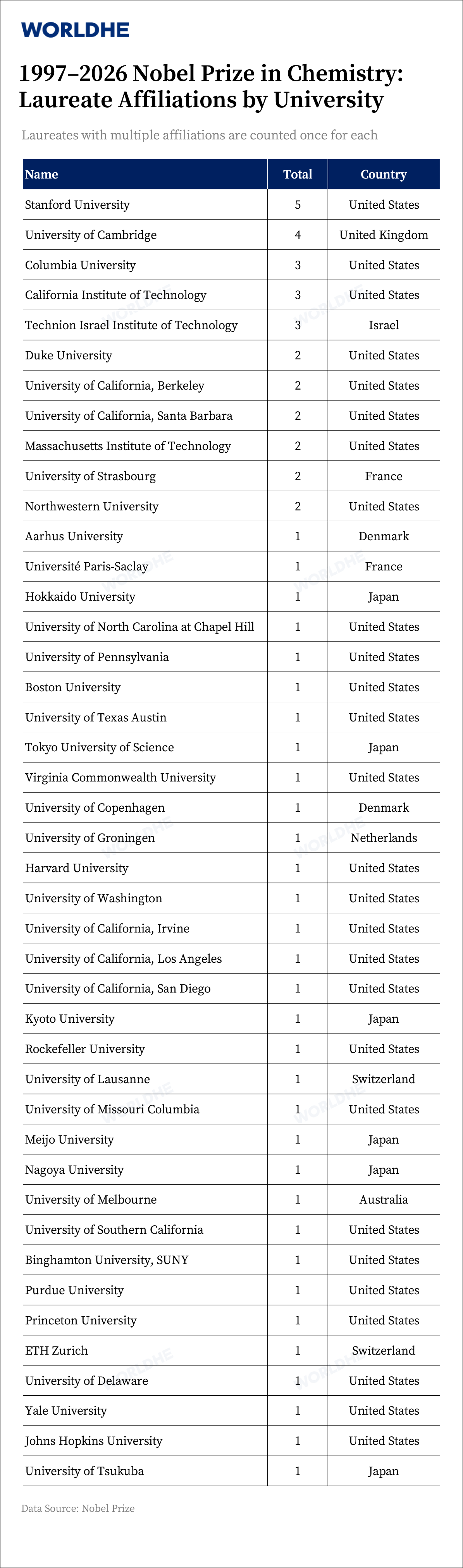
Over the past 30 years, Nobel Chemistry laureates have been affiliated with 43 universities at the time of their awards.
US universities maintain a clear lead, accounting for roughly two-thirds of laureate affiliations — substantially more than any other country. A network of leading US universities has helped create a world-class research ecosystem characterized by complementary strengths and substantial mobility of scientific talent.
Stanford University ranks first, with five Nobel Chemistry laureates affiliated with the university at the time of their awards. University of Cambridge follows with four, while Columbia University, Caltech and Technion – Israel Institute of Technology each have three.
Duke University, UC Berkeley, UC Santa Barbara, MIT, the University of Strasbourg and Northwestern University each have two.
The concentration at the top remains striking. Nobel-level chemistry research is heavily clustered in a relatively small number of global research centers. This concentration reflects decades of investment in research ecosystems. Modern chemistry increasingly depends on advanced laboratory infrastructure, interdisciplinary collaboration and large research teams, giving universities with stable, long-term research environments an important advantage in producing major scientific breakthroughs.
This year's laureates also highlight the geographic diversity of the Nobel research landscape. Henri B. Kagan spent much of his academic career at Université Paris-Sud, now part of Université Paris-Saclay, while Kenso Soai is a professor at Tokyo University of Science. They are the first Nobel Chemistry laureates affiliated with their respective universities in the past 30 years.
Japan has produced Nobel Chemistry laureates from six universities over the same period, making it the second-largest national hub after the United States.
Harvard Emerges as a Major Talent Pipeline
Where Nobel laureates were educated provides another important measure of a university's global influence.
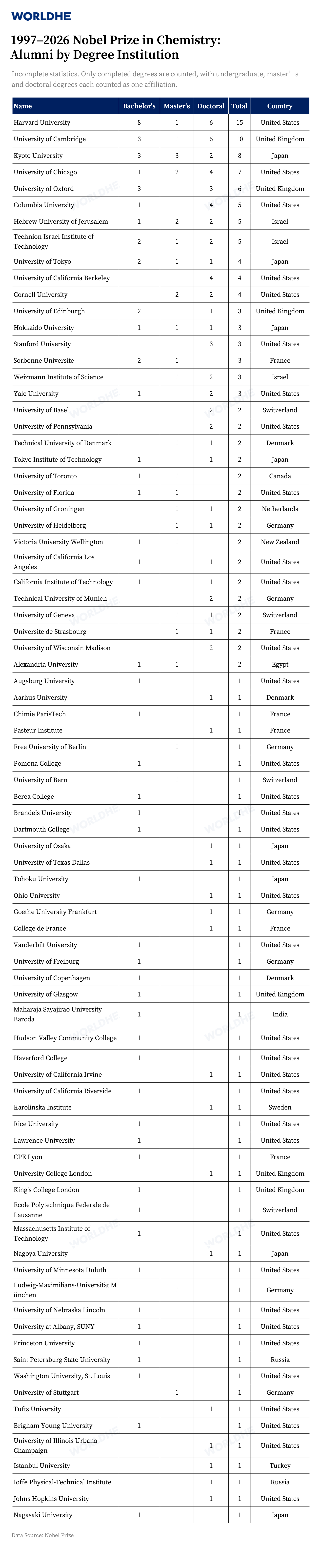
Over the past 30 years, 82 universities and research institutions have educated Nobel Chemistry laureates. Harvard University leads with 15 alumni affiliations, including eight bachelor's degrees, one master's degree and six doctorates. Its strong presence across both undergraduate and doctoral education highlights Harvard's role in developing scientific talent from the early stages of academic careers through advanced research training.
Cambridge follows with 10 alumni affiliations, while Kyoto University has eight, the University of Chicago seven and Oxford six. Columbia University, the Hebrew University of Jerusalem and Technion each have five.
The strong showing of Cambridge and Oxford reflects the UK's longstanding strength in scientific training. Japanese universities are also prominent, with Kyoto University ranking among the global leaders and the University of Tokyo accounting for four alumni affiliations. Japanese universities collectively have educated 18 Nobel Chemistry laureates over the period covered.
Israel presents a different model: a relatively small higher education system with a strong concentration of scientific talent. Both the Hebrew University of Jerusalem and Technion have five Nobel Chemistry alumni affiliations, while Technion has also been affiliated with three laureates at the time of their awards.
The 2026 laureates reflect these international education networks. Kagan studied at the Sorbonne Universite and the Chimie ParisTech before earning his doctorate at the Collège de France. Soai completed his bachelor's, master's and doctoral education at the University of Tokyo.
Methodology
Institutional names have been standardized where universities have undergone mergers or name changes. Where historical institutions have split into separate universities, their original names have been retained.
Alumni figures are based on degree attainment, with bachelor's, master's and doctoral degrees each counted as one affiliation. When a laureate was affiliated with multiple institutions at the time of the award, each institution was counted separately. The data were manually collected and should be considered an incomplete statistical overview.


TRENDING
From Training Talent to Winning Nobels: The Universities Behind the Laureates
Data & Rankings
MIT Overtakes Harvard as U.S. and China Dominate September Nature and Science Output
Data & Rankings
Getting Older, Crossing Disciplines: What Nobel Prize Data Reveal
Data & Rankings
Harvard Leads the Citation Laureates Rankings as Nobel Prize Season Approaches
Data & Rankings
Good University Guide 2027: St Andrews Takes No. 1 as Imperial Climbs Three Places
Data & Rankings