
Mapping the Global Universities Behind 30 Years of Nobel Prizes in Physics


The 2026 Nobel Prize in Physics was announced on October 6, with Francis Halzen awarded the prize “for decisive contributions to the IceCube Neutrino Observatory and the discovery of high-energy neutrinos of astrophysical origin.”
Behind every Nobel laureate lies a broader global map of universities — the institutions where groundbreaking research is conducted and where leading scientists are trained.
As the Nobel Prize marks its 125th anniversary this year, WorldHE has analyzed the institutional affiliations and undergraduate, master’s and doctoral education of Nobel laureates over the past three decades, from 1997 to 2026. The analysis will be released alongside the announcements in each Nobel category, offering a window into global patterns of university research, innovation and the development of top scientific talent.
Following our analysis of the Nobel Prize in Physiology or Medicine, this article focuses on the Nobel Prize in Physics.
US universities dominate Nobel affiliations in physics
Over the past 30 years, Nobel laureates in Physics have been affiliated with 45 universities at the time they received the prize.
The University of California, Santa Barbara (UCSB) and Princeton University lead the list, with five laureates each. Their strong showing reflects decades of investment in physics, established academic communities and research ecosystems that have supported sustained scientific excellence.
They are followed by the University of California, Berkeley and the University of Colorado Boulder, with four laureates each. The California Institute of Technology (Caltech) and the Massachusetts Institute of Technology (MIT) each have three.
The 2026 laureate Francis Halzen, who is based at the University of Wisconsin–Madison, is the university’s first Nobel laureate in Physics in the past three decades.
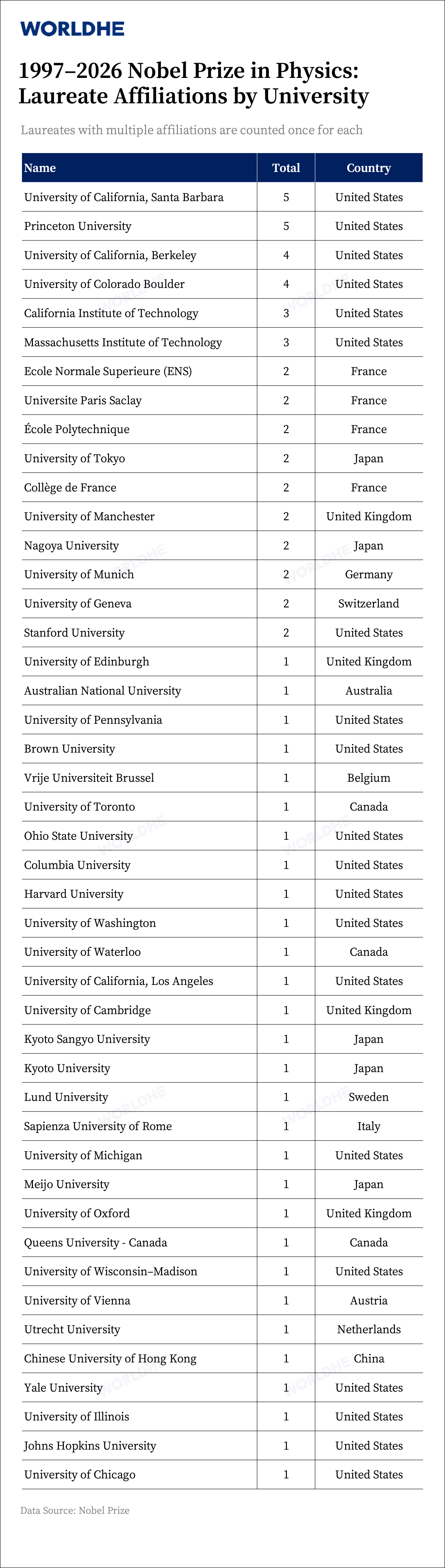
US universities account for roughly half of all laureate affiliations in the dataset, demonstrating the country’s particularly strong concentration of Nobel-level physics research. Notably, all six universities at the top of the affiliation ranking are based in the US, underscoring the country’s position as a major global center for physics research.
Outside the US, France and Japan also stand out.
French universities account for eight laureates, with institutions including the École Normale Supérieure, Université Paris-Saclay, École Polytechnique and Collège de France represented in the dataset.
Japanese universities account for seven laureates, including the University of Tokyo, Nagoya University, Kyoto University, Kyoto Sangyo University and Meijo University.
Physics laureates have a more diverse alumni landscape
The university landscape looks considerably more diverse when the analysis shifts from where laureates worked to where they studied.
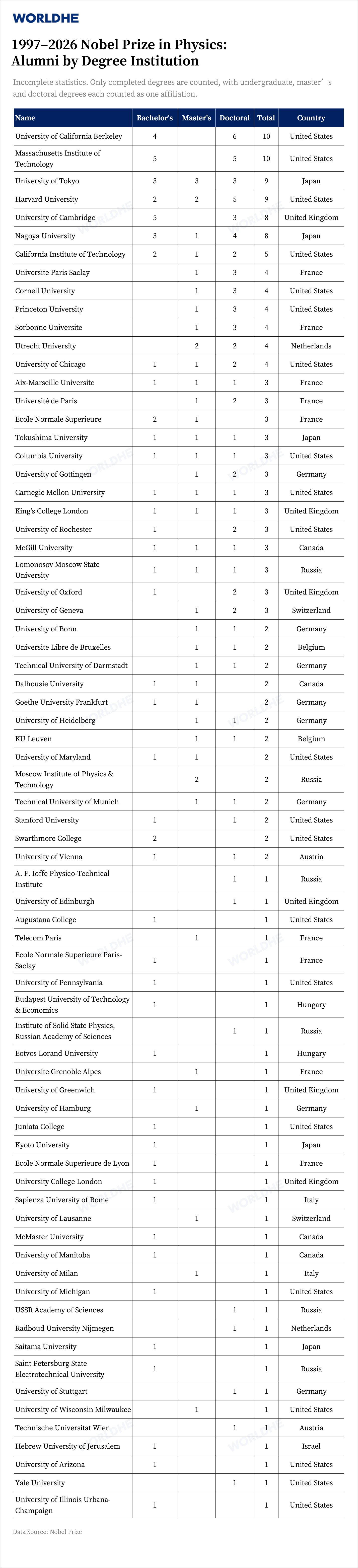
Over the past 30 years, 72 universities and research institutions have educated Nobel laureates in Physics.
The University of California, Berkeley and MIT rank joint first, with 10 laureate affiliations each.
Berkeley appears prominently in both the institutional-affiliation and alumni rankings, highlighting its strength in both research output and talent development. At MIT, five of the 10 affiliations were at the undergraduate level and five at the doctoral level, reflecting the institution’s role in both early scientific training and advanced research education.
The University of Tokyo and Harvard University follow with nine laureate affiliations each, while Cambridge University and Nagoya University have eight each.
Japanese universities stand out particularly strongly in the development of top physics talent. Their institutions have not only contributed Nobel-winning research but have also played a long-standing role in training scientists who go on to pursue research careers around the world.
Other countries also show strong performance in physics talent development. French universities account for 21 laureate affiliations, followed by Germany with 15 and Russia with 9.
The 2026 laureate Francis Halzen studied at the KU Leuven in Belgium, where he earned a master’s degree in physics in 1966 and a PhD in 1969.
Data notes
Institutional data have been standardized where appropriate. When universities have undergone clearly documented name changes or mergers, their current names are used. Where historical institutions have since been divided into multiple independent universities, the original institutional name has been retained.
For alumni data, only completed degrees are counted, with undergraduate, master’s and doctoral degrees each counted as one affiliation. If a laureate held positions at multiple institutions when receiving the Nobel Prize, each institution is counted separately.
The data were manually compiled and represent an incomplete rather than exhaustive dataset.


TRENDING
Harvard Leads the Citation Laureates Rankings as Nobel Prize Season Approaches
Data & Rankings
Good University Guide 2027: St Andrews Takes No. 1 as Imperial Climbs Three Places
Data & Rankings
From Lasker to Nobel: The Universities Behind Biomedical Breakthroughs
Data & Rankings
Before the Nobel: Which Universities Are Leading in Biomedical Breakthroughs?
Data & Rankings
WorldHE NS Watch: Harvard, MIT and Stanford Lead Global Nature and Science Output in August
Data & Rankings