
Harvard Leads the Citation Laureates Rankings as Nobel Prize Season Approaches


On September 17, Clarivate announced the 2026 Citation Laureates, recognizing 22 scientists whose research has made a significant impact on their fields. The laureates are affiliated with leading academic institutions across seven countries and regions. Sixteen are based in the United States, while Canada, Denmark, Israel, Japan, China and Switzerland each have one laureate.
The research recognized this year spans a range of issues closely tied to some of the most pressing challenges facing science, medicine and the global economy.
In physiology or medicine, the recognized work includes GLP-1 biology and obesity treatment, optical imaging and research into the immune system. Physics laureates are recognized for advances in OLED display technology, energy-efficient computing materials and quantum electronics. Chemistry research includes self-assembling nanomaterials, bioelectronic electron transfer and precision gene editing. In economics, the recognized research covers the economics of information technology, monetary policy and central banking, and organizational innovation and economic dynamism.
As Bar Veinstein, president of Clarivate’s Academic Research and Government business, noted, many of the achievements recognized by this year’s Citation Laureates—from GLP-1 drugs and precision gene editing to optical medical imaging—were once basic research questions being explored by scientists decades ago. Today, those lines of research are improving people’s lives, informing policymaking and helping shape the future of humanity.
At its core, the Citation Laureates program asks a fundamental question: which research being conducted today could become a transformative scientific breakthrough tomorrow?
That question also helps explain the long-standing connection between Citation Laureates and the Nobel Prizes.
Looking to Highly Cited Research for the Next Scientific Breakthrough
Since 2002, analysts at Clarivate’s Institute for Scientific Information (ISI) have used publication and citation data from the Web of Science Core Collection to identify scientists whose pioneering work has the potential to shape the future of science and society.
The process draws on a vast global research database. Since 1970, the Web of Science Core Collection has indexed more than 67 million journal articles and conference proceedings. Fewer than 0.02 percent of those publications have received more than 2,000 citations. Citation Laureates are selected from this exceptionally influential group of researchers through a combination of citation analysis and expert judgment.
The significance of this approach lies partly in the time it can take for scientific discoveries to translate into broad societal impact.
A promising piece of basic research may require years or even decades of further scientific validation, engineering development, regulatory approval and market adoption before its wider significance becomes clear. Sometimes, time itself is what reveals the importance of a discovery.
David Pendlebury, Head of Research Analysis at Clarivate’s Institute for Scientific Information, has pointed to precisely this challenge: it is extraordinarily difficult at the moment of discovery to know which findings will ultimately have transformative societal impact.
Citation analysis therefore provides one important lens for identifying researchers whose work has achieved Nobel-level impact, even before that recognition arrives.
The historical record offers some context. Since the Citation Laureates program was established, 487 scientists have been named Citation Laureates, 89 of whom subsequently received a Nobel Prize—around 18.3 percent. Thirteen Citation Laureates went on to receive a Nobel Prize in the same year they were named.
On average, the interval between receiving the Citation Laureates distinction and subsequently receiving a Nobel Prize has been 5.27 years. This track record has led the award to be widely described as a “Nobel Prize indicator.”
The 2024 Nobel Prizes offered a particularly striking example. Eight Nobel laureates that year had previously been named Citation Laureates. Three of them—John M. Jumper, Demis Hassabis and David Baker—received the Citation Laureates recognition and the Nobel Prize in Chemistry in the same year.
Harvard Leads the Citation Laureates Rankings
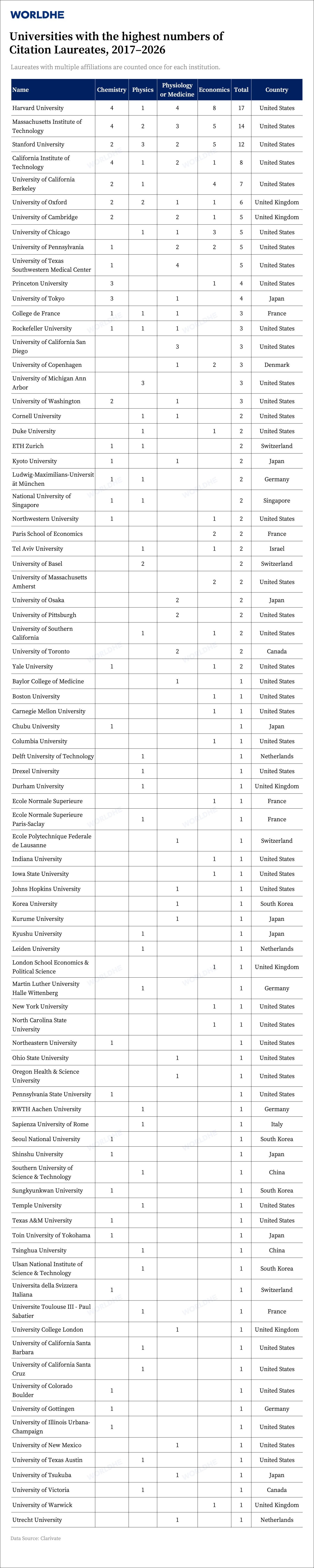
With the Nobel Prizes once again approaching in October, WorldHE analyzed the institutional affiliations of Citation Laureates over the past decade, from 2017 to 2026, to examine where these highly cited researchers are based.
During the 10-year period, 206 scientists were named Citation Laureates: 54 in Chemistry, 48 in Physics, 53 in Physiology or Medicine, and 51 in Economics.
Universities account for the overwhelming majority of their institutional affiliations. A total of 180 laureates—87 percent of all Citation Laureates during the period—were affiliated with universities.
The figure underscores the continuing role of universities as major engines of high-impact research, particularly in fields that depend on long-term scientific investment, sustained basic research and interdisciplinary collaboration.
U.S. universities dominate the institutional landscape.
Harvard University leads the 10-year tally with 17 laureates. Its Citation Laureates span all four fields, including eight in Economics, four in Physiology or Medicine, four in Chemistry and one in Physics.
The Massachusetts Institute of Technology follows with 14 laureates, while Stanford University has 12, the California Institute of Technology has eight, and the University of California, Berkeley has seven. MIT, Stanford and Caltech each have laureates across all four fields.
The distribution suggests that leading U.S. research universities are not simply strong in individual disciplines. They have also developed research ecosystems capable of producing highly influential work across chemistry, physics, biomedicine and economics.
Outside the United States, the University of Oxford recorded six laureates, while the University of Cambridge recorded five. The University of Chicago, the University of Pennsylvania and UT Southwestern Medical Center also recorded five laureates each.
The concentration at the top is notable. The five leading universities—Harvard, MIT, Stanford, Caltech and UC Berkeley—accounted for 58 laureate affiliations, roughly 30 percent of all university affiliations recorded during the period.
But the picture is not one of complete concentration among a handful of institutions.
A total of 85 universities appeared in the 10-year dataset. Alongside the leading U.S. institutions, the list includes universities such as the University of Copenhagen, the University of Tokyo, Kyoto University, ETH Zurich, the Paris School of Economics, Tel Aviv University, Southern University of Science and Technology and Tsinghua University.
Japanese universities stand out in particular. The University of Tokyo recorded four laureates during the decade, while Kyoto University and Osaka University recorded two each. Several other Japanese universities had one laureate apiece.
European universities also maintain a strong presence, with researchers from institutions across the UK, France, Switzerland, Germany and the Netherlands appearing in the data.
Different Countries, Distinct Research Strengths
Looking beyond universities to national patterns reveals another dimension of the global research landscape.
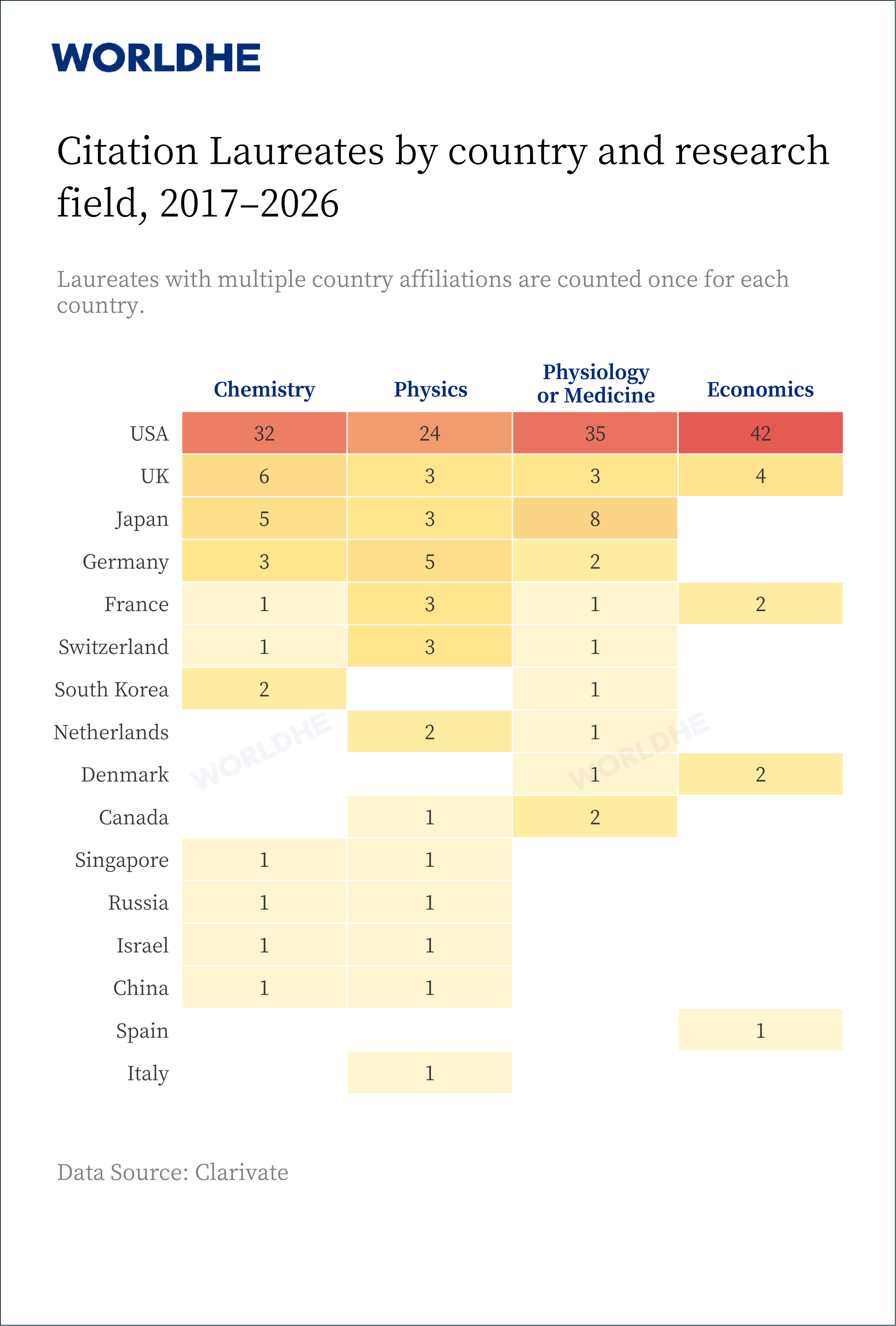
Of the 206 Citation Laureates recorded over the past decade, 133 were based in the United States, putting the country well ahead of other nations. Japan and the UK each recorded 16 laureates, followed by Germany with 10, France with seven and Switzerland with five. Canada, Denmark, the Netherlands and South Korea each recorded three.
The U.S. also leads across all four Citation Laureates fields. It recorded 32 laureates in Chemistry, 24 in Physics, 35 in Physiology or Medicine and 42 in Economics.
The concentration is particularly pronounced in Economics, reflecting the long-established strength of U.S. universities and research institutions in economics, business, the social sciences and policy research.
Other countries show more concentrated areas of strength. Japan recorded eight laureates in Physiology or Medicine, the UK had six in Chemistry, and Germany recorded five in Physics. These patterns are consistent with the long-standing research traditions and institutional strengths that those countries have developed in particular fields.
Citation Laureates and the Nobel Prize: What Comes Next?
The Nobel Prizes will be announced in October, bringing renewed attention to the researchers identified by Clarivate as among the world’s most highly cited and influential scientists.
Whether the Citation Laureates program will once again overlap with that year’s Nobel winners remains to be seen.
But as Clarivate notes, quoting sociologist Harriet Zuckerman: “Every year more scientists are eligible for the Nobel Prizes than can win them… There has always been an accumulation of uncrowned laureates.”
Whether or not the scientists named as Citation Laureates ultimately receive a Nobel Prize, their research has already made a measurable mark on the scientific record—and, in many cases, is helping to reshape the world beyond academia.
Data note: The data are based on the institutional affiliations listed on the official Citation Laureates website for laureates from 2017 to 2026. Some laureates were affiliated with multiple institutions, and each institution was counted separately. Universities that appeared under different names or campus affiliations were recorded separately where applicable, with appropriate adjustments made during the analysis.


TRENDING
Harvard Leads the Citation Laureates Rankings as Nobel Prize Season Approaches
Data & Rankings
Good University Guide 2027: St Andrews Takes No. 1 as Imperial Climbs Three Places
Data & Rankings
From Lasker to Nobel: The Universities Behind Biomedical Breakthroughs
Data & Rankings
Before the Nobel: Which Universities Are Leading in Biomedical Breakthroughs?
Data & Rankings
WorldHE NS Watch: Harvard, MIT and Stanford Lead Global Nature and Science Output in August
Data & Rankings