

Before the Nobel: Which Universities Are Leading in Biomedical Breakthroughs?


Every October, ahead of the Nobel Prize announcements, a number of major international awards begin to attract attention across the scientific community. Among them is the Canada Gairdner Awards, one of the world’s most prestigious honors in biomedical science.
The Gairdner Awards have long shared a remarkable overlap with the Nobel Prizes. This March, the Canada Gairdner International Award was presented to five scientists whose foundational work has advanced cryo-electron tomography, drug development for protein misfolding, and proteomics. Their recognition quickly reignited debate over whether “proteins” and “mass spectrometry” could once again feature among future Nobel-winning breakthroughs. Behind that discussion is the distinctive weight of the Gairdner Awards as an early indicator of research that may go on to receive the Nobel Prize.
According to official Gairdner data, since the awards were established in 1957, they have recognized 434 scientists from more than 40 countries. Of these, 103 later went on to receive Nobel Prizes — a conversion rate of close to one in four. Among Nobel laureates in Physiology or Medicine between 1983 and 2012, roughly 70% had previously received a Gairdner Award, and around 70% of those went on to win a Nobel Prize within 10 years of receiving the Gairdner.
This suggests that the Gairdner Awards do more than recognize scientists who have already made major breakthroughs. They can also identify, at an earlier stage, research that is already reshaping — or is poised to reshape — the boundaries of science.
Shimon Sakaguchi, who received the 2025 Nobel Prize in Physiology or Medicine, is a case in point. A decade earlier, he received the Canada Gairdner International Award for his pioneering discoveries concerning regulatory T cells. An even more striking example is provided by Demis Hassabis and John Jumper, the scientists behind AlphaFold. They received the Gairdner International Award in 2023 and the Nobel Prize in Chemistry just one year later.
But what happens when the focus shifts from individual scientists to the universities and research institutions behind them?
WorldHE analyzed Gairdner Award recipients from 2000 to 2026 and mapped their institutional affiliations. The results point to a familiar but revealing global landscape: US universities continue to dominate, leading UK institutions form a strong and consistent cluster, while Canadian universities show particular strength in developing homegrown talent and supporting mid-career researchers.
Harvard and Rockefeller Lead the Gairdner International Award
The Canada Gairdner International Award is the most internationally influential of the three major Gairdner awards. It recognizes scientists who have made original contributions to advancing the understanding of human biology and disease. Between 2000 and 2026, 139 scientists received the award.
The institutional landscape revealed by the award closely mirrors the traditional centers of excellence in global biomedical research.
Harvard University and Rockefeller University share the top position, with nine recipients each, placing them clearly ahead of the other institutions in the dataset.
They are followed by the University of Washington, with six recipients. Columbia University, Stanford University, the University of Cambridge and the University of Oxford each have five.
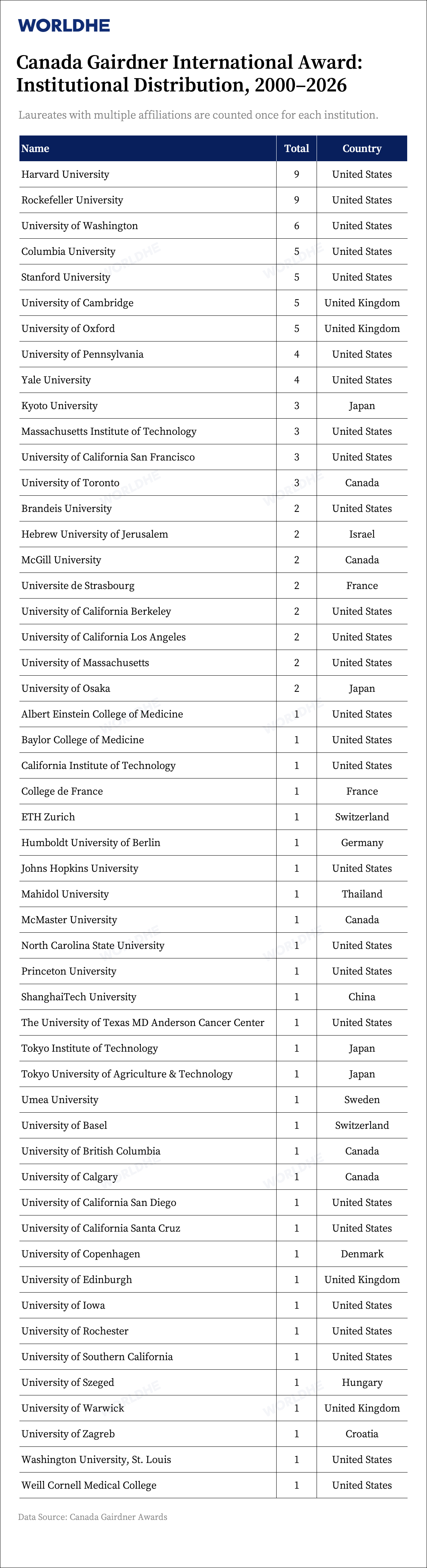
It is particularly notable that the strength of Harvard and Rockefeller cannot simply be attributed to institutional size. Their performance reflects, in large part, decades of investment in biomedical research and the research cultures that have developed around it.
Rockefeller University, for example, is considerably smaller than comprehensive research universities such as Harvard and Stanford. Yet its position at the top of the Gairdner rankings highlights an important point: success in elite research awards is not simply a function of university size. It depends on an institution’s ability to sustain world-class research teams in strategically important fields over the long term.
US institutions also account for the overwhelming majority of the universities and research organizations represented among International Award recipients. Harvard, Rockefeller, Washington, Columbia, Stanford, the University of Pennsylvania and Yale form a particularly strong leading group.
If the Gairdner International Award is viewed as a window into where Nobel-caliber biomedical research is being produced, leading US research universities remain the world’s densest concentration of such research.
Global Health Awards Reveal a Different University Landscape
If the International Award is primarily associated with fundamental biomedical research and major scientific breakthroughs, the John Dirks Canada Gairdner Global Health Award reveals a rather different institutional landscape.
The award recognizes scientists who have made significant contributions to global health. Between 2000 and 2026, 22 scientists received the award.
The London School of Hygiene & Tropical Medicine ranks first, with three recipients. Columbia University, the University of Hong Kong, the University of KwaZulu-Natal and the University of Washington each have two.
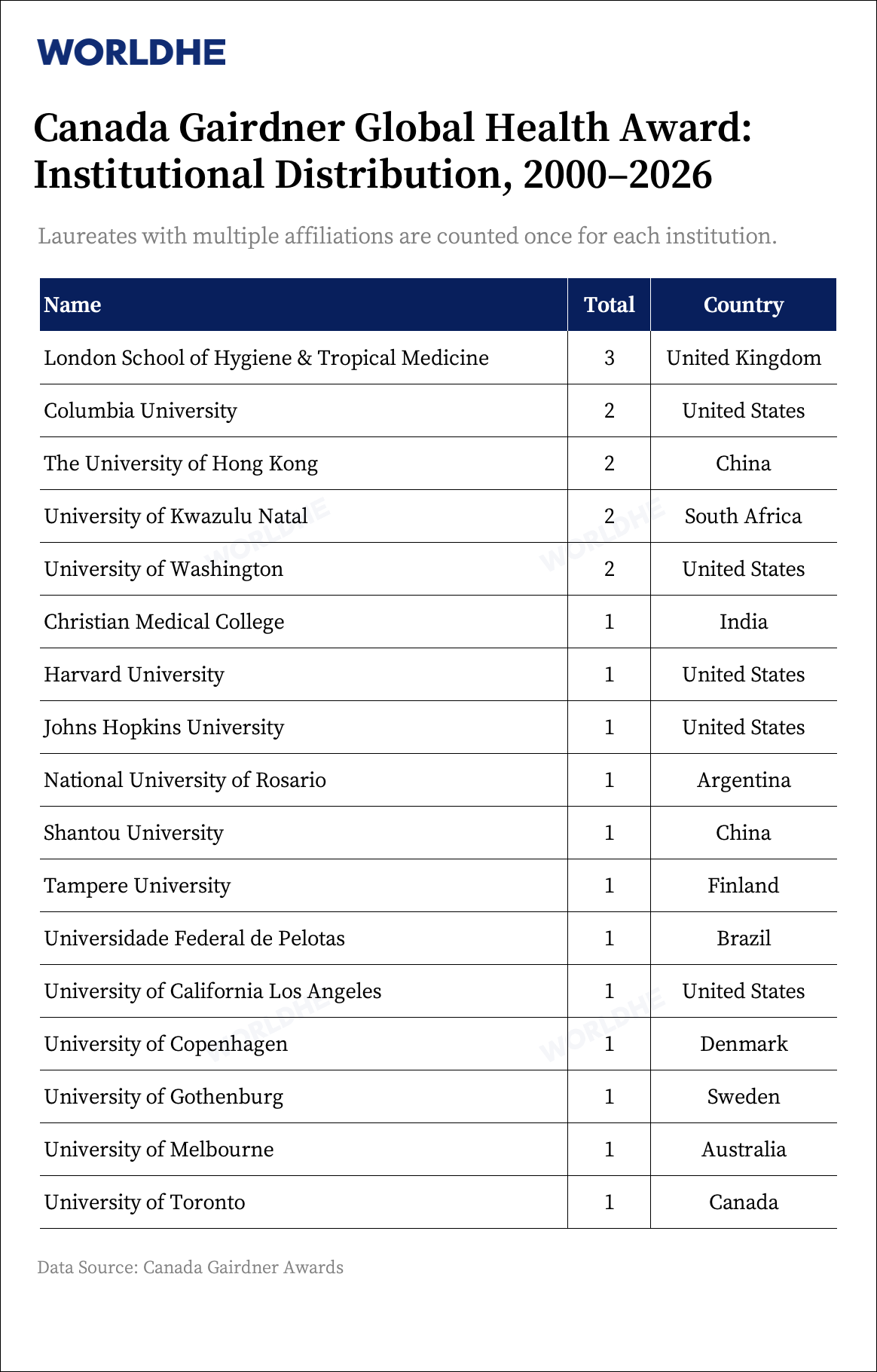
Compared with the International Award, the institutional distribution of the Global Health Award is considerably more diverse.
One reason is that global health research is often rooted in real-world health challenges. Breakthroughs in this field depend not only on laboratory-based science, but also on epidemiology, public health, clinical research and research systems built through sustained engagement with specific populations and regions.
As global health, public health and translational medicine become increasingly important, a university’s international research standing is shaped by more than its publication record or strength in fundamental science. It also depends on whether the institution can bring its research capabilities to bear on real-world health challenges across different populations and settings.
What the Momentum Award Says About Canada’s Talent Pipeline
Unlike the International and Global Health awards, which take a global view, the Peter Gilgan Canada Gairdner Momentum Award focuses specifically on Canadian research talent.
The Momentum Award succeeded the Canada Gairdner Wightman Award in 2023. Its focus shifted from established scientific leaders toward mid-career researchers in Canada, with the aim of identifying and supporting high-potential scientists at an earlier stage of their careers. For the purposes of this analysis, the two awards are combined.
The data show a clear concentration of Momentum Award recipients among a small group of Canadian universities.
The University of Toronto ranks first, with five recipients, making it the strongest Canadian institution across the three award categories analyzed. The University of Manitoba follows with four, while McMaster University and the University of British Columbia each have three.
These institutions are emerging as important hubs for Canada’s mid-career biomedical research talent.
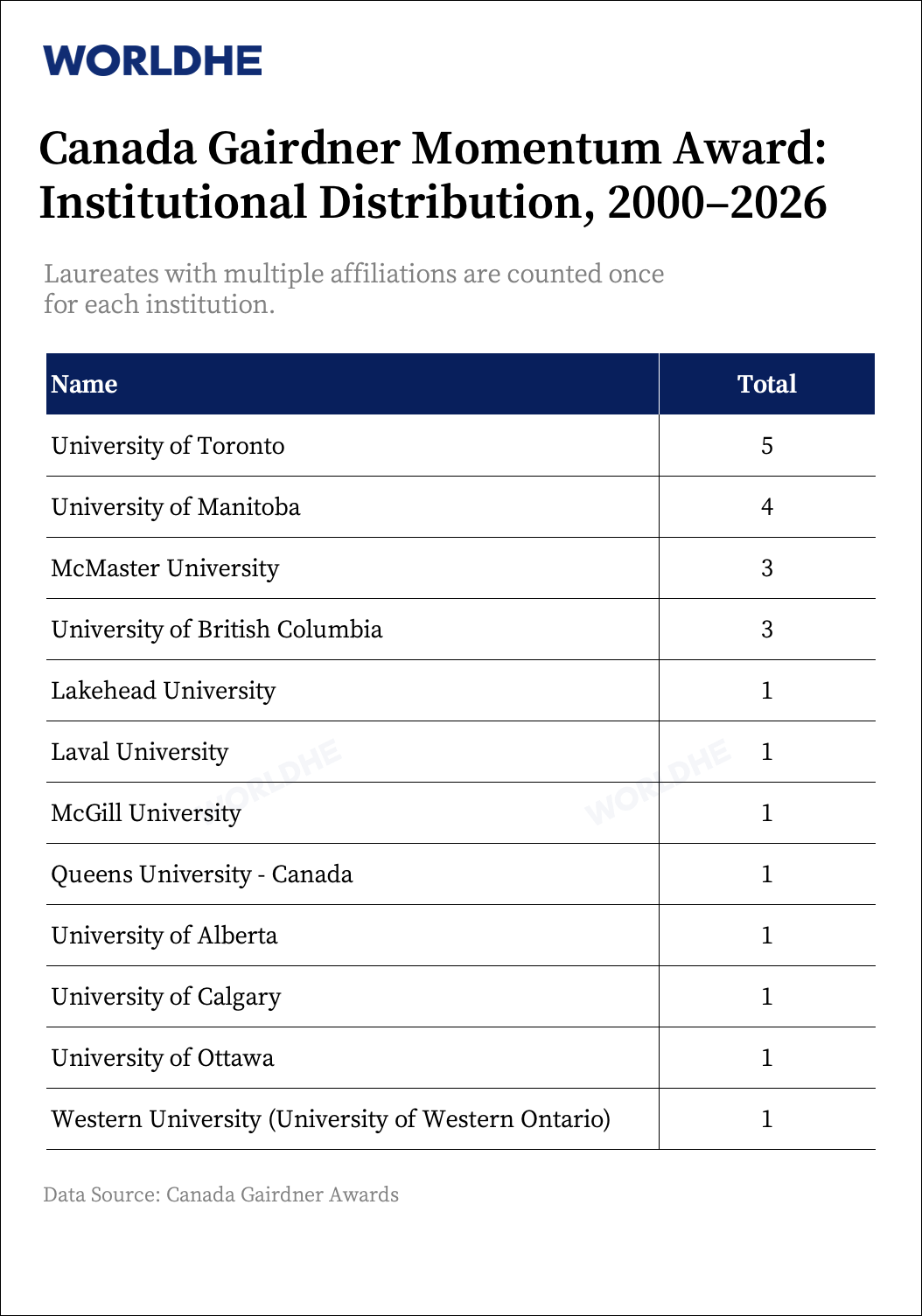
The mid-career stage is often a pivotal point in a researcher’s trajectory — the period when an independent investigator begins to develop into a broader academic leader. Whether universities can provide stable research platforms, access to resources and strong international collaboration networks at this stage can have a significant impact on how far these researchers ultimately go.
In this sense, the institutional pattern revealed by the Momentum Award offers a useful snapshot of Canada’s emerging competition for scientific talent.
Beyond the Nobel Connection: Lessons for Universities from the Gairdner Data
Nobel Prizes are typically awarded only after scientific discoveries have been extensively validated and their impact has become clear. The Gairdner Awards, by contrast, offer an earlier view of research that may shape the future of science.
For universities, the awards are therefore more than a “Nobel predictor.” They provide a lens through which to examine research ecosystems, disciplinary strengths and emerging scientific talent.
The data point to three broader lessons. First, world-class research depends on long-term investment, as shown by the repeated appearance of institutions such as Harvard, Rockefeller, Washington, Cambridge and Oxford. Second, major biomedical breakthroughs increasingly emerge from collaboration across disciplines and research platforms. Third, supporting mid-career researchers is essential to developing future scientific leaders.
Ultimately, the key question is not which university wins the most awards in a given year, but which institutions can consistently bring promising researchers to the scientific frontier. The Gairdner Awards offer a useful window into how sustained institutional commitment can translate into globally recognized research.
Data note: The dataset is based on the institutional affiliations of Gairdner Award recipients listed on the official Canada Gairdner Awards website from 2000 to the present. Where a recipient was affiliated with multiple institutions, each institution was counted separately. In cases where institutions appeared under different names due to name changes or campus distinctions, the data were consolidated and standardized where appropriate for the purposes of analysis.
Further Reading
Which Universities Are Producing the Next Nobel Laureates? The Breakthrough Prize Offers Some Clues
Before the Nobel Prizes: Which Universities Are Leading the Pipeline of Future Laureates?


TRENDING
WorldHE NS Watch: Harvard, MIT and Stanford Lead Global Nature and Science Output in August
Data & Rankings
Before the Nobel Prizes: Which Universities Are Leading the Pipeline of Future Laureates?
Data & Rankings
Where Fields Medalists Studied and Worked?
Data & Rankings
MIT Tops QS World Rankings for 15th Straight Year
Data & Rankings
Which Universities Are Producing the Next Nobel Laureates? The Breakthrough Prize Offers Some Clues
Data & Rankings