
Before the Nobel Prizes: Which Universities Are Leading the Pipeline of Future Laureates?


In October, the annual Nobel Prize announcements will once again take center stage. Ahead of the Nobel Prize season, WorldHE will continue to examine a series of prestigious international awards widely regarded as “Nobel indicators” because of the significant overlap between their recipients and subsequent Nobel laureates. The aim is to answer a simple question: Which universities win the most of these awards—and therefore appear best positioned to produce future Nobel laureates?
Previously, WorldHE analyzed the Breakthrough Prize in Life Sciences, Fundamental Physics and Mathematics, which carries prize money of up to $3 million. This time, we turn to the Sloan Research Fellowships.
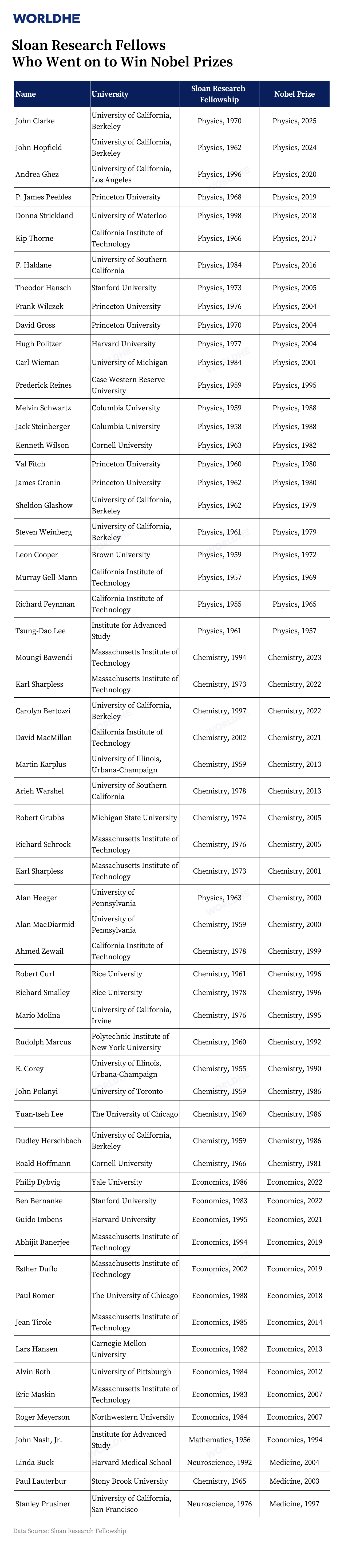
59 Sloan Fellows Have Gone on to Win Nobel Prizes
In February this year, the Sloan Foundation announced its 2026 Sloan Research Fellows. A total of 126 early-career scientists from 44 universities and research institutions in the United States and Canada were selected. Each fellow receives a $75,000 award, which can be used flexibly over two years to support research-related expenses.
Since the first awards were presented in 1955, the Sloan Research Fellowships have focused on scholars at an early stage of their careers, placing particular emphasis on their innovative potential and future impact. The program seeks to identify researchers who may bring transformative advances to their fields and is widely regarded as one of the highest honors available to early-career researchers.
This forward-looking approach—essentially an investment in scientific talent before its full impact becomes apparent—has allowed the program to follow generations of researchers from emerging scholars to scientific leaders. It has also earned the Sloan Fellowship a reputation as a “Nobel indicator.”
To date, 59 Sloan Fellows have gone on to receive Nobel Prizes. Among them is Karl Sharpless, who won the Nobel Prize twice. Last year’s Nobel Prize in Physics laureate John Clarke, for example, received a Sloan Fellowship in Physics in 1970.
Notably, for 10 consecutive years from 2016 through 2025, every cohort of Nobel laureates included at least one former Sloan Fellow.
Among the 59 Nobel laureates who previously received Sloan Fellowships, the Massachusetts Institute of Technology (MIT) leads with seven, followed by the University of California, Berkeley, with six. The California Institute of Technology (Caltech) and Princeton University each have five.
The Sloan network has also produced recipients of several other major academic honors. Its alumni include 19 Fields Medalists, 10 Abel Prize winners, 26 John Bates Clark Medal recipients, and 72 National Medal of Science recipients. This year’s new Fields Medalists, Jacob Tsimerman and Yu Deng, were Sloan Fellows in Mathematics in 2015 and 2021, respectively.
Because Nobel Prizes are often awarded decades after the underlying research breakthroughs, there is typically a substantial time lag between a researcher’s early-career recognition and eventual Nobel recognition. The Sloan-to-Nobel trajectory shows a similar lag of roughly two decades.
With this in mind, WorldHE examined 20 years of Sloan Fellowship data, from 2006 through 2026, to gain a more focused view of the potential future Nobel talent pipeline and identify the universities with the highest concentration of researchers who may eventually become Nobel laureates.
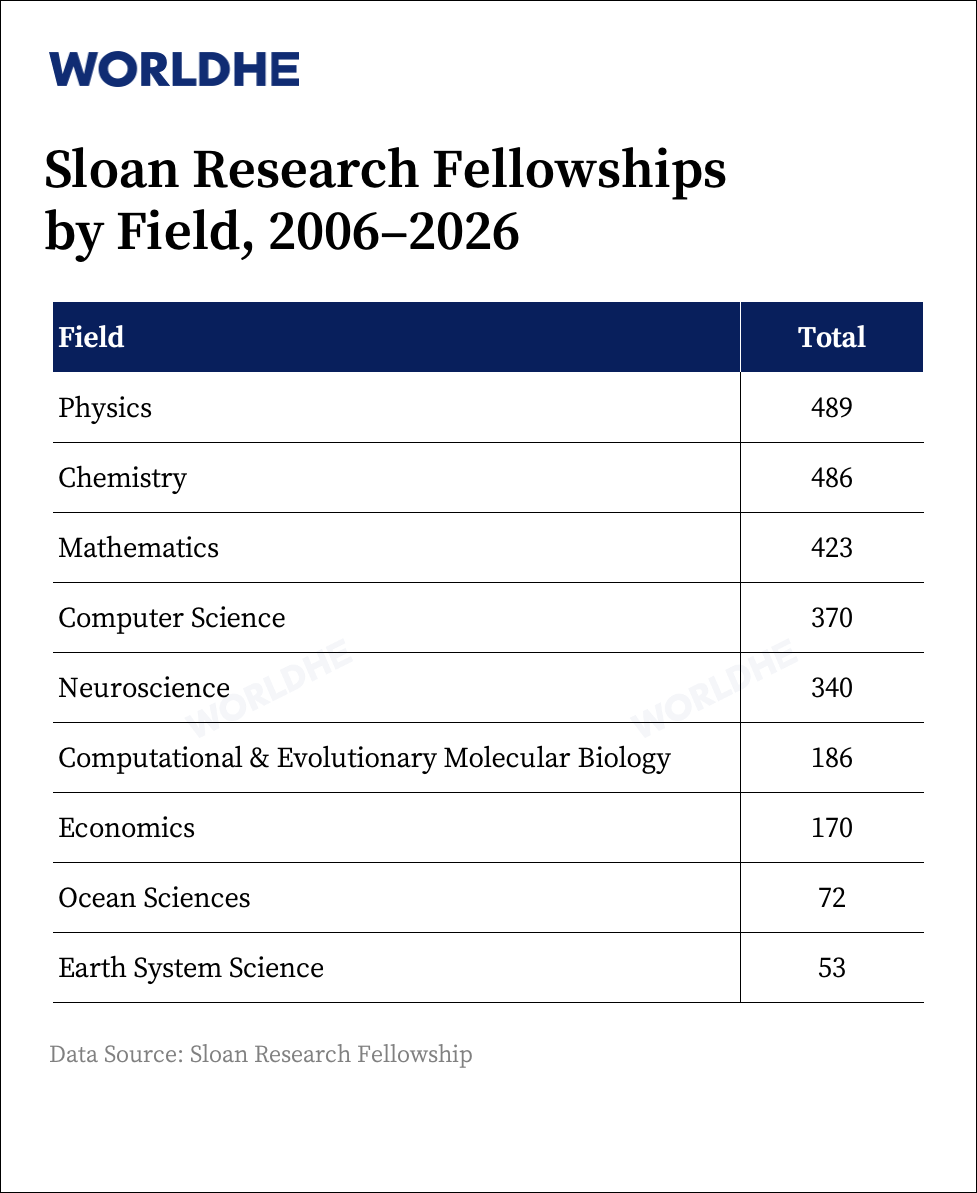
During this period, the Sloan program awarded fellowships to 2,589 researchers across nine fields: Chemistry, Computational & Evolutionary Molecular Biology, Computer Science, Earth System Science, Economics, Mathematics, Neuroscience, Ocean Sciences, and Physics. The program has since consolidated these into seven fields, with Computational & Evolutionary Molecular Biology and Ocean Sciences currently no longer being awarded as standalone categories.
By total number of fellows, Physics and Chemistry dominate, with 489 and 486 recipients, respectively. Mathematics ranks third with 423, followed by Computer Science with 370 and Neuroscience with 340.
These five fields form the core of the Sloan landscape. The competition for top scientific talent is no longer confined to the traditional disciplines of physics, chemistry and mathematics. Computer science, neuroscience and other emerging fields have become increasingly important talent pools.
In recent years, the Nobel Prizes have also increasingly reflected the growing importance of interdisciplinary research, with major breakthroughs often emerging at the boundaries between established disciplines. The 2024 Nobel Prizes in Physics and Chemistry, for example, both recognized scientists whose foundational contributions were closely connected to artificial intelligence.
This suggests that, when assessing universities’ potential to produce future Nobel-caliber researchers, interdisciplinary strength—particularly the intersection of computer science with life sciences, physics and other fields—may become an increasingly important dimension.
MIT Leads the Sloan Rankings
Sloan Fellows must be faculty members at degree-granting institutions. As a result, of the 2,589 Sloan Fellows selected over the 20-year period, 2,566 were affiliated with universities, accounting for an overwhelming majority of recipients.
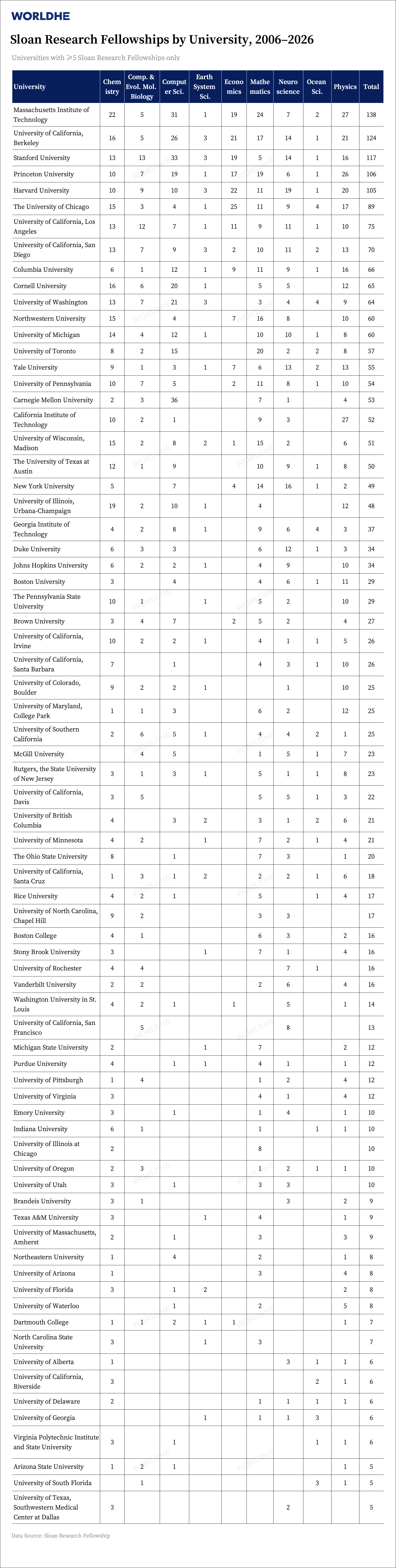
MIT leads the university rankings with 138 Sloan Fellows, making it the clearest “Nobel indicator university” in the dataset.
The University of California, Berkeley, follows with 124, ahead of Stanford University with 117, Princeton University with 106, and Harvard University with 105. All five universities have produced more than 100 Sloan Fellows during the period, forming a clear first tier among America’s leading research universities.
The concentration is striking. The top 10 universities collectively account for 955 Sloan Fellows, or approximately 37% of all university-affiliated recipients.
The Sloan talent pool is therefore highly concentrated among a relatively small group of elite research universities.
At the same time, MIT, UC Berkeley, Stanford, Princeton, Harvard, the University of Chicago, UCLA, UC San Diego, Columbia University and Yale University all recorded Sloan Fellows across all nine fields included in the dataset.
Their strength is not based on a single discipline. Instead, these institutions have built broad research ecosystems spanning mathematics, physics, chemistry, computer science, life sciences, neuroscience and economics.
Different Disciplines Point to Different “Nobel Indicator” Universities
Looking at individual fields provides a much clearer picture of each university’s academic strengths—and offers a more targeted way to identify potential Nobel contenders by discipline.
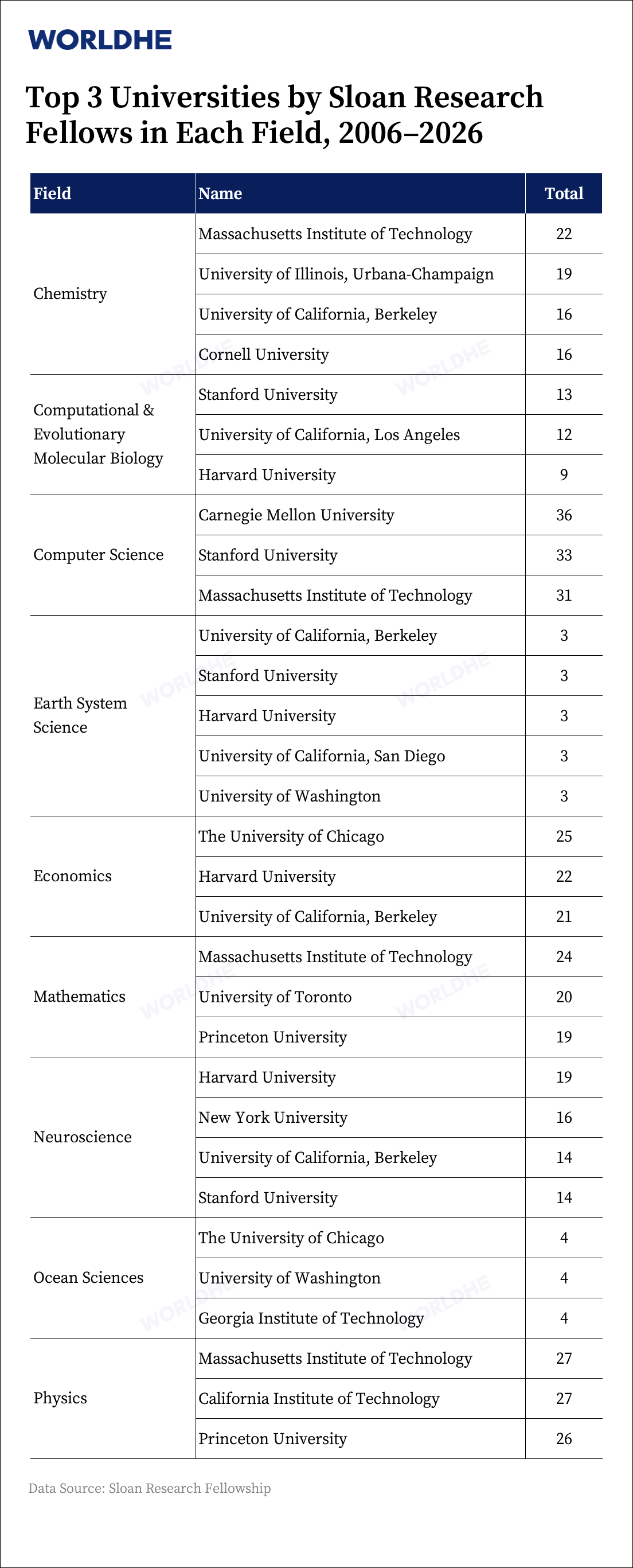
MIT, Harvard, UC Berkeley and Stanford each rank among the top three universities in four fields, while MIT leads three fields outright.
In Chemistry, MIT ranks first with 22 Sloan Fellows, followed by the University of Illinois Urbana-Champaign with 19, while UC Berkeley and Cornell University each have 16.
In Computational & Evolutionary Molecular Biology, Stanford stands out with 13 fellows.
In Computer Science, Carnegie Mellon University emerges as a clear specialist leader, with 36 Sloan Fellows, ahead of Stanford with 33 and MIT with 31. Remarkably, computer science accounts for roughly two-thirds of Carnegie Mellon’s 53 Sloan Fellows overall.
In Economics, the University of Chicago has a decisive lead with 25 fellows.
In Mathematics, MIT, the University of Toronto and Princeton form a highly competitive top three, with 24, 20 and 19 fellows, respectively. This year’s Fields Medalist Jacob Tsimerman is affiliated with the University of Toronto.
In Neuroscience, Harvard leads with 19 fellows, highlighting the university’s deep strength in the life sciences.
In Physics, MIT and Caltech share the top spot with 27 fellows each, followed closely by Princeton with 26—further underscoring the strength of these institutions in fundamental science.
Interestingly, the leading universities in individual Sloan fields closely mirror the traditional powerhouses of the Nobel Prizes.
Princeton ranks first among universities by the number of Nobel laureates in Physics. UC Berkeley appears among the top three universities by Nobel laureates in Chemistry. Harvard leads in Nobel Prizes in Physiology or Medicine, while the University of Chicago has a commanding lead in Economics, reflecting the enduring influence of the Chicago School of Economics.
What the Sloan Data Tells Us About Future Nobel Talent
Nobel Prize results may be announced over just a few days each year, but the research achievements behind those prizes are built over decades.
That is precisely why awards such as the Sloan Research Fellowship are worth examining as early indicators of future Nobel talent.
The Sloan Fellowship is not, of course, a crystal ball. Winning a Sloan Fellowship does not guarantee a future Nobel Prize. The two awards have different selection criteria and operate on very different timescales.
But the historical overlap is significant.
The Sloan Fellowship identifies researchers early in their careers, when their potential is becoming visible but their most influential work may still lie ahead. The Nobel Prize, by contrast, often recognizes discoveries only after their long-term scientific impact has been established.
For higher education institutions, this makes the Sloan pipeline particularly revealing.
The Nobel Prize winners will be announced in October. But the next generation of potential laureates may already be visible in today’s early-career talent pipeline.
Before the Nobel Prizes reveal who has reached the summit, it may be worth looking at the universities that are already cultivating the scientists most likely to climb there.
Data note
The analysis is based on institutional affiliation data for Sloan Research Fellows from 2006 through 2026, as published by the official Sloan Research Fellowship program. Some universities are listed separately in the original data due to institutional name changes or campus distinctions; these have been reasonably consolidated for the purposes of this analysis.


TRENDING
Before the Nobel Prizes: Which Universities Are Leading the Pipeline of Future Laureates?
Data & Rankings
Where Fields Medalists Studied and Worked?
Data & Rankings
Which Universities Are Producing the Next Nobel Laureates? The Breakthrough Prize Offers Some Clues
Data & Rankings
MIT Tops QS World Rankings for 15th Straight Year
Data & Rankings
Harvard Tops U.S. News Global University Rankings
Data & Rankings