
Which Universities Are Producing the Next Nobel Laureates? The Breakthrough Prize Offers Some Clues


Every October, the global scientific community turns its attention to one of the world’s most prestigious honors — the Nobel Prize. This year, the Nobel Prizes will be announced from October 5 to 12.
Because the nomination and selection processes remain strictly confidential and are never publicly disclosed, Nobel laureates usually emerge only at the very last moment. As a result, predicting the Nobel Prize winners has become a unique annual tradition — and a moment of excitement across the scientific community.
Yet Nobel laureates do not appear entirely out of nowhere. Looking back at previous winners, many had already received other major international scientific honors before winning the Nobel Prize, including the Breakthrough Prize, Citation Laureates, Lasker Awards, Horwitz Prize, Canada Gairdner International Award, Wolf Prize, Balzan Prize, and others. Because of the strong overlap between recipients of these awards and subsequent Nobel laureates, they are widely regarded as “Nobel Prize indicators.”
By tracking these awards, it may be possible to identify potential future Nobel laureates.
Ahead of this year’s Nobel Prize announcements, WorldHE will launch a series analyzing these major “Nobel indicators” and exploring a key question: which universities have produced the largest number of recipients of these prestigious awards, and therefore may be more likely to produce future Nobel laureates?
As the opening article of this series, we begin with the Breakthrough Prize.
The $3 Million Scientific Prize
In 2012, Russian entrepreneur Yuri Milner founded the Breakthrough Prize with the goal of giving scientists the recognition they deserve.
The prize was later established with support from Sergey Brin, Mark Zuckerberg and Priscilla Chan, Julia and Yuri Milner, and Anne Wojcicki. Its mission is to celebrate scientists as “heroes of our society.”
The Breakthrough Prize holds an annual high-profile awards ceremony where scientific pioneers share the stage with global entertainment and sports figures. Because of this unique format, it has often been described as the “Oscars of Science.”
Following several adjustments to its structure, the prize now includes three major awards: Breakthrough Prize in Fundamental Physics; Breakthrough Prize in Life Sciences; Breakthrough Prize in Mathematics.
Each major prize carries a $3 million award — three times the value of the Nobel Prize monetary award and the largest individual prize among global scientific honors.
The Breakthrough Prize also includes: New Horizons Prize in Physics; New Horizons Prize in Mathematics (each worth $100,000); Maryam Mirzakhani New Frontiers Prize ($50,000); Vera Rubin New Frontiers Prize ($50,000), newly established in 2026.
The total prize money awarded in 2026 reached $18.75 million, while cumulative awards since the prize’s establishment have exceeded $340 million.
Unlike the Nobel Prize, which often recognizes discoveries decades after they were made, the Breakthrough Prize focuses more directly on major discoveries currently expanding the boundaries of human knowledge.
This is why many Breakthrough Prize recipients have later gone on to win Nobel Prizes. For example, Jennifer A. Doudna and Emmanuelle Charpentier, recipients of the 2015 Breakthrough Prize in Life Sciences, jointly received the 2020 Nobel Prize in Chemistry.
As a result, the Breakthrough Prize has become an important window into global scientific strength and university innovation capacity.
Universities Dominate the Breakthrough Prize Landscape
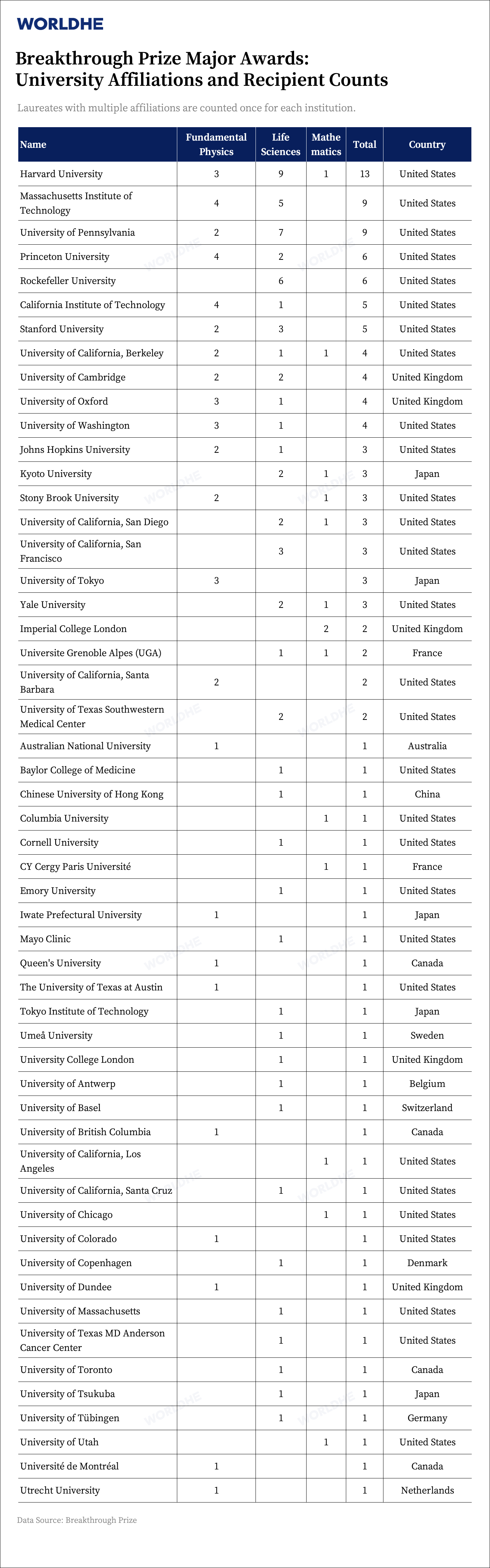
Since 2012, the three major Breakthrough Prizes have been awarded to 173 individuals or teams: 87 Breakthrough Prizes in Life Sciences; 17 Breakthrough Prizes in Mathematics; 69 Breakthrough Prizes in Fundamental Physics (including Special Breakthrough Prizes).
An analysis of recipients’ institutional affiliations shows that universities are the dominant force. A total of 123 laureates were affiliated with universities, accounting for 71% of all recipients.
Among these universities, institutions in the United States demonstrate overwhelming dominance.
Of the 123 university-affiliated recipients, around 70% come from American universities. U.S. institutions lead across all three disciplines — physics, life sciences, and mathematics.
All universities with five or more recipients are located in the United States. Harvard University ranks first globally with 13 recipients: 3 in Fundamental Physics; 9 in Life Sciences; 1 in Mathematics.
Its overwhelming advantage in life sciences highlights Harvard’s exceptional strength in biomedical research.
The Massachusetts Institute of Technology (MIT) and the University of Pennsylvania rank second with nine recipients each.
Princeton University and Rockefeller University each have six recipients, while the California Institute of Technology (Caltech) and Stanford University each have five.
MIT, Princeton, and Caltech have been particularly dominant in Fundamental Physics, with four recipients each. Their long-standing leadership in theoretical physics, particle physics, and cosmology has shaped modern scientific research.
Meanwhile, the University of Pennsylvania and Rockefeller University have demonstrated outstanding performance in Life Sciences. All six Rockefeller recipients came from this field.
The 2026 Breakthrough Prize in Life Sciences, recognizing the world’s first gene replacement therapy for inherited blindness, was also rooted in research conducted at the University of Pennsylvania.
European Research Powerhouses Maintain Global Influence
European universities continue to demonstrate strong international competitiveness thanks to their deep traditions in fundamental science.
The University of Cambridge and the University of Oxford each have four Breakthrough Prize recipients.
In mathematics — a field with particularly intense competition and relatively few awards — European institutions show even stronger performance.
Imperial College London has produced two Mathematics Breakthrough Prize winners, while Université Grenoble Alpes (UGA) in France and CY Cergy Paris Université each have one.
Frank Merle, who received the 2026 Breakthrough Prize in Mathematics for “Advances in Mathematics of Waves and Nonlinear Systems,” is affiliated with CY Cergy Paris Université.
Asian Universities Emerging as a New Scientific Force
Asian universities are becoming an increasingly important force in the global scientific landscape.
Japan has five universities with Breakthrough Prize recipients, covering all three prize categories.
Kyoto University and the University of Tokyo each have three recipients, placing them among the world’s leading institutions.
The Chinese University of Hong Kong has also produced one Breakthrough Prize recipient in Life Sciences.
These achievements demonstrate the growing international influence of Asian universities in fundamental research.
Inspiring the Next Generation of Scientists
Beyond the three major prizes, the Breakthrough Prize’s New Horizons Prizes recognize early-career researchers who have demonstrated exceptional promise.
The New Horizons Prize in Mathematics has become an important indicator of future leaders in mathematics and is widely regarded as a predictor of the Fields Medal, often considered the highest honor in mathematics.
Among the four newly awarded Fields Medalists in 2026, three had previously received the New Horizons Prize. Chinese mathematician Hong Wang won the New Horizons Prize earlier in the same year before receiving the Fields Medal.
To date:
The New Horizons Prize in Physics has recognized 95 scientists;
The New Horizons Prize in Mathematics has recognized 38 scientists.
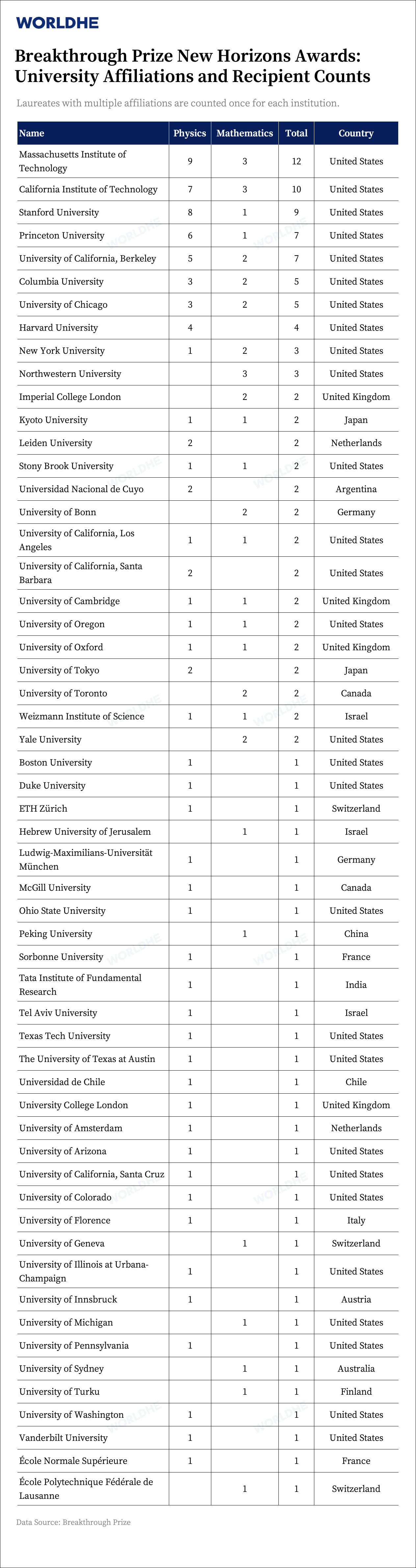
Universities remain the primary source of recipients, with 117 winners affiliated with universities, accounting for 88%.
American universities continue to lead. All institutions with three or more recipients are American. MIT ranks first with 12 recipients: 3 in Mathematics; 9 in Physics. Caltech follows closely with 10 recipients.
European universities maintain traditional strength in mathematics. Imperial College London and the University of Bonn each have two New Horizons Prize recipients in Mathematics.
These results highlight the continuing ability of top universities to cultivate and produce the next generation of scientific leaders.
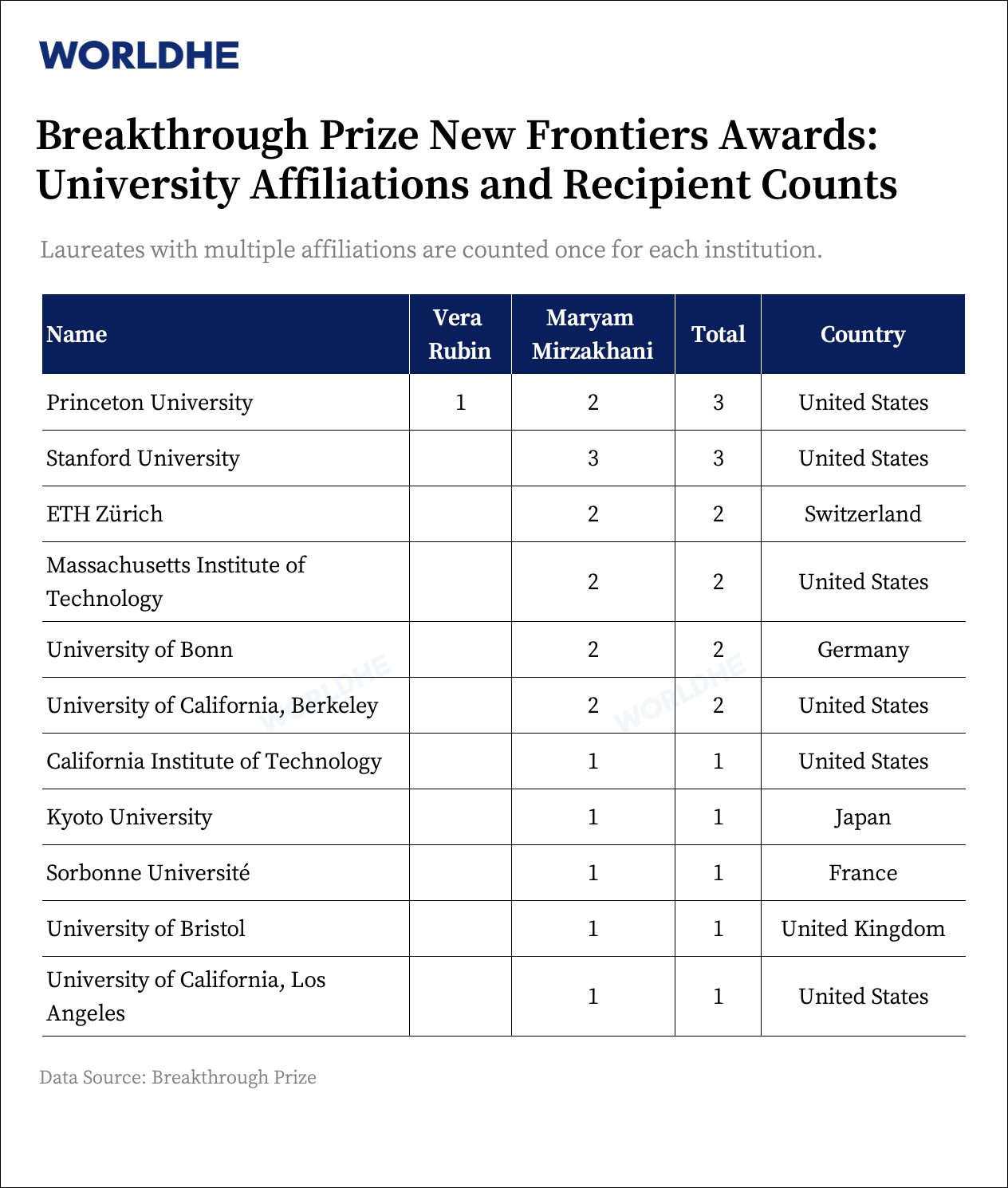
The Maryam Mirzakhani New Frontiers Prize and Vera Rubin New Frontiers Prize focus respectively on outstanding female researchers in mathematics and physics who completed their PhDs within the past two years. These awards reflect the scientific community’s growing commitment to supporting women researchers.
The United States remains dominant in institutional representation. Princeton University and Stanford University each have three recipients. The inaugural recipient of the Vera Rubin New Frontiers Prize in 2026, Carolina Figueiredo, is affiliated with Princeton University.
In Europe, ETH Zurich and the University of Bonn have also demonstrated strong performance.
The United States’ leading position in fundamental science is rooted in decades of accumulated advantages: sustained investment in research funding; world-class scientific infrastructure; globally competitive talent recruitment systems; mature collaboration networks between universities and research institutions.
Looking ahead, emerging fields such as artificial intelligence, life sciences, and quantum technology may reshape global scientific competition.
However, universities with stable research ecosystems and the ability to continuously attract global talent will remain central players in future scientific innovation.
Data Notes
This analysis is based on institutional affiliations listed in recipient biographies on the official Breakthrough Prize website from 2012 to the present.
Some recipients are affiliated with multiple institutions, and each institution is counted separately.
Some universities have undergone name changes or have multiple campuses. Reasonable institutional consolidation has been applied during data analysis.


TRENDING
Which Universities Are Producing the Next Nobel Laureates? The Breakthrough Prize Offers Some Clues
Data & Rankings
Where Fields Medalists Studied and Worked?
Data & Rankings
MIT Tops QS World Rankings for 15th Straight Year
Data & Rankings
Harvard Tops U.S. News Global University Rankings
Data & Rankings
2026 Fields Medal Winners Announced: Four Mathematicians Honored
Research & Innovation