
2026 Fields Medal Winners Announced: Four Mathematicians Honored


On July 23, the 2026 Fields Medal—often regarded as the "Nobel Prize of Mathematics"—was announced at the International Congress of Mathematicians (ICM). As had been leaked earlier, the four recipients are:
Hong Wang: For her work in harmonic analysis and geometric measure theory, including applications of multiscale and decoupling techniques to the local smoothing conjecture for the planar wave equation, and major advances in Fourier restriction, Falconer distance sets, Furstenberg sets in the plane, and the Kakeya problem in three dimensions.
Yu Deng: For his work in partial differential equations, including the rigorous derivation of the Boltzmann equation from hard-sphere dynamics for rarefied gases, the derivation of wave kinetic equations from nonlinear dispersive systems, and probabilistic approaches to nonlinear Schrodinger dynamics.
John Pardon: For his achievements in symplectic geometry including new approaches to virtual fundamental cycles, Fukaya categories of certain manifolds and counting holomorphic curves, and for his contributions to other areas of geometry and topology, including group actions on 3-manifolds and knot theory.
Jacob Tsimerman: For his contribution in the recasting of o-minimality as a fundamental method of arithmetic and complex algebraic geometry, and his role in the proof of many central conjectures including Griffiths' conjecture on the algebraicity of images of the period maps, and the Andre-Oort conjecture for Siegel modular varieties.
For the first time, China has produced two Fields Medalists in the same year, and both are alumni of the Class of 2007 undergraduate mathematics program at Peking University. The four laureates are also distinguished alumni of École Polytechnique, Université Paris-Sud (now Paris-Saclay University), MIT, Princeton University, Stanford University, and the University of Toronto.
Awarded every four years, the Fields Medal honors mathematicians under the age of 40 who have made outstanding contributions and demonstrated exceptional promise. Since its establishment, only 67 mathematicians have received the honor, making it even more exclusive than the Nobel Prize.
Below are the stories of the four 2026 Fields Medalists.
Hong Wang: Solving the Kakeya Conjecture
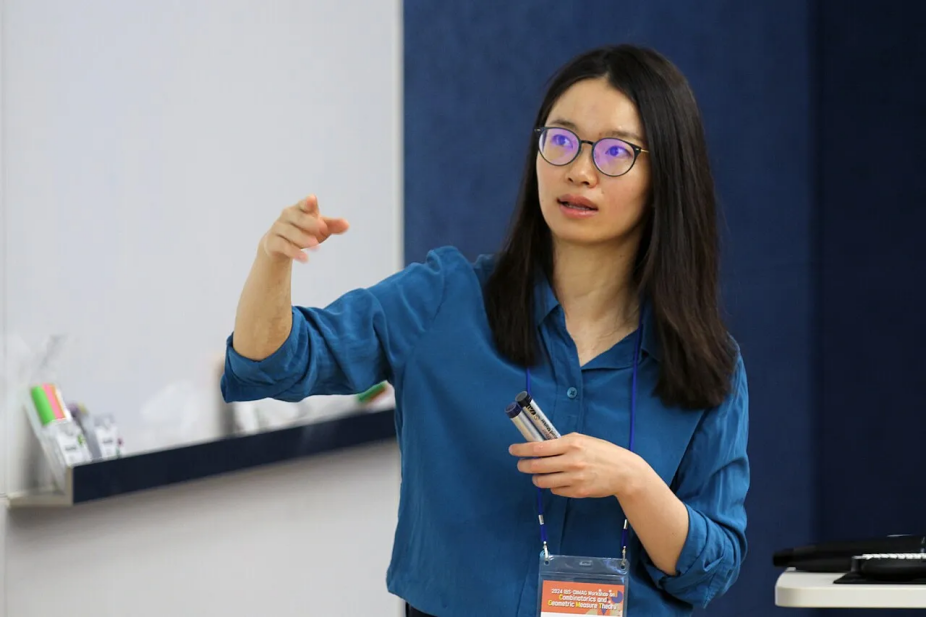
Hong Wang is currently a permanent professor of mathematics at the Institut des Hautes Études Scientifiques (IHES) in France and a professor at the Courant Institute of Mathematical Sciences, New York University. Her research focuses on harmonic analysis.
Born in 1991 in Guilin, Guangxi, China, Wang could hardly have imagined that she would one day reach the pinnacle of mathematics. Yet her extraordinary academic talent became evident early in life. After skipping several grades, she entered Peking University's School of Earth and Space Sciences at the age of 16 in 2007. The following year, she transferred to the School of Mathematical Sciences, beginning her journey into mathematical research.
After graduating from Peking University, Wang pursued further studies in France, earning an engineering degree from École Polytechnique and a master's degree from Université Paris-Sud. She then completed her Ph.D. at MIT, conducted postdoctoral research at the Institute for Advanced Study (IAS) in Princeton, and later joined UCLA as an assistant professor.
Although her career path appears remarkably smooth in retrospect, Wang has spoken candidly about her struggles. She once admitted that she had "always felt rather lost" in research and had "always struggled with mathematics."
While studying in France, she even spent six months away from mathematics to study architecture. In a 2023 interview, she joked, "I realized architecture was also very difficult, so I came back to mathematics. By then I recognized that I had actually received tremendous mathematical training, especially at Peking University—but there were so many brilliant classmates there that I had forgotten that."
In a 2025 video produced by IHES, she reflected more seriously on that experience: "I realized I simply liked mathematics more, so I returned."
According to Georgia Tech associate professor Tuo Zhao, Wang did not choose mathematics only once, nor did she have a clear direction from the beginning. Rather, she repeatedly questioned herself, adjusted course, and gradually found her way. It was this continuous exploration that ultimately strengthened her commitment to mathematics.
The year 2025 became a landmark in Wang's career. In February, she and Joshua Zahl published a 127-page paper announcing the solution to the Kakeya Conjecture, a breakthrough that sent shockwaves throughout the mathematical community.
The Kakeya problem originated from a deceptively simple question posed by Japanese mathematician Sōichi Kakeya: what is the smallest area needed for a unit-length needle to rotate 180 degrees in a plane? Mathematicians showed that the area can be made arbitrarily close to zero. Extending the problem to higher dimensions led to profound questions about the dimension of Kakeya sets.
A Kakeya set in n-dimensional space contains a unit line segment pointing in every direction. Mathematicians sought to determine the Hausdorff and Minkowski dimensions of such sets. Wang and Zahl proved that in three-dimensional space, both dimensions equal 3, resolving a major long-standing conjecture.
Later that year, Wang became the first Chinese permanent professor at IHES. Within a single year, she also received the 2026 Clay Research Award, the New Horizons in Mathematics Prize, and the ICCM Mathematics Gold Medal.
Now, by winning the Fields Medal, Wang becomes only the third woman in history to receive the award. As Chinese mathematician Zhongmin Shen remarked, "I have always believed that Chinese women are every bit as capable as men in mathematics and scientific research. Hong Wang's achievement is compelling proof."
Yu Deng: A Breakthrough on Hilbert's Sixth Problem
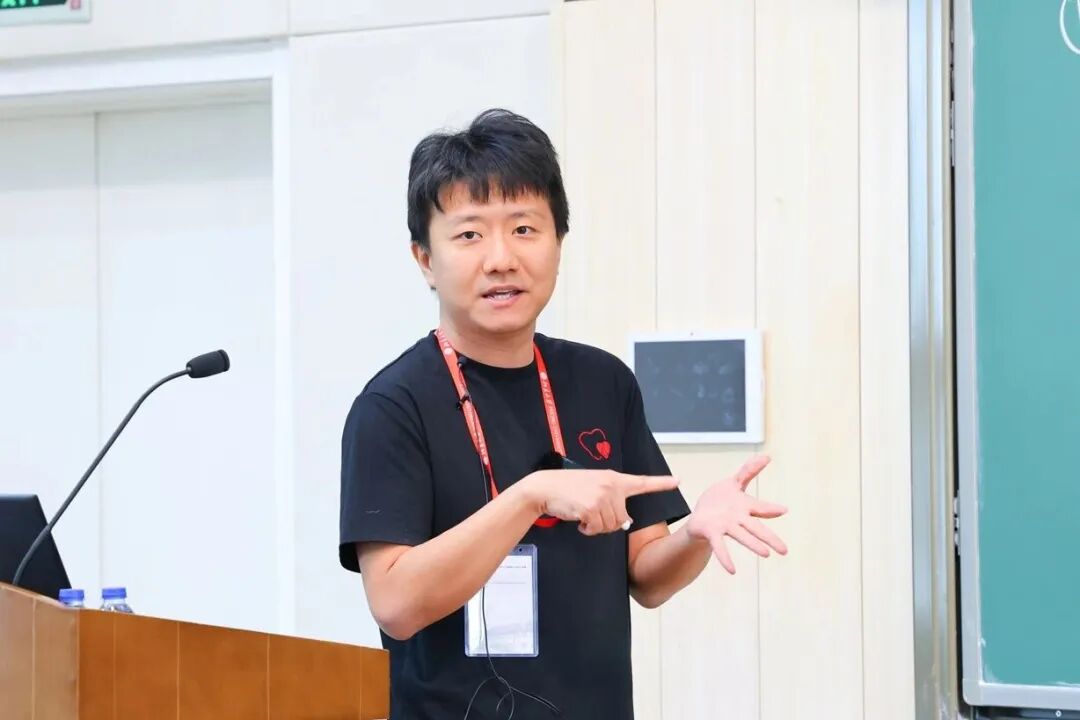
Born in 1989 in Shenzhen, China, Yu Deng is now a professor of mathematics at the University of Chicago.
Unlike Wang, Deng recognized his mathematical talent at an early age. At 17, he won a gold medal at the International Mathematical Olympiad (IMO) and was admitted directly to Peking University's School of Mathematical Sciences. Two years later, he transferred to MIT, where he earned his bachelor's degree in mathematics. He received his Ph.D. from Princeton University in 2015, completed postdoctoral research at NYU's Courant Institute, taught at the University of Southern California, and later joined the University of Chicago.
During his time at Peking University, Deng first encountered frontier problems in harmonic analysis. Looking back, he said, "My education at Peking University gave me a very solid foundation."
Between 2024 and 2025, Deng, together with Xiao Ma and Zaher Hani, made a breakthrough on Hilbert's Sixth Problem, one of the famous 23 problems proposed by David Hilbert in 1900.
Hilbert's Sixth Problem calls for the rigorous axiomatization of physics, particularly deriving the equations of fluid mechanics from microscopic Newtonian mechanics through Boltzmann's kinetic theory. Although Oscar Lanford had shown that macroscopic irreversibility can emerge from microscopic reversible dynamics, a complete mathematical derivation had remained elusive.
Using a dilute hard-sphere gas model, Deng and his collaborators rigorously derived the Boltzmann equation, establishing a firm foundation for solving Hilbert's Sixth Problem. They further proved the long-time validity of the Boltzmann equation and rigorously derived both the compressible Euler equations and the incompressible Navier–Stokes–Fourier equations.
Both collaborators spoke highly of Deng.
Xiao Ma described him as "a true mathematical genius," saying: "There are many smart people in mathematics, but Professor Deng is one of the very few I would call a genius. His explosive creativity is astonishing. Give him a problem, and he can sometimes solve it almost instantly. Once he has an idea, he can often complete the work within a day or two."
Zaher Hani added: "I hope all the recognition he receives will allow people beyond his small research circle to appreciate just how extraordinary he is. His talent, diligence, depth of thought, and incredible speed of thinking are all exceptionally rare. He is undoubtedly a source of pride for China."
Deng's path was not entirely devoted to mathematics from the beginning. As a teenager, he also displayed remarkable talent in Go (Weiqi) and nearly pursued it professionally. Even today, his personal homepage lists his interests as "poetry, stories, novels, puzzles, comics, Go, football, and anything beautiful and fascinating."
For Deng, mathematics belongs among those "beautiful and fascinating things." As he has said:
"As long as you're doing something you truly love, and you enjoy the process of thinking, exploring, and researching, that enjoyment is already a reward. Whether other rewards come later can simply be left to fate."
By pursuing mathematics with joy, Deng ultimately received its highest honor.
John Pardon: Publishing in the Annals as an Undergraduate
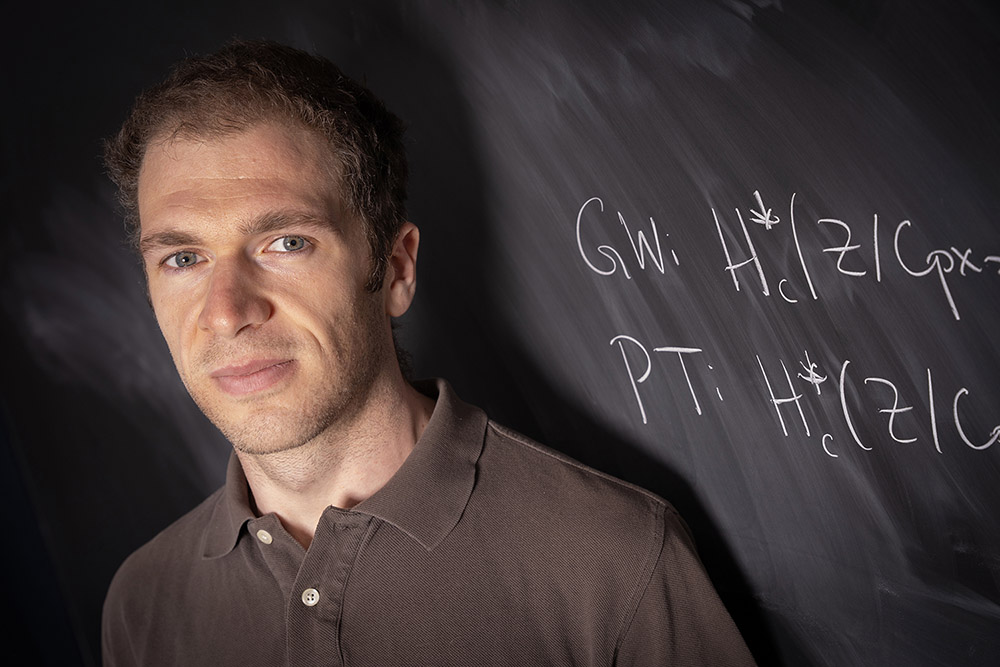
John Pardon is a professor at the Simons Center for Geometry and Physics at Stony Brook University and is widely regarded as a mathematical prodigy.
Born in 1989 in North Carolina, Pardon grew up in a mathematical family—his father was a mathematics professor at Duke University. When he became tired while hiking or swimming as a child, his parents would distract him by posing mathematical problems. Over time, he realized that mathematics allowed him to become completely absorbed in thought, temporarily forgetting physical discomfort and outside pressures.
During high school, Pardon competed in the International Olympiad in Informatics (IOI) for three consecutive years, winning three gold medals.
He entered Princeton University in 2007 to study mathematics. As a senior, he solved a knot theory problem proposed by Mikhail Gromov in 1983—a problem he had been contemplating since high school. His single-authored paper was published in the Annals of Mathematics, one of the world's four leading mathematics journals, an exceptionally rare achievement for an undergraduate.
While at Princeton, Pardon also developed a passion for Chinese. He studied the language systematically and even won the Eastern U.S. regional championship of the "Chinese Bridge" competition.
Graduating with highest honors in 2011, Pardon began doctoral studies at Stanford University. In his very first year, he proved the three-dimensional Hilbert–Smith Conjecture, combining geometric, topological, and low-dimensional techniques. The work appeared in the Journal of the American Mathematical Society.
Only one year after completing his doctorate, Pardon became a full professor at Princeton University at age 27, making him one of the youngest full professors in Princeton's history.
Thanks to his groundbreaking work in geometry and topology, he has received the NSF Alan T. Waterman Award, the Clay Research Award, and the New Horizons in Mathematics Prize.
Caltech mathematician Yi Ni described Pardon as a "barrier breaker." Rather than solving isolated problems, Pardon has repeatedly dismantled the boundaries separating different branches of mathematics, combining algebra, geometry, analysis, topology, and probability in unexpected ways to solve deep problems.
Jacob Tsimerman: Completing the Proof of the André–Oort Conjecture
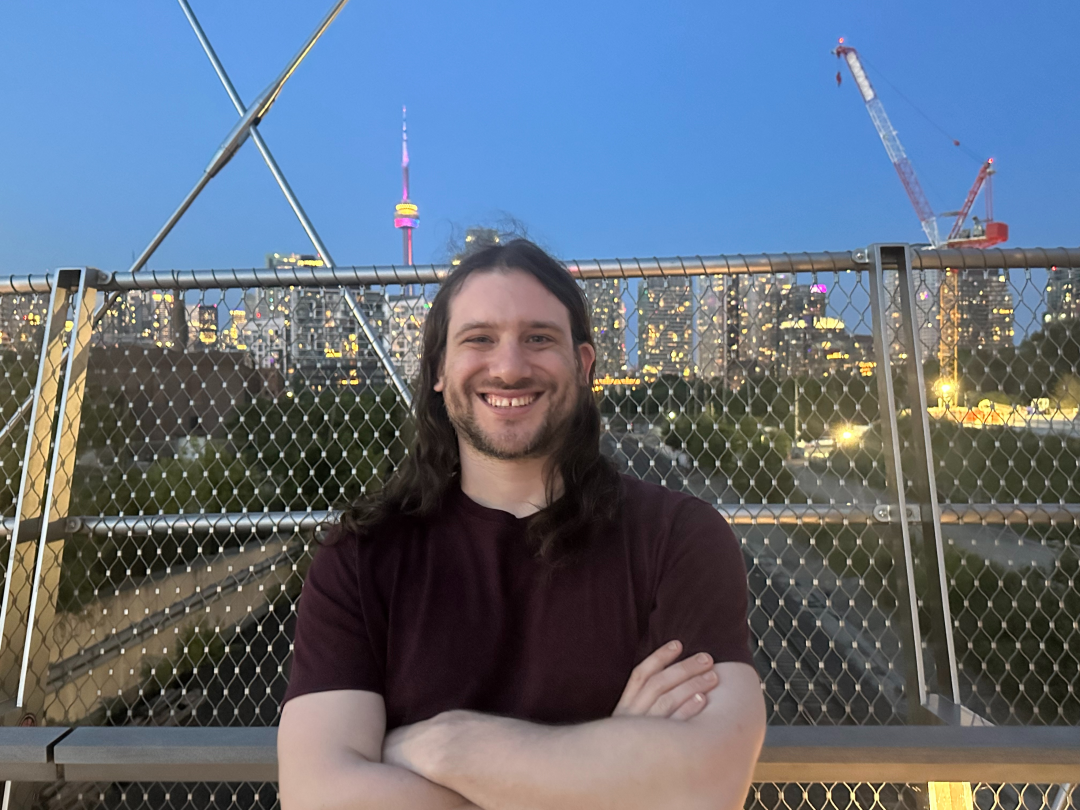
Jacob Tsimerman is a professor of mathematics at the University of Toronto and is widely regarded as one of the leading number theorists of his generation.
Born in 1988 in Kazan, then part of the Soviet Union, Tsimerman came from an academically accomplished family. His grandfather was a physicist, his mother a high school mathematics teacher, and his father a computer scientist. While other children played, Tsimerman constantly asked his grandfather for mathematical puzzles. As he later recalled, "I completely fell in love with this way of thinking."
At age eight, his family immigrated to Toronto so he could benefit from North America's strongest educational opportunities.
As a teenager, Tsimerman won two IMO gold medals, the second with a perfect score. That same year, at just 16 years old, he entered the University of Toronto to study mathematics, completing his undergraduate degree in only two years before moving on to Princeton University for his Ph.D.
During graduate school, he encountered the André–Oort Conjecture, which concerns the distribution of special points on Shimura varieties. Existing approaches all relied on the Generalized Riemann Hypothesis, itself one of mathematics' greatest unsolved problems.
In 2021, Tsimerman, together with Jonathan Pila and Ananth Shankar, successfully proved the André–Oort Conjecture without assuming the Generalized Riemann Hypothesis. Beyond resolving a major conjecture, their work introduced powerful new techniques that are expected to influence many other areas of mathematics.
This achievement earned Tsimerman the Fields Medal.
His award also carries special significance for the University of Toronto. Although the Fields Medal is named after University of Toronto professor John Charles Fields, Tsimerman became the first Fields Medalist based in Canada.
Former department chair Robert Jerrard observed: "It is extremely rare for a scholar at a North American public university to win the Fields Medal. By the time someone becomes a serious contender, they have usually already been recruited by wealthier elite institutions."
For Tsimerman, however, prizes have always been secondary. What has sustained him since childhood is the simple joy of doing mathematics. As he once put it:
"Compared with many other professions, mathematics teaches you just how rarely results come. Even when you're at your absolute best, you might produce only two or three meaningful results in an entire year."
Mathematics is one of the few disciplines whose deepest ideas often have no immediate practical application. Yet it is precisely this seemingly "impractical" pursuit that illuminates the foundations of human civilization. As his collaborator Jonathan Pila remarked:
"Mathematics is part of humanity's exploration of knowledge. We study the deepest theoretical foundations, and I believe that one day our understanding of these theories will find its own applications."


TRENDING
MIT Overtakes Harvard as U.S. and China Dominate September Nature and Science Output
Data & Rankings
From Training Talent to Winning Nobels: The Universities Behind the Laureates
Data & Rankings
Getting Older, Crossing Disciplines: What Nobel Prize Data Reveal
Data & Rankings
Harvard Leads the Citation Laureates Rankings as Nobel Prize Season Approaches
Data & Rankings
Good University Guide 2027: St Andrews Takes No. 1 as Imperial Climbs Three Places
Data & Rankings