
MIT Overtakes Harvard as U.S. and China Dominate September Nature and Science Output


The 2026 Nobel Prizes in the natural sciences have now all been announced, with six scientists recognized for breakthroughs that have reshaped their respective fields. Yet the awards may also be seen as a long-overdue tribute: many of the key discoveries recognized by the Nobel committees were made two or three decades ago. In this sense, the Nobel Prize itself is a scorecard that comes with a considerable time lag.
So what does the global research landscape look like today? Publications in leading scientific journals may offer one useful snapshot.
WorldHE continuously tracks university publication output in Nature and Science. Its latest data show that 134 universities worldwide published papers in Nature or Science in September, with research output remaining highly concentrated among leading institutions. A relatively small group of world-class research universities accounted for a substantial share of NS publications, while nearly two-thirds of universities published just one paper during the month. At the same time, universities in the United States and China Mainland continued to occupy a central position in global research output.
MIT and Harvard Continue to Lead
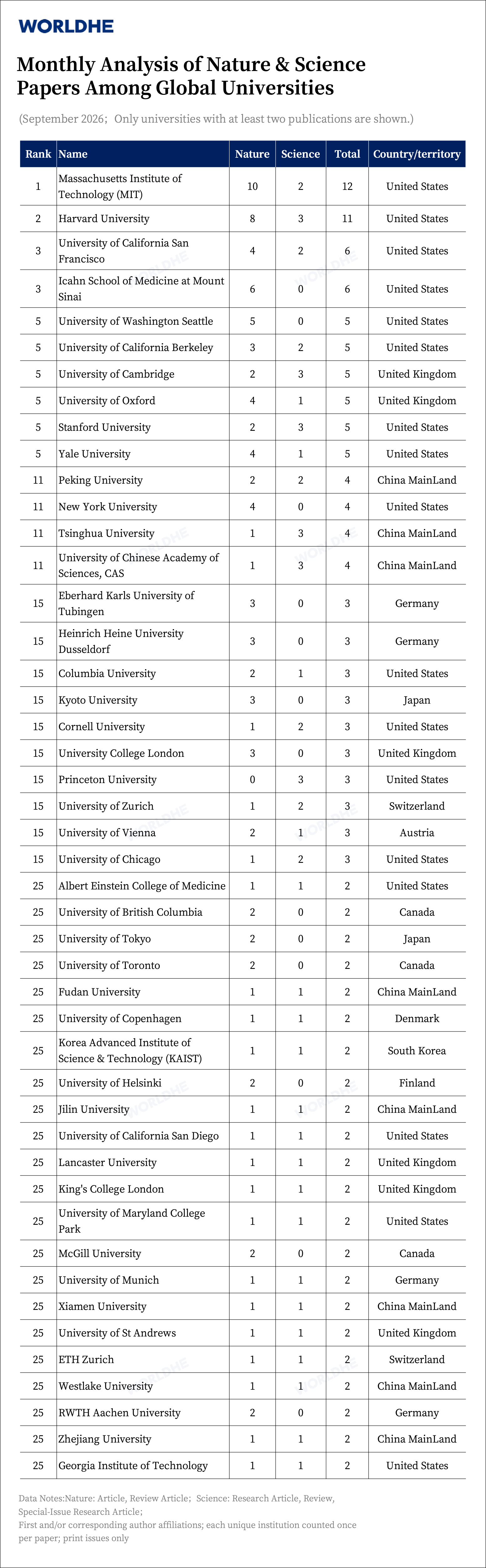
In September, MIT overtook Harvard to rank first, with 12 publications, including 10 in Nature and two in Science. MIT also recorded the highest number of Nature publications among universities during the month.
Harvard followed with 11 publications, including eight in Nature and three in Science. The two institutions were the only universities to record more than 10 NS publications in September. Both also published papers in Nature or Science every week of the month, demonstrating a sustained and consistent research output.
The University of California, San Francisco (UCSF) and the Icahn School of Medicine at Mount Sinai saw a significant increase in NS publications compared with August, with six publications each. UCSF published four papers in Nature and two in Science, while all six of Mount Sinai's publications were in Nature.
The University of Washington Seattle, UC Berkeley, the University of Cambridge, the University of Oxford, Stanford University and Yale University each published five papers, while Peking University, New York University, Tsinghua University and the University of Chinese Academy of Sciences each published four, forming the next tier of leading institutions.
Behind the high publication volumes of these leading universities is a strong degree of institutional leadership in research projects and collaborations. Leading universities frequently appeared as the corresponding-author affiliation. At Mount Sinai, UC Berkeley and Stanford, all of their September publications counted the institution as both the first-author and corresponding-author affiliation, highlighting their central role in global research collaboration networks.
In contrast to the concentration of output among leading institutions, 88 universities published only one NS paper in September. Universities capable of maintaining a high and consistent level of publication in Nature and Science therefore remain a relatively small group within the global research system.
U.S. Universities Maintain Their Global Lead in NS Publications
Of the 10 universities that published five or more papers in Nature or Science in September, eight were from the United States and two from the United Kingdom.
U.S. universities continued to be the largest contributors to Nature and Science output. In September, 39 U.S. universities published NS papers, accounting for approximately 40% of all universities represented in the global dataset. The United States remained well ahead of other countries and regions in both the number of universities publishing in the two journals and their overall publication volume.
China ranked second, with 35 universities represented — including 29 in China Mainland, four in Taiwan, China, and two in Hong Kong, China. Together, universities in the United States and China accounted for more than half of the world's universities publishing in Nature or Science in September, reinforcing their position as the two central forces in global top-tier research output.
However, the two countries showed noticeably different publication profiles across the two journals. U.S. universities had a stronger presence in Nature, while Chinese universities were more prominent in Science. Among the 29 China Mainland universities represented in September, 21 published papers in Science.
Of the four NS publications recorded by Tsinghua University and the University of Chinese Academy of Sciences, three were published in Science, putting both institutions among the universities with the highest Science output in September.
Beyond the United States and China, 12 German universities and 11 UK universities were represented in the September data. Canada, Japan, Switzerland and several other countries also maintained a significant presence in high-impact scientific research.
Methodology
For Nature, the analysis includes Article and Review Article publications.
For Science, it includes Special-Issue Research Article, Research Article and Review publications.
The affiliation of each first author and corresponding author is counted once. If the first author and corresponding author are affiliated with the same institution, the institution is counted only once.
The statistics include only papers that have been formally published and exclude papers in pre-publication or advance online status.
Further Reading
WorldHE NS Watch: Harvard, MIT and Stanford Lead Global Nature and Science Output in August


TRENDING
MIT Overtakes Harvard as U.S. and China Dominate September Nature and Science Output
Data & Rankings
Harvard Leads the Citation Laureates Rankings as Nobel Prize Season Approaches
Data & Rankings
Good University Guide 2027: St Andrews Takes No. 1 as Imperial Climbs Three Places
Data & Rankings
From Lasker to Nobel: The Universities Behind Biomedical Breakthroughs
Data & Rankings
Before the Nobel: Which Universities Are Leading in Biomedical Breakthroughs?
Data & Rankings