
Global Nature and Science Leaders, H1 2026


Nature and Science, the world's most influential and prestigious scientific journals, have long served as the premier venues for publishing major scientific discoveries and groundbreaking research. The number of papers published in these two top-tier journals has become one of the key indicators for evaluating the research strength of universities and research institutions.
With the first half of 2026 now complete, WorldHE has compiled publication data for universities worldwide in Nature and Science from January to June 2026, providing a snapshot of the global research landscape during the first half of the year. In addition, WorldHE continues to track universities' Nature and Science publications over the past 12 months, with the complete dataset available through the link.
More Than 30 Universities Published Over 10 Nature & Science Papers in the First Half of the Year
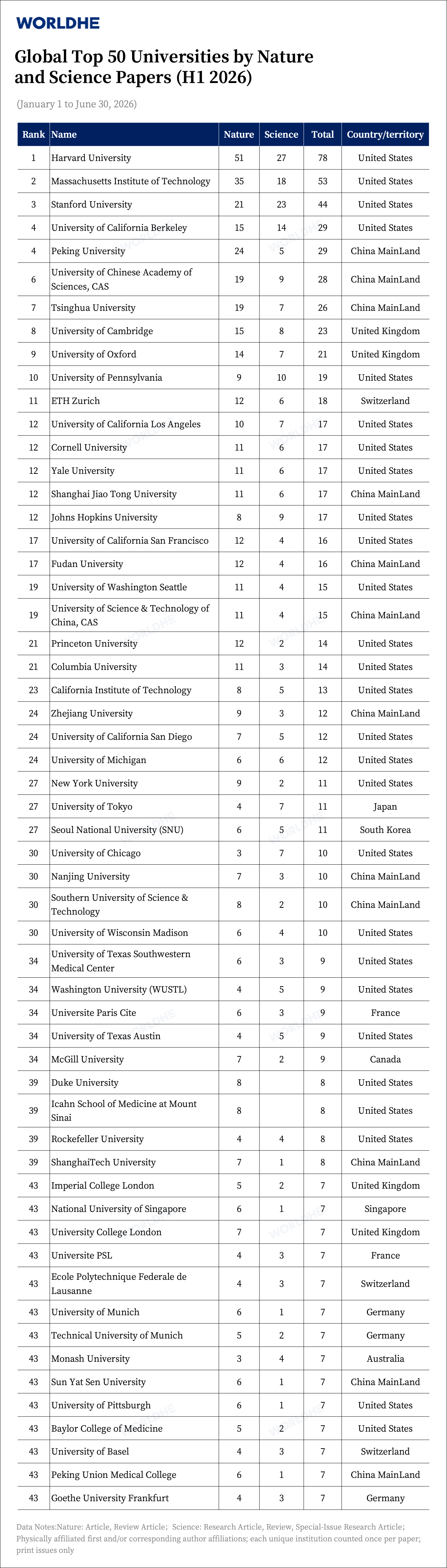
Among the Top 10 universities worldwide by total Nature and Science (NS) publications in the first half of 2026, five are from the United States, three from China Mainland, and two from the United Kingdom, forming the leading tier of global research output in top-tier journals.
Harvard University ranked first by a wide margin with 78 papers (51 in Nature and 27 in Science). Remarkably, 76 of these papers listed Harvard-affiliated corresponding authors, underscoring the university's unparalleled research scale and leadership. Massachusetts Institute of Technology (MIT) followed with 53 papers, while Stanford University ranked third with 44 papers, reaffirming the dominance of the longstanding "top three" among U.S. institutions. Stanford is also one of the few universities to publish more papers in Science (23) than in Nature (21), reflecting its long-established disciplinary strengths.
Peking University and the University of California, Berkeley tied for fourth place with 29 NS papers each. Peking University stood out particularly in Nature, publishing 24 papers, trailing only Harvard and MIT and ranking third globally. This achievement demonstrates that Peking University's output in the natural sciences has reached the world's highest level. UC Berkeley, by contrast, maintained a balanced publication profile across Nature and Science, highlighting its comprehensive excellence spanning the physical sciences, life sciences, and earth sciences.
Among universities in China Mainland, the University of Chinese Academy of Sciences (28 papers) and Tsinghua University (26 papers) ranked 6th and 7th globally, respectively. The United Kingdom's University of Cambridge (23 papers) and University of Oxford (21 papers) placed 8th and 9th, forming Europe's strongest duo. The University of Pennsylvania, with 19 papers, rounded out the global top ten.
In total, 33 universities worldwide published at least 10 NS papers during the first half of 2026. In addition to the top ten institutions, universities such as ETH Zurich, University of California, Los Angeles (UCLA), Cornell University, Yale University, Shanghai Jiao Tong University, and Johns Hopkins University also delivered outstanding performances.
A Tripolar Global Research Landscape
From a national and regional perspective, the United States remains the undisputed global leader. Of the 33 universities publishing more than 10 NS papers, 19 are American, accounting for well over half of the total.
U.S. universities are particularly dominant in Science. The five institutions publishing more than 10 Science papers—Harvard University, Stanford University, MIT, UC Berkeley, and the University of Pennsylvania—are all based in the United States. Moreover, several American universities, including Johns Hopkins University and the University of Chicago, published more papers in Science than in Nature, reflecting their deep strengths in medicine and the life sciences. At the same time, the proportion of papers with U.S.-based corresponding authors remains exceptionally high, reinforcing the country's leadership in international research collaborations.
China Mainland has firmly established itself as the second global research powerhouse, with its overall publication volume significantly surpassing that of traditional scientific powers such as the United Kingdom and Germany. Nine universities in China Mainland published more than 10 NS papers during the first half of the year.
Universities in China Mainland display a clear preference for Nature, with publication counts generally exceeding those in Science. This trend reflects China's longstanding strengths in fields such as physics, chemistry, materials science, and nanoscience, and highlights the structural characteristics of its basic research portfolio. Notably, the share of papers with corresponding authors from institutions in China Mainland has increased substantially, indicating that Chinese researchers are assuming increasingly prominent leadership roles in international collaborations.
Europe continues to maintain a stable and highly competitive research ecosystem. The University of Cambridge and the University of Oxford both remained in the global top ten, while Imperial College London and University College London (UCL) each published seven papers. ETH Zurich, with 18 papers, ranked 11th globally, making it the highest-performing non-English-speaking university in Europe. The vast majority of its papers were led by researchers from the institution itself, demonstrating its strong research independence and institutional leadership.
In France, Université Paris Cité published nine papers, while Université PSL contributed seven, making them the leading institutions in the French-speaking academic community. In Germany, LMU Munich, the Technical University of Munich (TUM), and Goethe University Frankfurt each published seven papers, collectively forming a key pillar of European scientific research.
Methodology
For Nature, only articles classified as "Article" and "Review Article" were included. For Science, the analysis covered "Special-Issue Research Article," "Research Article," and "Review."
The data cover the period from January 1 to June 30, 2026. Only the physically first-listed first author was counted as the first author. All corresponding authors were counted, with each affiliated institution receiving one count. If the first author and corresponding author belonged to the same institution, the paper was counted only once for that institution. The analysis includes only formally published papers and excludes articles that remained in online pre-publication or early-access status.


TRENDING
Before the Nobel Prizes: Which Universities Are Leading the Pipeline of Future Laureates?
Data & Rankings
Where Fields Medalists Studied and Worked?
Data & Rankings
Which Universities Are Producing the Next Nobel Laureates? The Breakthrough Prize Offers Some Clues
Data & Rankings
MIT Tops QS World Rankings for 15th Straight Year
Data & Rankings
Harvard Tops U.S. News Global University Rankings
Data & Rankings