

From Lasker to Nobel: The Universities Behind Biomedical Breakthroughs


The Lasker Awards have once again put a spotlight on the scientists and institutions at the forefront of biomedical research—just weeks before the Nobel Prizes are announced.
The 2026 Lasker Awards, widely regarded as one of the strongest indicators of potential Nobel Prize winners in medicine and biomedical science, were announced on September 9.
Emmanuel Mignot of Stanford University and Masashi Yanagisawa of the University of Tsukuba received the Lasker Basic Medical Research Award. Kunihiro Hattori, Tomoyuki Igawa and Takehisa Kitazawa of Chugai Pharmaceutical Co. in Tokyo received the Lasker Clinical Medical Research Award. Michael J. Fox was awarded the Lasker Public Service Award.
Founded in 1946, the Lasker Awards are among the most prestigious honors in biomedical science. The awards recognize achievements in Basic Medical Research, Clinical Medical Research, Special Achievement in Medical Science and Public Service.
Their significance extends beyond the awards themselves. Lasker laureates have historically overlapped to a striking degree with future Nobel laureates. More than 30 Lasker winners over the past two decades have subsequently received Nobel Prizes.
The pattern was particularly evident in recent years. Demis Hassabis and John Jumper, who received the Lasker Basic Medical Research Award in 2023, went on to share the Nobel Prize in Chemistry the following year.
With the Nobel Prizes due to be announced in October, the Lasker Awards offer a timely lens through which to examine the institutions behind some of the world’s most influential biomedical discoveries.
WorldHE analyzed Lasker Award winners and their institutional affiliations from 2000 to the present to explore a broader question: Which universities are consistently producing the scientists working at the leading edge of biomedical research?
Universities dominate the Lasker landscape
Since 2000, the Lasker Awards have recognized 143 award instances, including 57 Basic Medical Research Awards, 51 Clinical Medical Research Awards, 15 Special Achievement Awards in Medical Science and 20 Public Service Awards.
Universities account for the largest share of the institutions represented among these winners.
Of the 143 award instances, 86 were associated with university researchers, representing 60% of the total. Basic Medical Research accounted for 44 of these awards, while Clinical Medical Research accounted for 27.
The figures point to a particularly strong university presence in basic biomedical research.
That distinction matters. Basic research often requires years—or even decades—of sustained investment before its significance becomes clear. It also tends to carry greater uncertainty around eventual clinical or commercial applications.
Universities that repeatedly produce Lasker-recognized basic research are therefore likely to have more than individual star researchers. Their success points to the presence of a broader research ecosystem: well-funded laboratories, interdisciplinary collaboration, strong academic talent pipelines and the institutional capacity to support long-term, high-risk research.
In this sense, the Lasker data offer more than a ranking of individual researchers. They provide a snapshot of where the infrastructure for breakthrough biomedical science is concentrated.
Rockefeller leads a group of biomedical powerhouses
Among universities, Rockefeller University stands out.
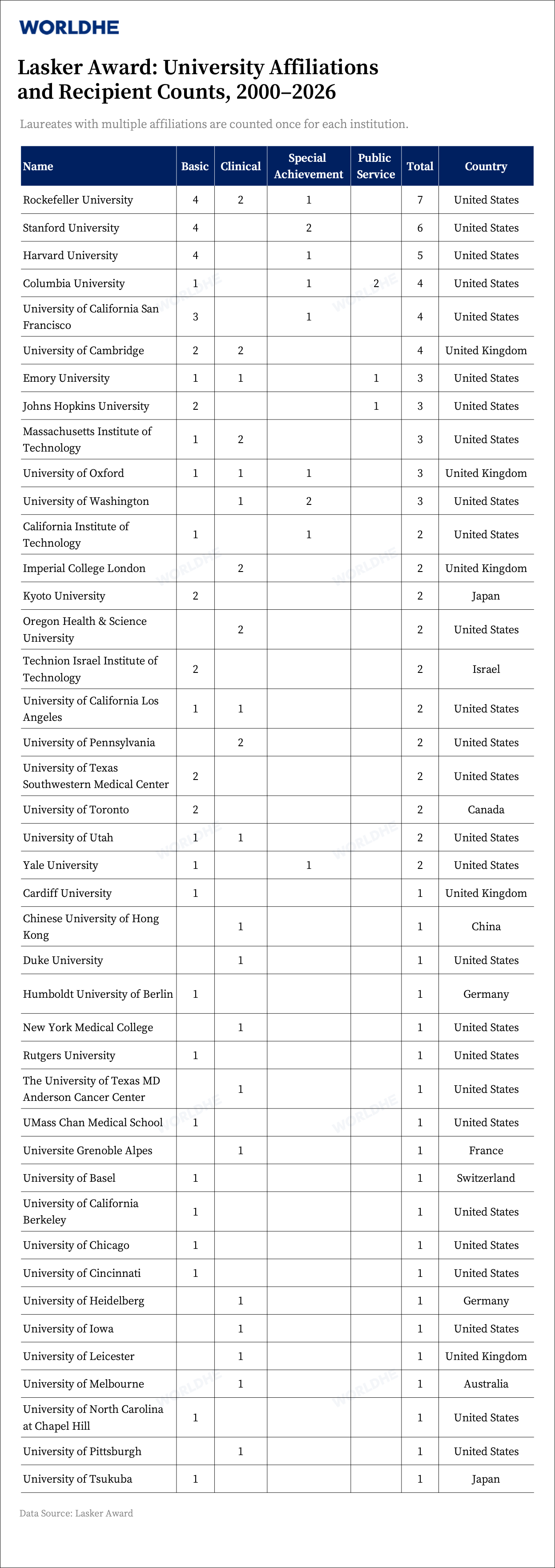
The New York-based institution has been associated with seven Lasker awards since 2000—the highest total among universities in the analysis. These include four Basic Medical Research Awards, two Clinical Medical Research Awards and one Special Achievement Award in Medical Science.
Rockefeller is an unusual case in the global higher education landscape. Unlike large comprehensive universities such as Harvard and Stanford, it is a relatively small institution with a highly specialized focus on biomedical research.
Its position at the top of the Lasker rankings nevertheless illustrates how institutional scale does not necessarily translate into influence in cutting-edge science. A concentrated research mission, strong laboratory culture and sustained investment in biomedical discovery can generate an outsized impact.
Stanford University follows with six awards, while Harvard University has five.
Stanford has received four Basic Medical Research Awards and two Special Achievement Awards in Medical Science. This year’s Basic Medical Research laureate Emmanuel Mignot is affiliated with Stanford.
Harvard has received four Basic Medical Research Awards and one Special Achievement Award in Medical Science.
Columbia University, the University of California, San Francisco (UCSF) and the University of Cambridge each have four award instances.
Cambridge is the strongest-performing non-US university in the analysis, with two Basic Medical Research Awards and two Clinical Medical Research Awards.
US universities account for nearly three-quarters of university-affiliated winners
The concentration becomes even more pronounced when the data are examined geographically.
Of the 86 university-affiliated award instances since 2000, 62 were associated with US universities—72% of the total.
That means roughly three out of every four university-affiliated Lasker award instances went to researchers based at US institutions.
The UK follows with 11, while Japan has three. Israel, Canada and Germany each have two, while France, Switzerland, Australia and Hong Kong each have one.
The US lead reflects both the depth of its elite university system and the diversity of institutions contributing to biomedical research.
The list extends well beyond the country’s best-known comprehensive universities. Harvard, Stanford, Columbia and Johns Hopkins are joined by highly specialized biomedical institutions such as Rockefeller University, UCSF, UT Southwestern Medical Center and Oregon Health & Science University.
This institutional diversity may be one of the US research system’s greatest strengths. Breakthrough biomedical research is not concentrated exclusively within a handful of broad-based universities; it is supported by a wider network of medical schools, specialist research universities and academic health centers.
The UK presents a different pattern. Its Lasker presence is concentrated among a relatively small group of research-intensive universities: Cambridge accounts for four award instances, Oxford for three and Imperial College London for two.
Together, these institutions represent one of the most significant concentrations of top-tier biomedical research outside the United States.
A window into the next Nobel Prize in Medicine?
The historical overlap between the Lasker and Nobel Prizes makes this year’s results particularly timely.
The Lasker Awards do not predict Nobel winners with certainty, nor do the two awards recognize exactly the same achievements. But the historical record suggests that Lasker recognition can serve as an early signal of scientific work that later receives the Nobel committee’s highest recognition.
For universities, however, the more revealing story may lie beyond the individual laureates.
The concentration of Lasker winners at a relatively small group of research-intensive institutions highlights the importance of the academic environments in which breakthrough science is produced. Sustained excellence in biomedical research appears to depend not only on exceptional individuals, but also on laboratories, funding systems, interdisciplinary networks and institutional cultures capable of supporting ambitious research over long periods.
As the Nobel Prizes approach in October, the question is not simply which Lasker laureates might hear their names called again.
It is also which universities will continue to emerge as the institutional homes of the scientists reshaping the boundaries of medicine and the life sciences.
Data note: WorldHE’s analysis is based on institutional affiliation data for Lasker Award winners listed on the official Lasker Awards website from 2000 to the present. Some laureates have multiple institutional affiliations, with each affiliation counted separately. Where institutional names have changed or campuses are listed separately, affiliations have been consolidated or distinguished where appropriate to ensure consistency in the analysis.


TRENDING
From Lasker to Nobel: The Universities Behind Biomedical Breakthroughs
Data & Rankings
Before the Nobel: Which Universities Are Leading in Biomedical Breakthroughs?
Data & Rankings
WorldHE NS Watch: Harvard, MIT and Stanford Lead Global Nature and Science Output in August
Data & Rankings
Before the Nobel Prizes: Which Universities Are Leading the Pipeline of Future Laureates?
Data & Rankings
Where Fields Medalists Studied and Worked?
Data & Rankings