
Getting Older, Crossing Disciplines: What Nobel Prize Data Reveal


With the Nobel Prize in Economic Sciences announced, the 2026 Nobel Prize season has come to a close. This year’s laureates have opened up new frontiers across disciplines: Karl Deisseroth, Peter Hegemann and Georg Nagel gave the brain a “light switch”; Francis Halzen detected cosmic “ghost particles” deep beneath the Antarctic ice; Henri B. Kagan and Kenso Soai helped unravel the mystery of molecular mirror images; Anne Carson forged creative connections between classical literature and the contemporary world; and Robert E. Hall and Michael Woodford brought microeconomic foundations into macroeconomic analysis.
This year also marks the 125th anniversary of the Nobel Prizes. Guided by Alfred Nobel’s vision of delivering “the greatest benefit to humankind,” the laureates collectively represent the global landscape of outstanding research and talent. How long does it take to reach the pinnacle of this landscape? What do their achievements reveal about the frontiers of human knowledge? And what patterns emerge from the institutions and disciplines behind their success?
To explore these questions, WorldHE compiled data on Nobel laureates’ ages at the time of their awards, their prize-winning achievements, their institutional affiliations, and the universities where they earned their bachelor’s, master’s and doctoral degrees. (Note: All analyses in this article exclude the Nobel Peace Prize.) This article offers an overview of the laureates and their achievements. The next instalment will examine the global university landscape behind the Nobel Prizes.
Nobel Laureates Are Winning at Increasingly Older Ages
How long does it take a scientist to reach Nobel Prize recognition? The answer varies widely.
Since the first Nobel Prizes were awarded in 1901, 892 individuals have received the honour. At just 25, Lawrence Bragg remains the youngest Nobel laureate in history. He shared the 1915 Nobel Prize in Physics with his father in recognition of their work on the analysis of crystal structures using X-rays. At the other end of the spectrum is John B. Goodenough, who was 97 when he received the 2019 Nobel Prize in Chemistry for his contributions to the development of lithium-ion batteries.
In a striking coincidence, Henri B. Kagan, this year’s Chemistry laureate, is only two years younger than Goodenough. Now 95, Kagan is being recognised for work that helped lay the foundations of asymmetric catalysis four decades ago. Many observers believe he missed out on the Nobel Prize in 2001, making this year’s award seem, to some, like long-overdue recognition.
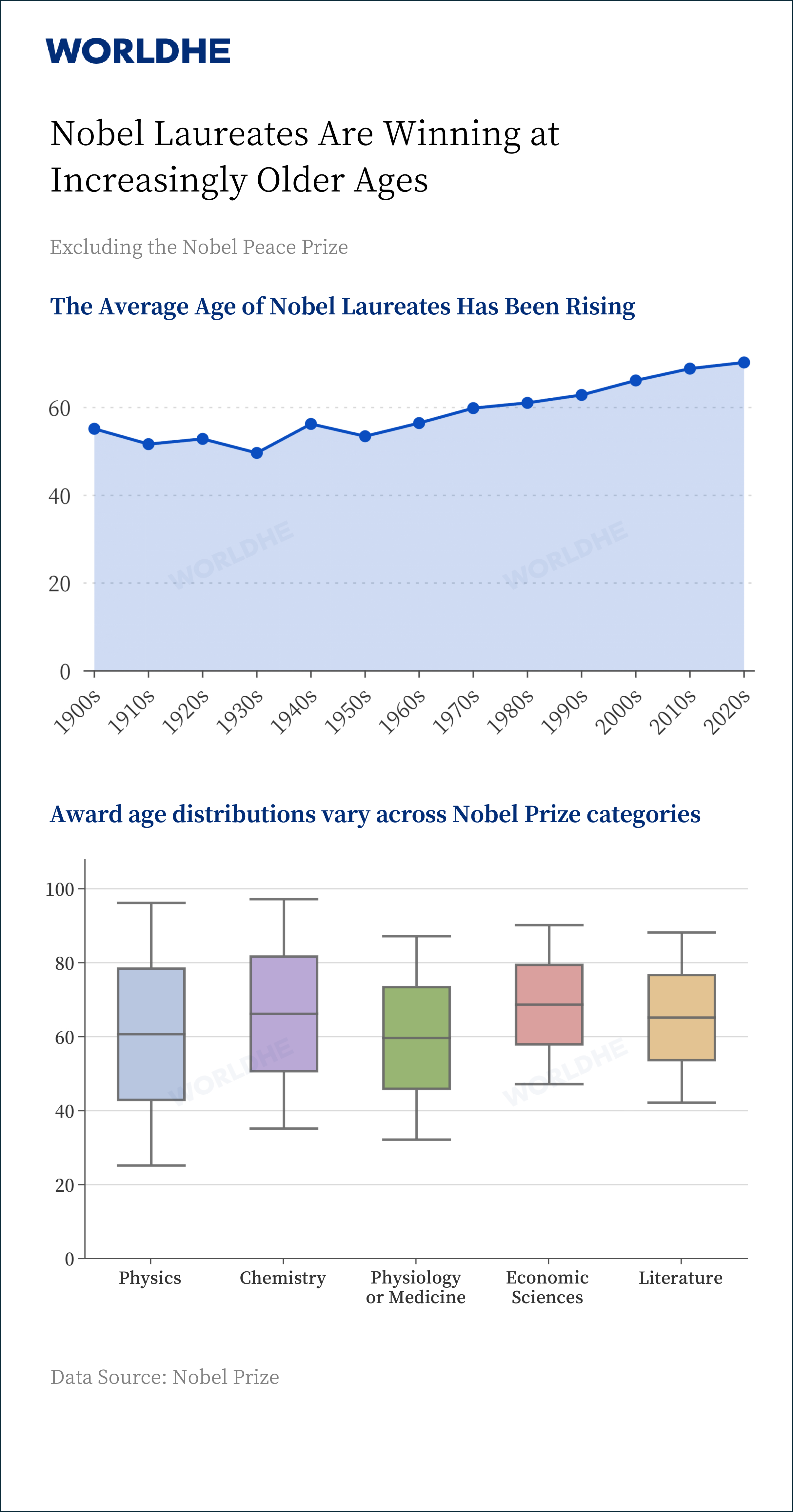
For many laureates, Nobel recognition comes only after a long wait. Across the history of the prizes, the average age at the time of winning has reached 60.5. Economic Sciences laureates have the highest average age, at 67.2, significantly above the 57.8 average for Physics laureates. This gap may reflect the time often required for economic research to accumulate evidence, develop theoretical foundations and demonstrate its broader significance.
A breakdown by decade reveals an even clearer trend: Nobel laureates are winning at increasingly older ages. The average age at the time of winning was just 55 in the 1900s, compared with 70.1 in the 2020s—an increase of nearly 15 years over more than a century.
Nobel Research Fields Continue to Evolve
The growing time between a major discovery and Nobel recognition may also reflect the increasing complexity of scientific research.
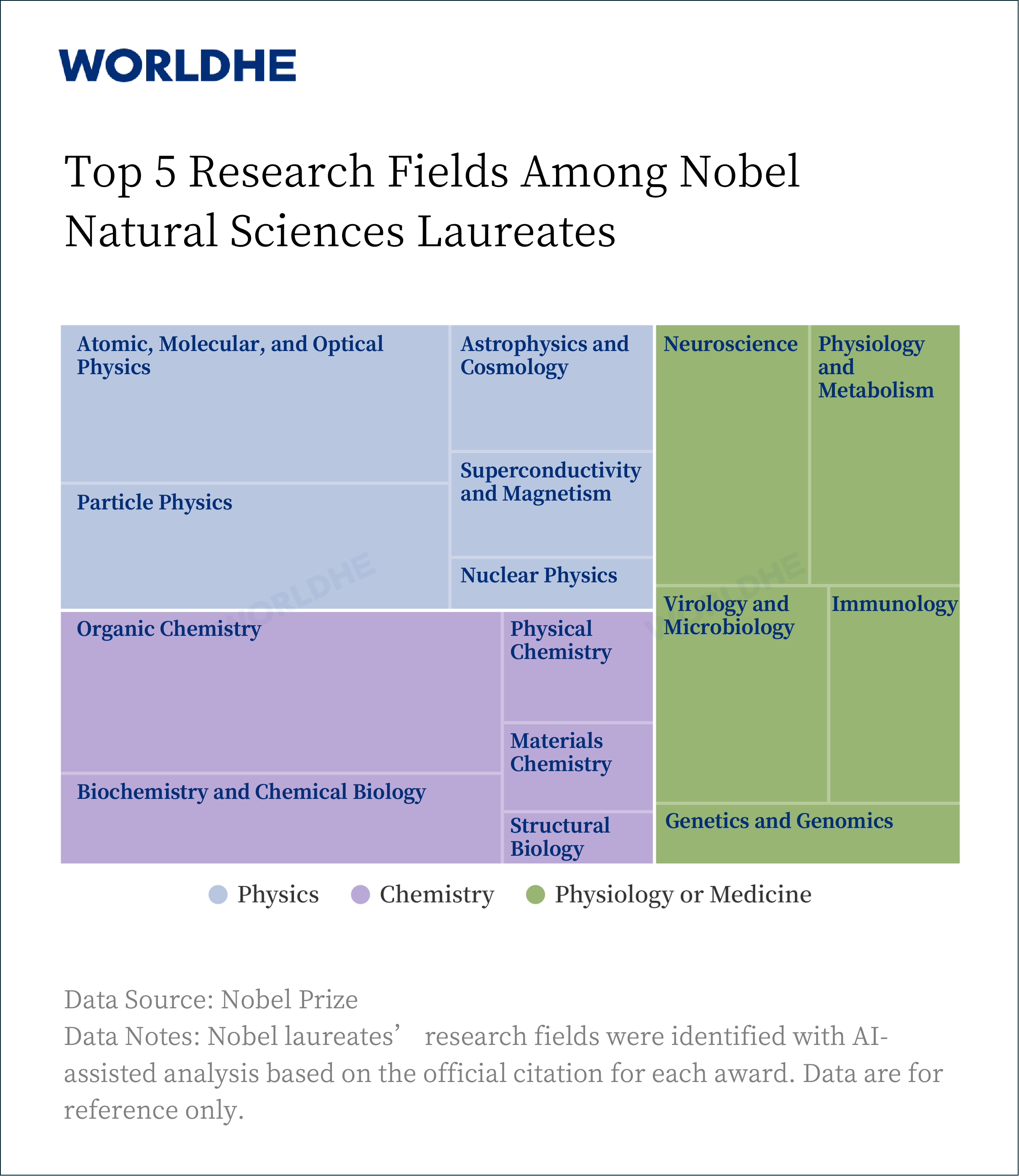
That complexity is evident in the changing research fields represented by the prizes. Over more than a century, Nobel-recognised research has shifted alongside broader changes in scientific priorities. In the first half of the 20th century, atomic, molecular and optical physics, as well as physiology and metabolism, featured prominently. In the second half, particle physics and organic chemistry gained ground.
Since the beginning of the 21st century, interdisciplinary fields have risen rapidly, including biochemistry and chemical biology, materials chemistry and nanomaterials, and neuroscience. The 2024 Nobel Prizes offered a particularly striking illustration of this shift: the Chemistry Prize recognised AI-driven advances in protein structure prediction, while the Physics Prize honoured pioneers of neural networks. These awards suggest that the traditional boundaries between scientific disciplines are becoming less distinct.
Can “Nobel Predictor” Awards Offer Early Clues?
The Nobel selection process is subject to strict confidentiality, making the winners notoriously difficult to predict. Yet several major international awards are widely regarded as potential “Nobel predictors,” offering clues to research that may later receive Nobel recognition.
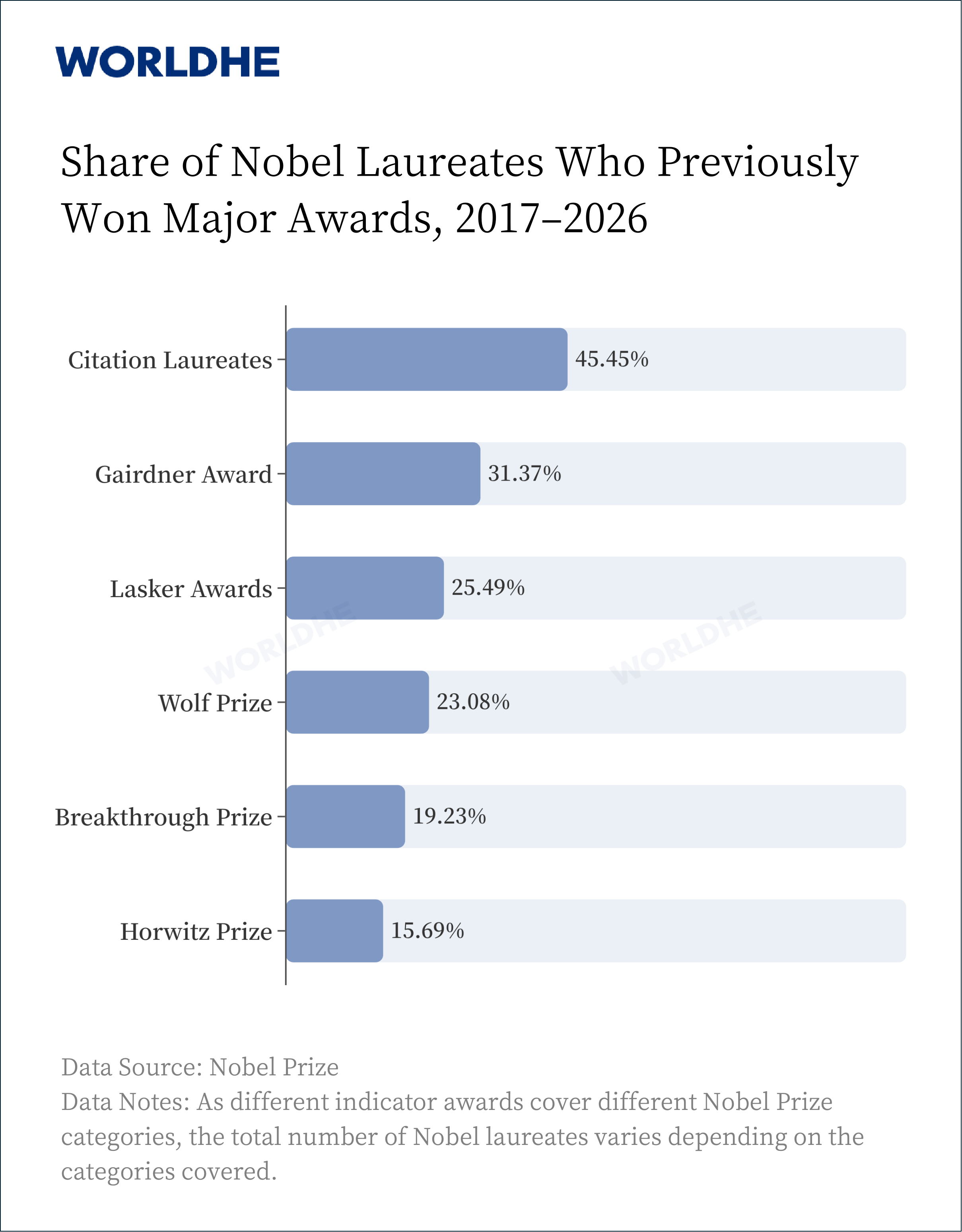
WorldHE examined the past decade of Nobel laureates and whether they had previously received any of six awards often described as Nobel indicators: the Breakthrough Prize, Clarivate Citation Laureates, the Lasker Awards, the Louisa Gross Horwitz Prize, the Canada Gairdner International Award and the Wolf Prize.
Over the past decade, more than 60% of Nobel laureates had received at least one of these awards before winning the Nobel Prize. Clarivate Citation Laureates had the broadest overlap with Nobel winners, with 45 Nobel laureates having previously received the distinction. This year’s Economic Sciences laureates Robert E. Hall and Michael Woodford, as well as Physiology or Medicine laureate Karl Deisseroth, were all previously named Clarivate Citation Laureates. According to Clarivate, the programme has successfully anticipated 92 future Nobel laureates to date.
James P. Allison, who received the 2018 Nobel Prize in Physiology or Medicine, achieved a remarkable clean sweep of all six indicator awards. All six were presented between 2014 and 2017, making his Nobel recognition in 2018 widely anticipated.
This year, Stanford University professor Karl Deisseroth has also attracted attention on social media, in part thanks to a heartwarming video of his children congratulating him on his Nobel Prize. Beyond the viral moment, his research record is notable: he has received five of the six awards tracked in this analysis, missing only the Wolf Prize. As one of his Stanford colleagues put it, “We knew he deserved it.”


TRENDING
From Training Talent to Winning Nobels: The Universities Behind the Laureates
Data & Rankings
MIT Overtakes Harvard as U.S. and China Dominate September Nature and Science Output
Data & Rankings
Getting Older, Crossing Disciplines: What Nobel Prize Data Reveal
Data & Rankings
Harvard Leads the Citation Laureates Rankings as Nobel Prize Season Approaches
Data & Rankings
Good University Guide 2027: St Andrews Takes No. 1 as Imperial Climbs Three Places
Data & Rankings