

From Training Talent to Winning Nobels: The Universities Behind the Laureates


With the 2026 Nobel Prize season now complete, WorldHE has continued to examine the awards and the people and institutions behind them. Previous analyses have explored Nobel laureates’ ages, research fields and their track records with awards widely regarded as potential “Nobel predictors.” But another question is equally worth asking: if Nobel laureates represent the pinnacle of a university’s research and talent, what does the global university landscape behind them look like?
(Note: All analyses in this article exclude the Nobel Peace Prize.)
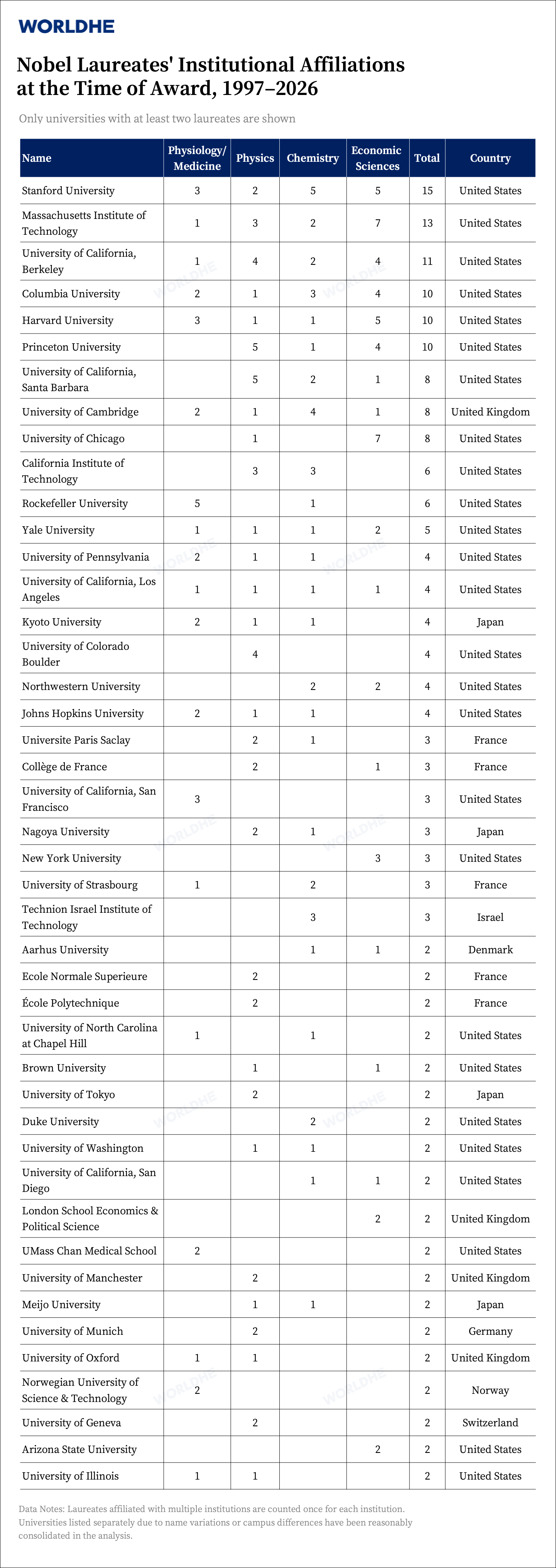
WorldHE examined the institutions where Nobel laureates were affiliated at the time of their awards, as well as their undergraduate, master’s and doctoral education, covering nearly three decades from 1997 to 2026. The data show that Nobel laureates during this period were affiliated with 108 universities at the time of their awards. All universities with 10 or more laureates were based in the United States.
Stanford University ranks first, with 15 laureates across the period: three in Physiology or Medicine, two in Physics, five in Chemistry and five in Economic Sciences. This year’s laureates Karl Deisseroth and Robert E. Hall were both affiliated with Stanford at the time of their awards.
The Massachusetts Institute of Technology (MIT) follows with 13 laureates, while the University of California, Berkeley has 11. Columbia University, Harvard University and Princeton University each have 10.
Looking at the Nobel categories separately reveals an even clearer picture of the distinct academic strengths of leading universities. In Physiology or Medicine, Rockefeller University ranks first with five laureates, reflecting its longstanding global influence in biomedical research. In Physics, the University of California, Santa Barbara and Princeton University share the top spot, with five laureates each. Stanford leads Chemistry with five laureates, while MIT and the University of Chicago dominate Economic Sciences, with seven laureates each.
Where Nobel Laureates Were Trained
The educational pathways of Nobel laureates present a considerably more diverse picture than their institutional affiliations at the time of the award.
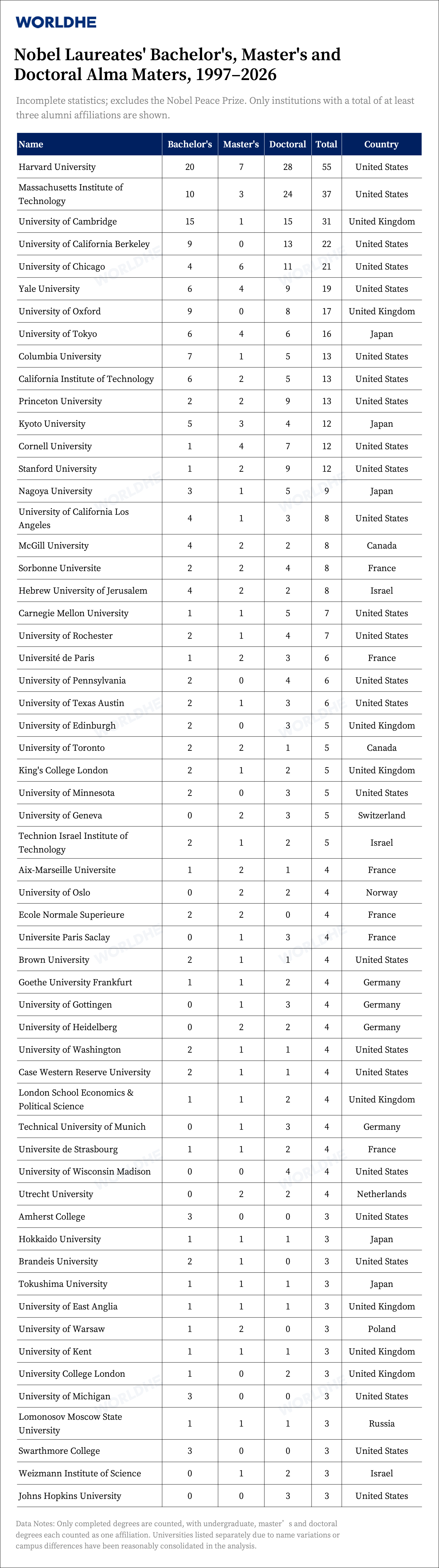
Over the past three decades, 222 universities and research institutions have educated Nobel laureates. Harvard University ranks first, with 55 alumni affiliations, including 20 bachelor’s-degree alumni and 28 doctoral alumni. Its presence at both the undergraduate and doctoral levels highlights its dual role in nurturing talent early in the academic journey and providing advanced research training.
MIT follows with 37 Nobel alumni affiliations, while the University of Cambridge has 31, the University of California, Berkeley 22, and the University of Chicago 21.
These institutions appear prominently in both the affiliation and alumni rankings. Their strength lies not only in developing sophisticated talent pipelines, but also in attracting leading researchers and providing the academic environments in which major discoveries can emerge.
The result is a self-reinforcing cycle: universities train exceptional researchers, attract outstanding talent, and sustain research ecosystems capable of producing high-impact discoveries. Over time, talent and research excellence reinforce one another, helping these institutions maintain a lasting presence on the global Nobel landscape.


TRENDING
From Training Talent to Winning Nobels: The Universities Behind the Laureates
Data & Rankings
MIT Overtakes Harvard as U.S. and China Dominate September Nature and Science Output
Data & Rankings
Getting Older, Crossing Disciplines: What Nobel Prize Data Reveal
Data & Rankings
Harvard Leads the Citation Laureates Rankings as Nobel Prize Season Approaches
Data & Rankings
Good University Guide 2027: St Andrews Takes No. 1 as Imperial Climbs Three Places
Data & Rankings