
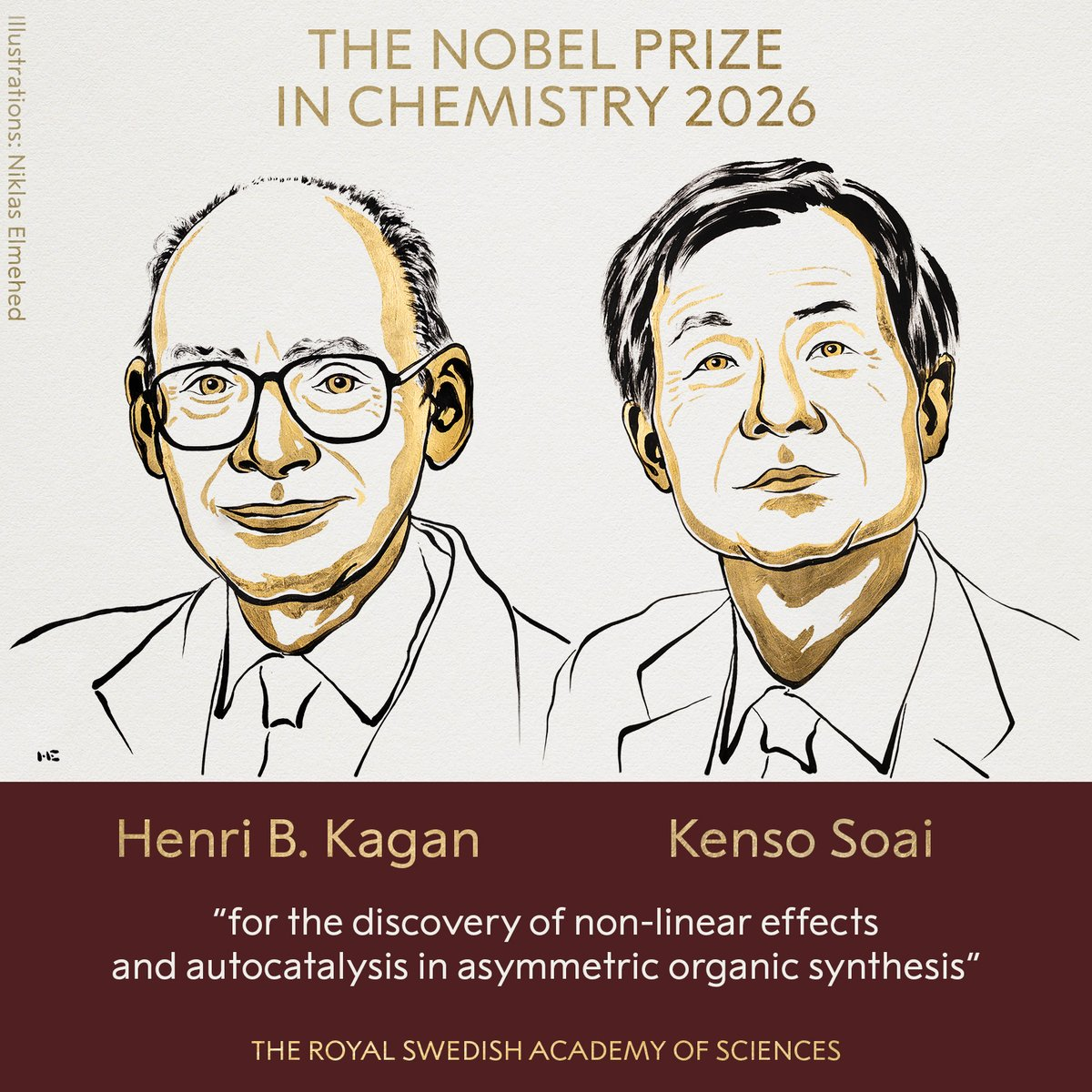
Henri B. Kagan and Kenso Soai Win 2026 Nobel Prize in Chemistry


The 2026 Nobel Prize in Chemistry has been awarded to Henri B. Kagan and Kenso Soai “for the discovery of non-linear effects and autocatalysis in asymmetric organic synthesis,” the Royal Swedish Academy of Sciences announced.
Kagan is affiliated with Université Paris-Sud in France, while Soai is affiliated with Tokyo University of Science in Japan.
According to the Nobel Prize website, molecules such as amino acids can exist as two mirror-image forms, yet living organisms use only one of them. How this chemical asymmetry emerged has long puzzled scientists. Kagan and Soai's research helped shed light on this fundamental question.
Henri B. Kagan
Born in 1930, Kagan is an emeritus professor at Université Paris-Sud and a pioneer in asymmetric catalysis, with research that has had a significant impact on pharmaceutical chemistry.
After studying at the University of Paris and the École Supérieure de Chimie de Paris, he completed doctoral research at the Collège de France. Among his major contributions was the development of C2-symmetric ligands, including DIOP, for asymmetric catalysis.
In 1986, Kagan identified non-linear effects in asymmetric catalysis and developed mathematical models to describe them. His work helped establish non-linear effects as an important area of chemical research, with implications for understanding asymmetric amplification and the origins of biological asymmetry.
Kenso Soai
Soai is a Japanese organic chemist and professor at Tokyo University of Science. He earned his PhD in organic synthesis from the University of Tokyo in 1979 under Teruaki Mukaiyama, followed by postdoctoral research at the University of North Carolina.
His research focuses on asymmetric synthesis, asymmetric autocatalysis and the origins of chirality. The Soai reaction, an asymmetric autocatalytic reaction named after him, has become an important example in research into how chemical asymmetry can emerge and amplify.
Soai has also held visiting positions at institutions including ESPCI Paris, Kyushu University, Waseda University, the University of Strasbourg and Jilin University.


TRENDING
Harvard Leads the Citation Laureates Rankings as Nobel Prize Season Approaches
Data & Rankings
Good University Guide 2027: St Andrews Takes No. 1 as Imperial Climbs Three Places
Data & Rankings
From Lasker to Nobel: The Universities Behind Biomedical Breakthroughs
Data & Rankings
Before the Nobel: Which Universities Are Leading in Biomedical Breakthroughs?
Data & Rankings
WorldHE NS Watch: Harvard, MIT and Stanford Lead Global Nature and Science Output in August
Data & Rankings