
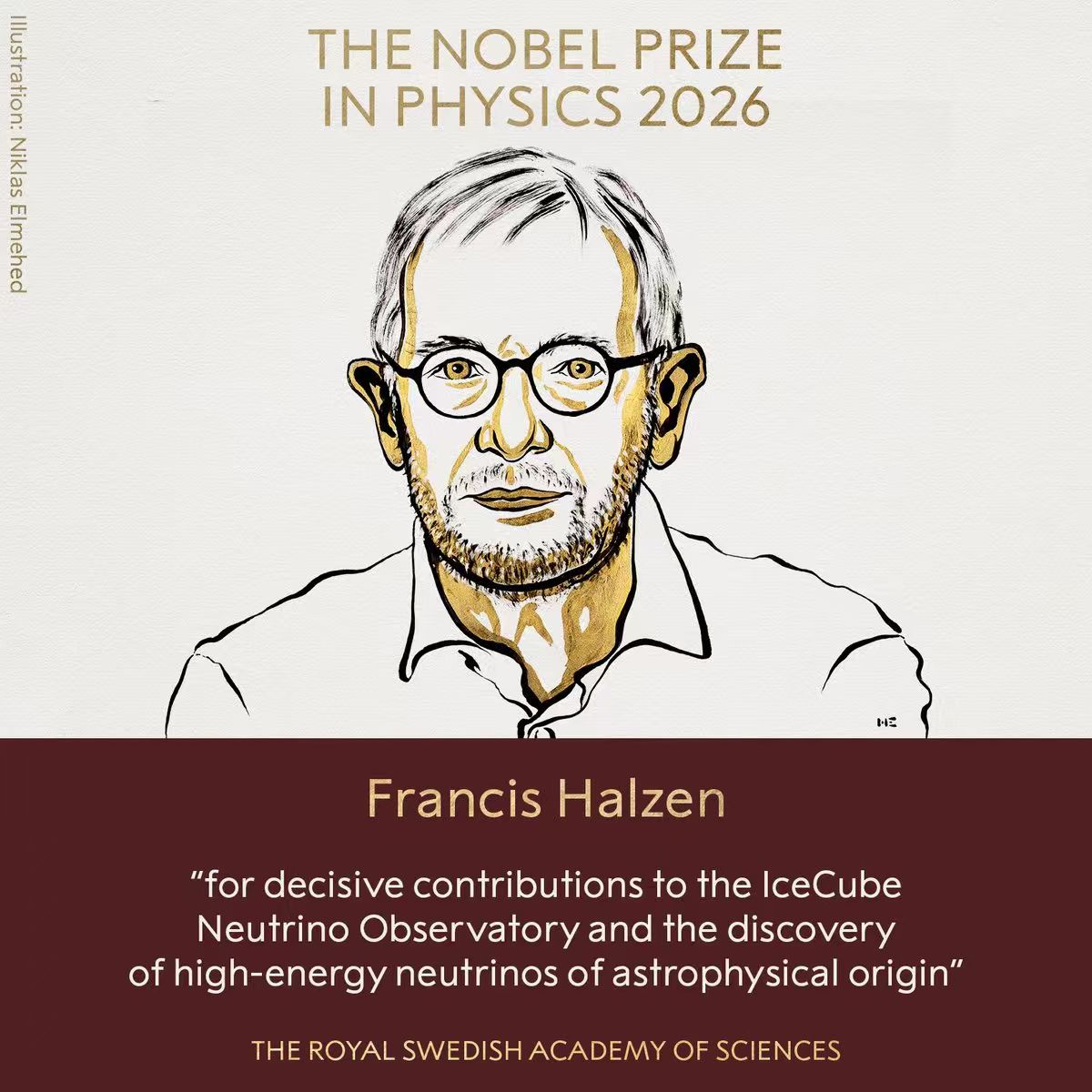
University of Wisconsin–Madison Physicist Francis Halzen Wins 2026 Nobel Prize in Physics


The 2026 Nobel Prize in Physics has been awarded to Francis Halzen for his decisive contributions to the IceCube Neutrino Observatory and the discovery of high-energy neutrinos of astrophysical origin, the Royal Swedish Academy of Sciences announced Tuesday.
Halzen, a professor at the University of Wisconsin–Madison, was recognized for his pioneering work in neutrino physics and his leadership in developing IceCube, the world’s largest neutrino observatory.
According to the Nobel Prize website, Halzen realized that the ice at the South Pole could be used to detect neutrinos, subatomic particles that can travel vast cosmic distances with little interaction with matter. His vision and scientific leadership were fundamental to the development of IceCube, a cubic-kilometer detector embedded in the Antarctic ice and equipped with light sensors.
The observatory enables researchers to detect neutrinos generated by some of the most energetic processes in the distant universe, providing a new way to study cosmic phenomena beyond the reach of conventional astronomical observations.
From Belgium to the South Pole
Born on March 23, 1944, in Tienen, Belgium, Halzen is a Belgian particle physicist and currently serves as the Hilldale and Gregory Breit Distinguished Professor of Physics at the University of Wisconsin–Madison. He also directs the university’s Institute for Fundamental Particle Physics Research and has served as the principal investigator of the IceCube project at the Amundsen–Scott South Pole Station in Antarctica.
IceCube began operating in 2010.
Halzen grew up in Belgium and studied physics at the University of Leuven, earning his master’s degree in 1966 and his PhD in 1969. He received a higher teaching qualification in 1972. From 1969 to 1971, he worked as a research associate at CERN.
He joined the University of Wisconsin–Madison in 1972 and has remained there throughout his academic career. He has also played a leading role in the AMANDA and IceCube projects.
A career spanning cosmic rays and particle astrophysics
Since the 1970s, Halzen has been a leading figure in the development of cosmic-ray physics and astroparticle physics.
His research has extended beyond particle physics to include cosmic-ray anomalies and quark matter, the connections between particle physics and cosmic rays, particles originating from supernovae, and muon production in atmospheric gamma-ray showers.
His work has helped establish neutrinos as a powerful tool for investigating some of the most energetic and distant phenomena in the universe, while bridging particle physics, astrophysics and cosmology.


TRENDING
Harvard Leads the Citation Laureates Rankings as Nobel Prize Season Approaches
Data & Rankings
Good University Guide 2027: St Andrews Takes No. 1 as Imperial Climbs Three Places
Data & Rankings
From Lasker to Nobel: The Universities Behind Biomedical Breakthroughs
Data & Rankings
Before the Nobel: Which Universities Are Leading in Biomedical Breakthroughs?
Data & Rankings
WorldHE NS Watch: Harvard, MIT and Stanford Lead Global Nature and Science Output in August
Data & Rankings