
Where Do Nobel Laureates Come From? Mapping the Global Universities Behind 30 Years of Medicine Prizes


The 2026 Nobel Prize season officially got underway on October 5, with the Nobel Prize in Physiology or Medicine announced as the first of this year’s awards.
The 2026 prize has been awarded to Karl Deisseroth, Peter Hegemann and Georg Nagel for their groundbreaking discoveries concerning light-gated ion channels and optogenetics.
Since the Nobel Prizes were first awarded in 1901, they have been guided by the principle of delivering “the greatest benefit to humankind.” As the Nobel Prize marks its 125th anniversary this year, the Nobel Foundation has also increased the prize money for each award to SEK 12 million, up SEK 1 million from the previous amount.
But behind every Nobel Prize is also a global network of universities and research institutions. Where were these scientists working when they received the world’s most prestigious scientific honor, and where did they receive their education?
To mark the Nobel Prize’s 125th anniversary, WorldHE has compiled data on the institutional affiliations and undergraduate, master’s and doctoral education of Nobel laureates over the past three decades, from 1997 to 2026. The analysis will be updated as each Nobel category is announced, offering a window into global patterns of university research, innovation and the cultivation of top scientific talent.
This article focuses on the Nobel Prize in Physiology or Medicine.
Rockefeller University leads in Nobel affiliations
Over the past 30 years, Nobel laureates in Physiology or Medicine have been affiliated with 41 universities at the time they received the prize.
Rockefeller University ranks first, with five laureates among its faculty or researchers at the time of their awards. Although Rockefeller is not a comprehensive university in the traditional sense and is relatively small in size, it has maintained an exceptionally strong global reputation in biomedical research.
Harvard University, the University of California, San Francisco (UCSF), and Stanford University follow, with three laureates each.
The University of Pennsylvania, Columbia University, the University of Cambridge, Kyoto University, UMass Chan Medical School, Norwegian University of Science and Technology (NTNU), and Johns Hopkins University each had two laureates.
The three 2026 laureates come from Stanford University, Humboldt University of Berlin and Julius-Maximilians-Universität Würzburg, respectively. For Humboldt University of Berlin and the University of Würzburg, this year’s award marks the first Nobel laureate associated with each institution in the past three decades.
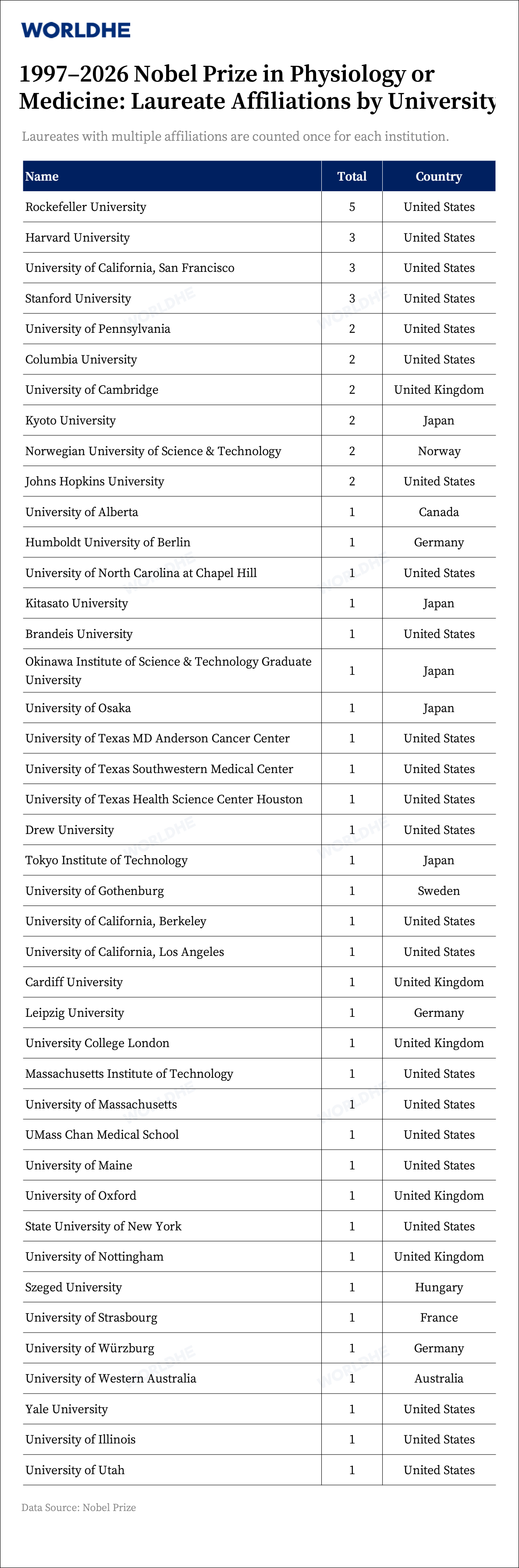
At the country level, US universities have a clear advantage. They account for roughly 60% of all university affiliations among laureates in the dataset. The US lead is driven not only by the number of institutions represented, but also by a pronounced concentration of Nobel-level research at a relatively small group of leading universities.
This concentration reflects several longstanding strengths of the US higher education and research system, including sustained investment in research, a high density of leading scientists and continued support for high-risk, fundamental research.
Outside the US, the UK and Japan also stand out.
UK universities account for six laureates in the dataset. Cambridge has two, while the University of Oxford, University College London, Cardiff University and the University of Nottingham each have one.
Japan also has six laureates. Kyoto University accounts for two, while Kitasato University, Okinawa Institute of Science and Technology, Osaka University and Tokyo Institute of Technology each account for one.
In both countries, top research achievements remain concentrated in a relatively small number of established academic centers, while the overall distribution also reflects considerable institutional diversity.
Harvard has educated the most Nobel laureates
If institutional affiliations show where Nobel-winning research was being conducted, alumni data offer a different perspective: where did these scientists begin their academic and research journeys?
Over the past 30 years, Nobel laureates in Physiology or Medicine have studied at 70 universities and research institutions.
Harvard University ranks first, with 10 laureate affiliations. Six of these were doctoral alumni, highlighting Harvard’s longstanding role in advanced research training and scientific talent development.
The University of Cambridge and the Massachusetts Institute of Technology follow with eight laureate affiliations each. The University of Texas at Austin and the University of Oxford each have five.
The University of Oslo, the University of California, Berkeley, the California Institute of Technology and McGill University each account for four.
US universities again occupy a leading position in the education of Nobel laureates, with approximately half of the laureates in the dataset having studied at US institutions. The UK and Japan follow, broadly mirroring the geographic distribution of the institutions where laureates were working when they received the prize.
The educational backgrounds of this year’s three laureates further illustrate the international nature of the academic pipeline.
Karl Deisseroth earned his undergraduate degree from Harvard University and his PhD from Stanford University.
Peter Hegemann initially studied chemistry at the University of Münster and the University of Munich before earning his doctorate at the Max Planck Institute of Biochemistry.
Georg Nagel studied biology and biophysics at the University of Konstanz and received his doctorate from Goethe University Frankfurt.
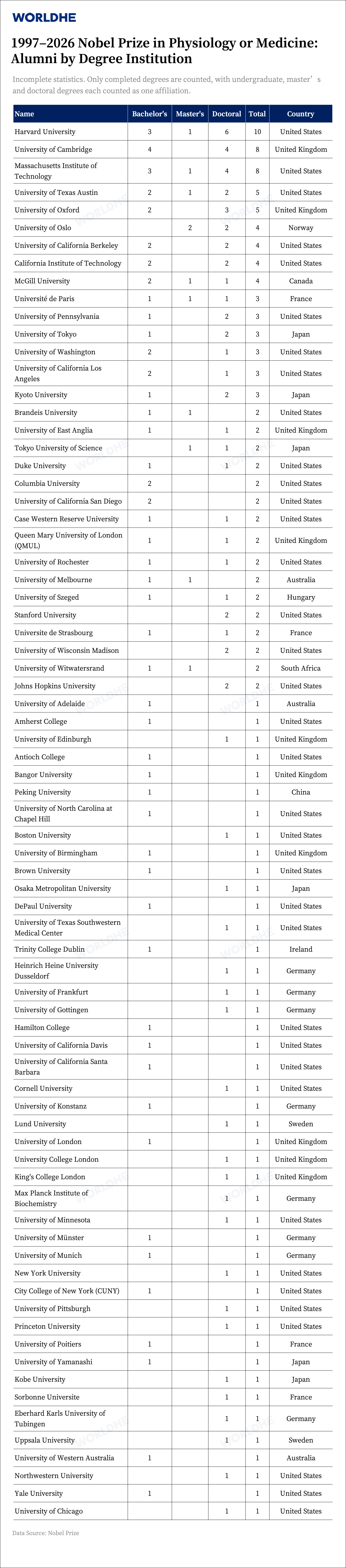
Notably, universities including Harvard, Cambridge, the University of Pennsylvania and Columbia appear prominently in both the institutional-affiliation and alumni rankings.
Their presence in both datasets points to a distinctive institutional strength: these universities are not only capable of training scientists who go on to make major discoveries, but also of attracting leading researchers and providing an environment in which high-impact research can continue to emerge.
Taken together, the data suggest that Nobel-level scientific achievement is shaped by more than individual talent. It also reflects the research ecosystems, talent pipelines and institutional capacity that universities build over decades.
Data notes
Institutional affiliations have been standardized where appropriate. When universities have undergone a clearly documented name change or merger, their current names are used. Where a historical institution has since split into multiple independent universities, the original institutional name has been retained.
For alumni data, only completed degrees are counted, with undergraduate, master’s and doctoral degrees each counted as one affiliation. If a laureate held appointments at multiple institutions at the time of receiving the Nobel Prize, each institution is counted separately.
The dataset was manually compiled and represents an incomplete rather than exhaustive record.


TRENDING
Harvard Leads the Citation Laureates Rankings as Nobel Prize Season Approaches
Data & Rankings
Good University Guide 2027: St Andrews Takes No. 1 as Imperial Climbs Three Places
Data & Rankings
From Lasker to Nobel: The Universities Behind Biomedical Breakthroughs
Data & Rankings
Before the Nobel: Which Universities Are Leading in Biomedical Breakthroughs?
Data & Rankings
WorldHE NS Watch: Harvard, MIT and Stanford Lead Global Nature and Science Output in August
Data & Rankings