

WorldHE NS Watch: UCAS Overtakes Cambridge as Global Research Rankings Shift


Last week, 49 universities worldwide published papers in Nature or Science. Two universities published three papers each, six published two each, and 41 published one, creating a pronounced long-tail distribution. Meanwhile, the rankings among the Top 10 universities by total Nature and Science output over the past year shifted, underscoring the dynamic nature of competition among the world’s leading research universities.
WorldHE continuously tracks the latest and rolling 12-month Nature and Science publication data from universities worldwide, offering a dynamic view of the evolving global higher education and research landscape.
Click here to access the complete university NS publication data.
Global University NS Publications: October 19–25, 2026
Of the 49 universities worldwide that published papers in Nature or Science last week, 16 were from the United States, 12 from China Mainland, six from Germany, and four from Australia. German universities once again delivered a particularly strong performance, marking their second consecutive week of standout research output.
Columbia University and the University of Chinese Academy of Sciences each published three NS papers last week. After publishing three Nature papers two weeks ago, Columbia continued its strong run with one Nature paper and two Science papers last week, giving it three NS publications in each of two consecutive weeks. All three papers from the University of Chinese Academy of Sciences were published in Nature.
Six universities published two NS papers each: Huazhong University of Science & Technology, the University of California, Berkeley, Tsinghua University, Washington University in St. Louis (WUSTL), Stanford University, and Indiana University Bloomington. All six are from the United States or China Mainland, further highlighting the continued leadership of the two countries in global research.
Another 41 universities published one NS paper each, forming a clear long tail in the global distribution.
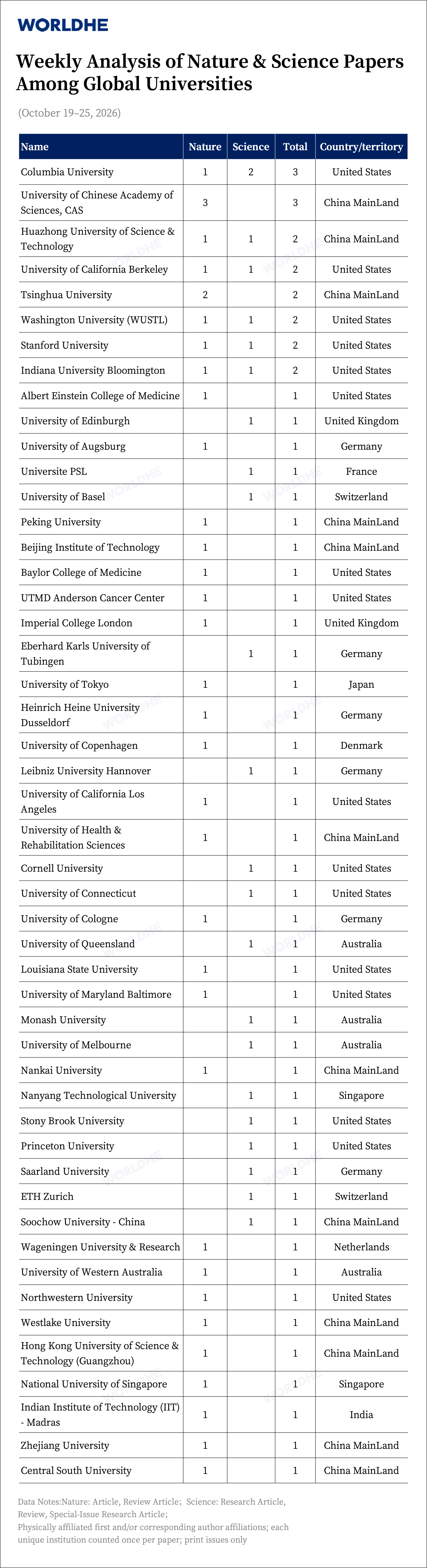
Global University NS Rankings: October 25, 2025–October 25, 2026
Over the rolling 12-month period, 62 universities worldwide have published at least 10 papers in Nature or Science, one fewer than in the previous period. The figures point to increasingly intense competition for high-impact research at the global level.
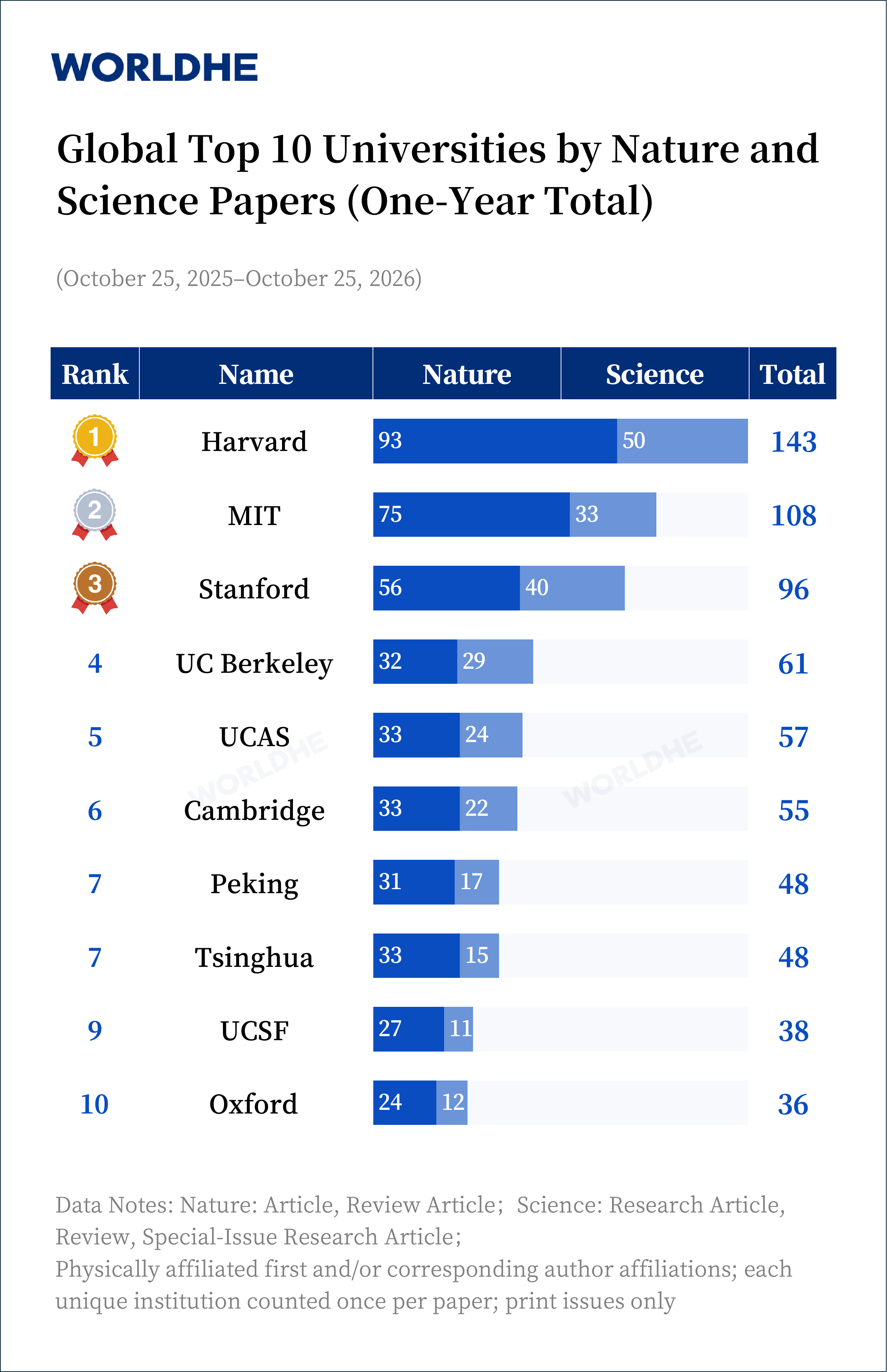
The Top 10 continues to comprise five universities from the United States, three from China Mainland, and two from the United Kingdom. While this three-country structure at the top remains unchanged, the rankings among individual universities have shifted, highlighting the dynamic evolution of competition among the world’s leading research institutions.
Harvard University remains the clear global leader with 143 NS papers, including 93 in Nature and 50 in Science. It ranks first among all universities in publication output in both journals. MIT also remains above the 100-paper mark, with 108 papers, ranking second globally. Stanford University follows with 96 papers. Together, Harvard, MIT, and Stanford form a firmly established elite research cluster at the 100-paper level and above.
The University of California, Berkeley ranks fourth with 61 NS papers, including 32 in Nature and 29 in Science, maintaining a relatively balanced publication profile across the two journals.
The University of Chinese Academy of Sciences rises to fifth place with 57 papers, overtaking the University of Cambridge, which has 55. UCAS is now the highest-ranked non-U.S. university in the global rankings. Cambridge ranks sixth.
Tsinghua University climbs one place to seventh with 48 papers, tying Peking University. The University of California, San Francisco and the University of Oxford retain their positions at ninth and tenth, respectively.
Click here to access the complete university NS publication data.
Methodology
For Nature, only publications classified as Article and Review Article were included. For Science, the analysis includes Research Article, Special-Issue Research Article, and Review.
Only the physically affiliated first author was counted as the first author. All corresponding-author affiliations were included, with each affiliated institution counted once. If the first-author institution and the corresponding-author institution were the same, the publication was counted only once for that institution.
Only formally published articles were included in the analysis. Advance online publications and papers in pre-publication status were excluded.


TRENDING
The Global Higher Education Map Is Shifting: The Universities on the Rise — and in Retreat
Data & Rankings
The Global Higher Education Map Is Changing: Winners, Rising Powers and New Entrants
Data & Rankings
MIT Overtakes Harvard as U.S. and China Dominate September Nature and Science Output
Data & Rankings
From Training Talent to Winning Nobels: The Universities Behind the Laureates
Data & Rankings
Getting Older, Crossing Disciplines: What Nobel Prize Data Reveal
Data & Rankings