
The Global Higher Education Map Is Changing: Winners, Rising Powers and New Entrants


The globally recognised QS World University Rankings, Times Higher Education (THE) World University Rankings and U.S. News Best Global Universities rankings provide an important window into the changing landscape and global standing of universities.
With the release of the latest THE World University Rankings, all three major global university rankings for this year are now available. QS ranked a total of 1,504 universities, compared with 2,297 in THE and 2,250 in U.S. News.
What new patterns are emerging in this year’s global university rankings? Which universities have performed consistently strongly across all three rankings? Which countries and regions have produced the most impressive results? And which institutions have continued to climb over the past several years, emerging as new forces in the global higher education landscape?
To answer these questions, WorldHE has systematically analysed the latest data from the three major global rankings and tracked changes in universities’ positions over the past five years. By looking at the rankings from multiple angles, we aim to provide a panoramic view of the global university landscape.
This article begins by examining the latest picture of global university rankings.
A Three-Way Contest at the Top
The concentration of universities at the very top of the global rankings is even more striking than might be expected. Only 33 universities rank among the top 50 in all three rankings.
These institutions are also heavily concentrated in a small number of countries and territories. The United States accounts for the largest share, with 14 universities, followed by the United Kingdom with six and mainland China with five. Hong Kong SAR, Singapore and Canada each have two, while Australia and Switzerland each have one.
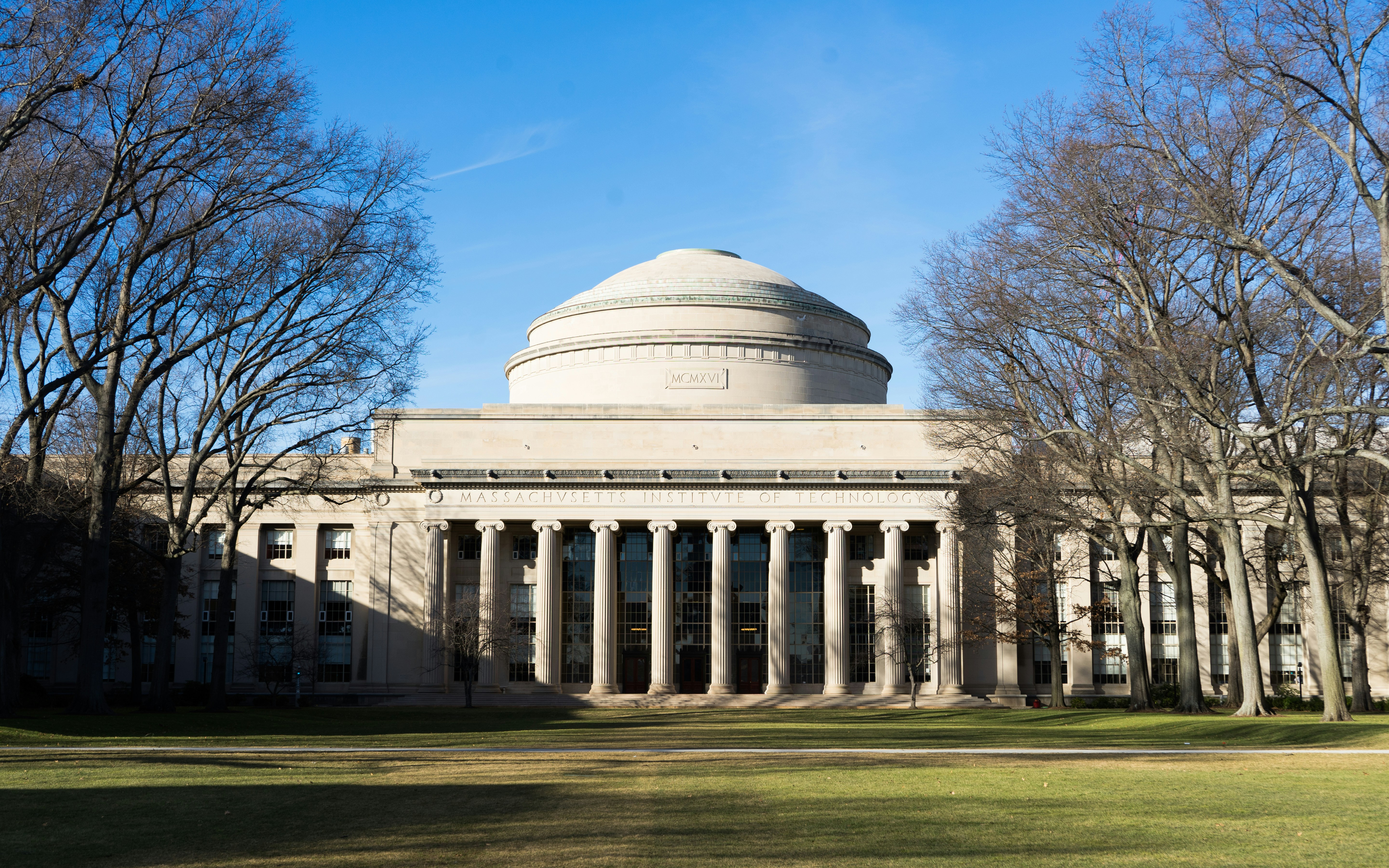
MIT, Stanford and Oxford are the only universities to rank consistently within the top five across all three rankings, underlining their exceptional overall strength.
MIT ranks No. 1 in QS and No. 2 in both THE and U.S. News, making it the only university to remain in the top two across all three rankings. Stanford places second or third in each ranking. Oxford tops the THE ranking, making it the only European university to dislodge a U.S. institution from the No. 1 spot; it ranks fourth in both QS and U.S. News.
Harvard, meanwhile, falls just outside the top five in THE, where it ranks sixth, but receives particularly strong recognition from U.S. News, which places it No. 1 globally. Cambridge also remains firmly within the top 10 across all three rankings, ranking sixth in QS and fifth in both THE and U.S. News.
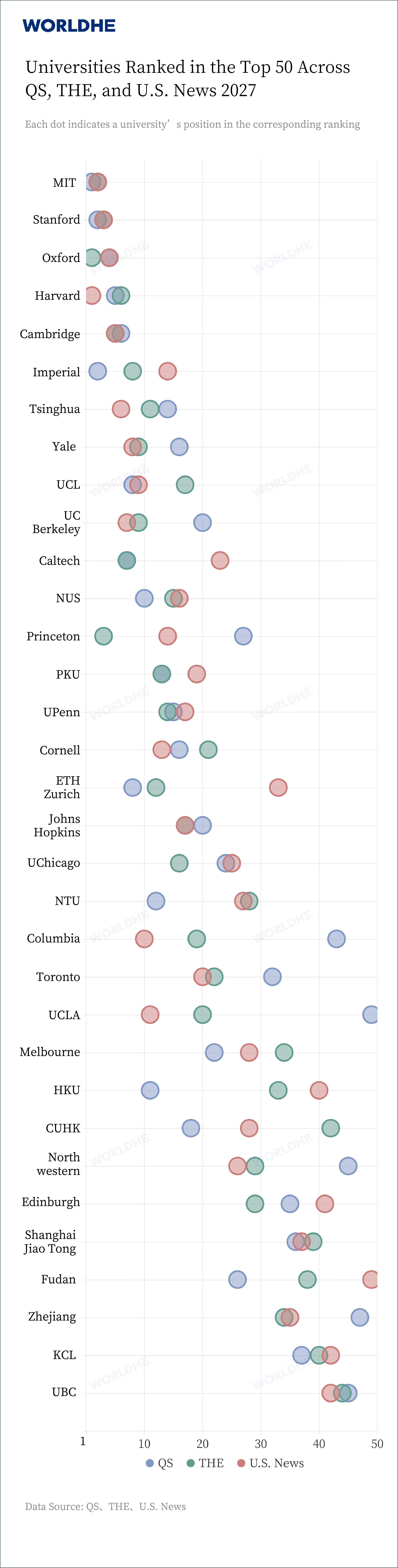
Yet the rankings also reveal some striking divergences. The position of the same university can vary dramatically depending on the ranking methodology.
Imperial College London, for example, ranks second in QS but only 14th in U.S. News — a gap of 12 places. Carnegie Mellon University ranks 24th in THE but falls to 112th in U.S. News. The difference is even more pronounced for École Polytechnique: it ranks 43rd in QS but 328th in U.S. News, a staggering 285-place gap.
These sharp differences reflect the fundamentally different methodologies used by the three rankings. QS places relatively greater weight on employer reputation and internationalisation. U.S. News places greater emphasis on academic reputation and research output, with a particularly strong focus on comprehensive research universities producing large volumes of research in leading journals. THE, meanwhile, seeks to strike a balance between teaching and research.
Imperial College London’s rise from sixth place in the previous QS ranking to second this year illustrates how changes in methodology can align with an institution’s existing strengths. In 2023, QS introduced the largest methodological overhaul in the ranking’s history, shifting greater emphasis from traditional measures of academic reputation towards employment outcomes and internationalisation.
Imperial’s longstanding strengths in applied fields such as engineering, technology and medicine align closely with these priorities, making the institution one of the clearest beneficiaries of the methodological shift.
A Highly Uneven Global Higher Education Landscape
Looking beyond the very top universities reveals an even more nuanced picture of global higher education.
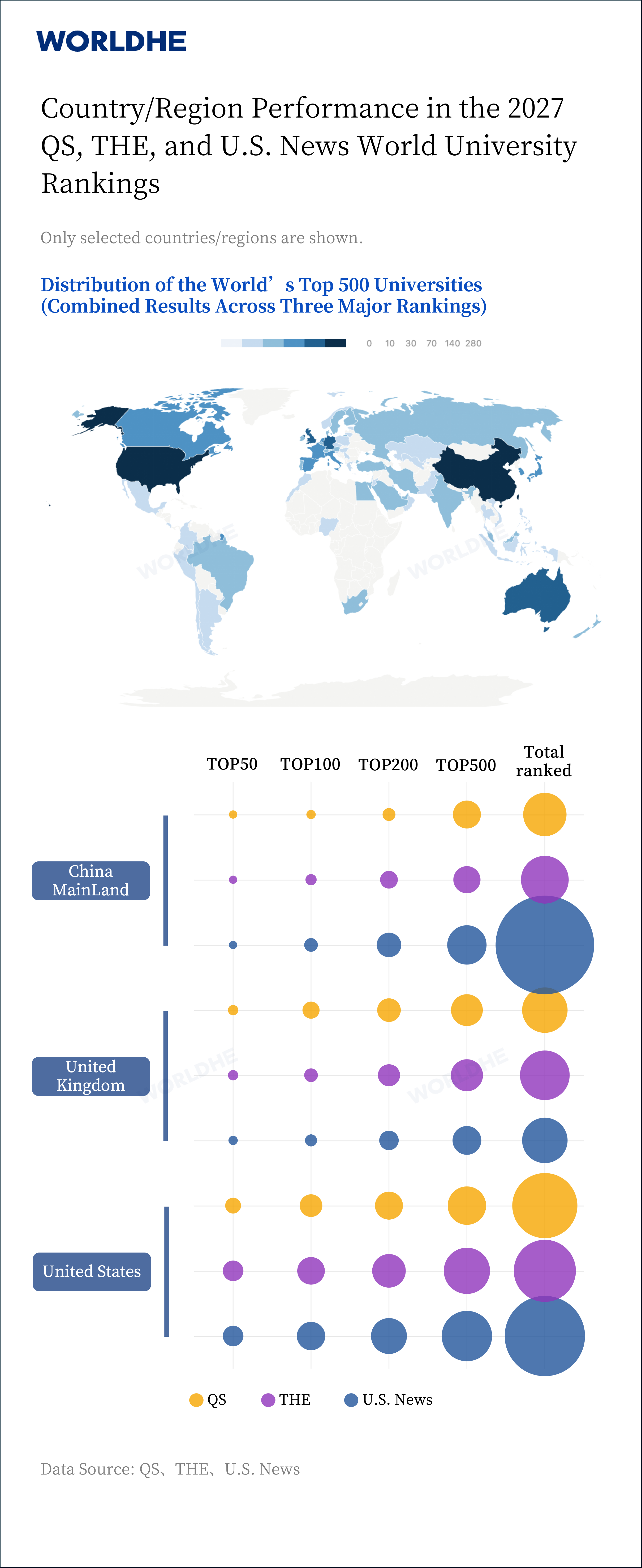
The United States dominates both the number of universities represented in the three rankings and their positions within them. U.S. universities account for 14 of the top 50 in QS, 22 in THE and 22 in U.S. News.
America’s advantage, however, extends well beyond its elite institutions. Across the top 50, 100, 200 and 500 of all three rankings, the number of U.S. universities is substantially higher than that of any other country — in most cases, more than twice that of the second-ranked country. The figures underline the United States’ exceptional depth and breadth across the global higher education system.
The United Kingdom follows the U.S. among the leading systems. Seven British universities make the top 50 in both QS and THE, while six are in the U.S. News top 50. Oxford, Cambridge, Imperial College London and University College London remain consistently positioned among the world’s leading universities across the major rankings.
Australia presents a different pattern. Its total number of ranked universities remains relatively modest, at around 37–38 across the three rankings, but its leading institutions are highly concentrated near the top. Six Australian universities make the QS top 50 and five make the U.S. News top 50. In THE, however, only one Australian university reaches the top 50, with the University of Sydney and UNSW Sydney falling just outside the threshold.
Universities in mainland China are perhaps the most notable rising force across the rankings. Tsinghua University, Peking University, Shanghai Jiao Tong University, Fudan University and Zhejiang University all remain within the top 50 across the three rankings, demonstrating the continued strength of China’s leading research universities.
More importantly, the number of mainland Chinese universities appearing in the top 100, 200 and 500 of all three rankings has continued to increase year on year. The trend is particularly striking in the U.S. News ranking, where mainland Chinese universities now outnumber British universities at every major ranking tier, behind only the United States.
China’s global competitiveness in higher education is therefore no longer concentrated solely in a handful of elite institutions. Its leading universities are increasingly forming a broader and more substantial base of globally competitive institutions.
Hong Kong SAR, the Netherlands, Switzerland and Singapore represent another model: relatively small higher education systems with a remarkably high concentration of strong institutions.
In the QS ranking, Hong Kong SAR has 10 universities listed, four of which make the top 50. All 12 Dutch universities included in the THE ranking are placed within the global top 500, with 10 reaching the top 200. Of the 12 Swiss universities ranked by U.S. News, seven place within the top 200. Singapore has only three or four universities represented across the three rankings, yet two consistently rank among the global top 50.
India presents a striking contrast. It has a large number of universities represented in the three rankings — 52 in QS, 143 in THE and 123 in U.S. News. Yet only 11 Indian universities make the top 500 in QS, just three in THE and none in U.S. News.
The contrast points to a major structural challenge: while India has a large and expanding pool of ranked institutions, relatively few have yet achieved strong positions in the global rankings. In other words, India’s higher education system has considerable scale, but world-class institutions remain comparatively scarce.
Data note: All data are sourced from the official QS, THE and U.S. News World University Rankings. Five-year changes are calculated based on the difference in ranking positions between the 2023 and 2027 editions. The analysis is based on quantifiable ranking data and does not constitute a comprehensive assessment of the overall strength of individual universities.


TRENDING
The Global Higher Education Map Is Shifting: The Universities on the Rise — and in Retreat
Data & Rankings
The Global Higher Education Map Is Changing: Winners, Rising Powers and New Entrants
Data & Rankings
MIT Overtakes Harvard as U.S. and China Dominate September Nature and Science Output
Data & Rankings
From Training Talent to Winning Nobels: The Universities Behind the Laureates
Data & Rankings
Getting Older, Crossing Disciplines: What Nobel Prize Data Reveal
Data & Rankings