

The Global Higher Education Map Is Shifting: The Universities on the Rise — and in Retreat


The global higher education landscape is undergoing a systemic transformation, with one of its clearest early signals appearing in the changing fortunes of universities in the global rankings.
The QS World University Rankings, Times Higher Education (THE) World University Rankings and U.S. News Best Global Universities rankings have now all been released for this year. In a previous analysis, WorldHE examined the new global university landscape revealed by the three rankings. This article takes a different perspective, focusing on how universities’ positions have changed over the past five years.
Russian Universities See Sharp Declines in QS Rankings
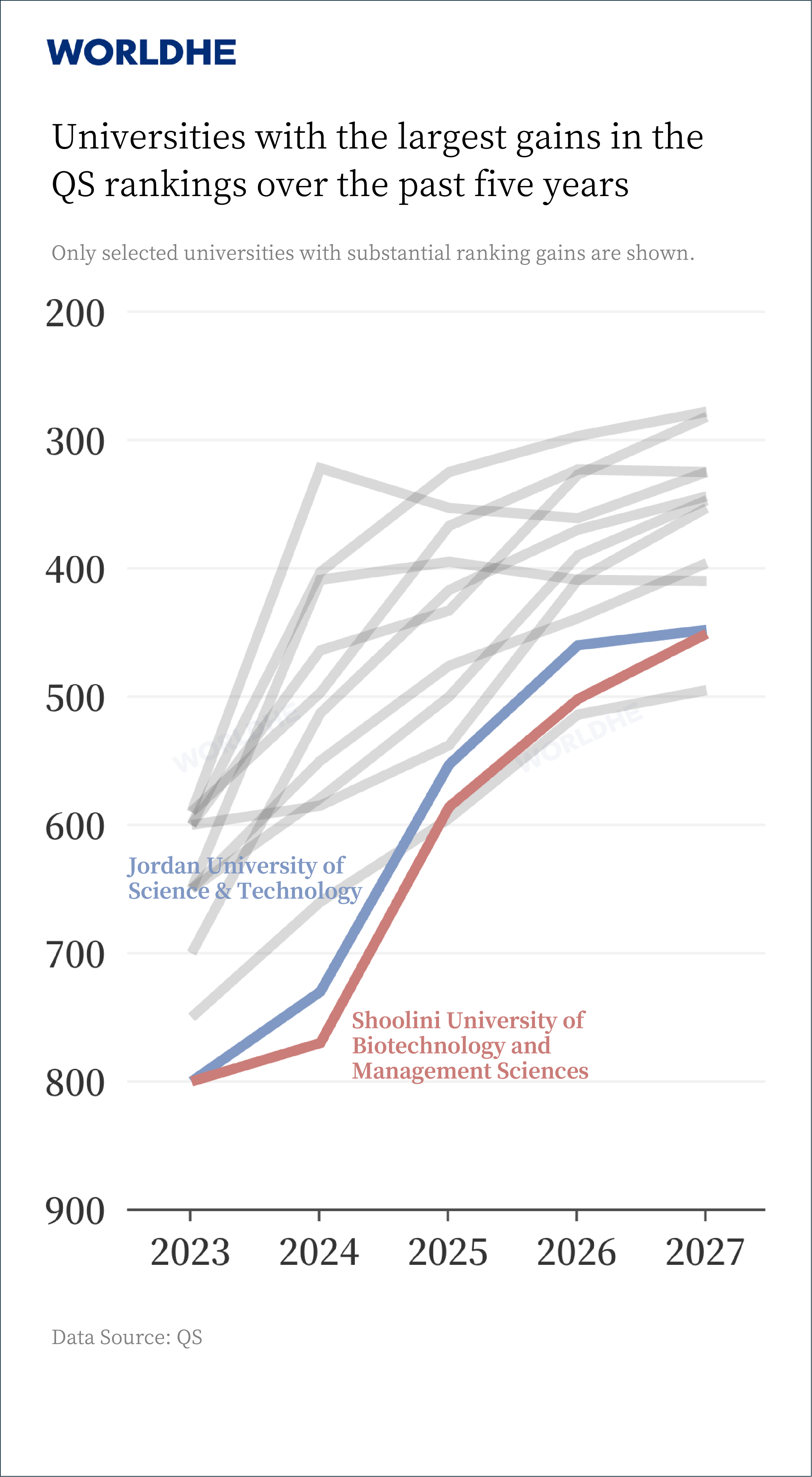
Among universities in the QS top 500, some of the fastest climbers over the past five years are from emerging higher education systems.
Jordan’s Jordan University of Science and Technology recorded one of the most dramatic rises, moving from the 801–1000 band in 2023 to 449th place, breaking into the global top 500. India’s Shoolini University of Biotechnology and Management Sciences likewise climbed from the 801–1000 band into the top 500.
Universities in Türkiye and the United Arab Emirates have also made substantial gains, with several institutions rising by more than 300 places amid increased investment in research and efforts to attract international academic talent.
The changes are even more striking among the QS top 100. Saudi Arabia’s King Fahd University of Petroleum & Minerals (KFUPM) recorded the largest improvement, rising from 160th to 63rd — a gain of 97 places. The rise comes against a backdrop of sustained government investment in higher education.
Ireland’s University College Dublin also made significant progress, climbing from 181st to 100th. Its near-continuous upward trajectory over the five-year period reflects the longer-term benefits of Ireland’s internationalisation strategy within the European higher education framework.
The picture is markedly different in Russia, where several universities have experienced substantial declines. Novosibirsk State University fell 228 places, while Kazan (Volga Region) Federal University dropped 146 places.
Switzerland’s USI – Università della Svizzera italiana declined by 216 places, highlighting the increasingly intense competition from universities around the world.
Japanese universities have also experienced a broad-based decline. Of the 12 Japanese universities in the QS top 500, all except Waseda University recorded downward movements. Hiroshima University suffered the steepest fall, dropping 143 places.
Mainland Chinese Universities Surge in U.S. News Rankings
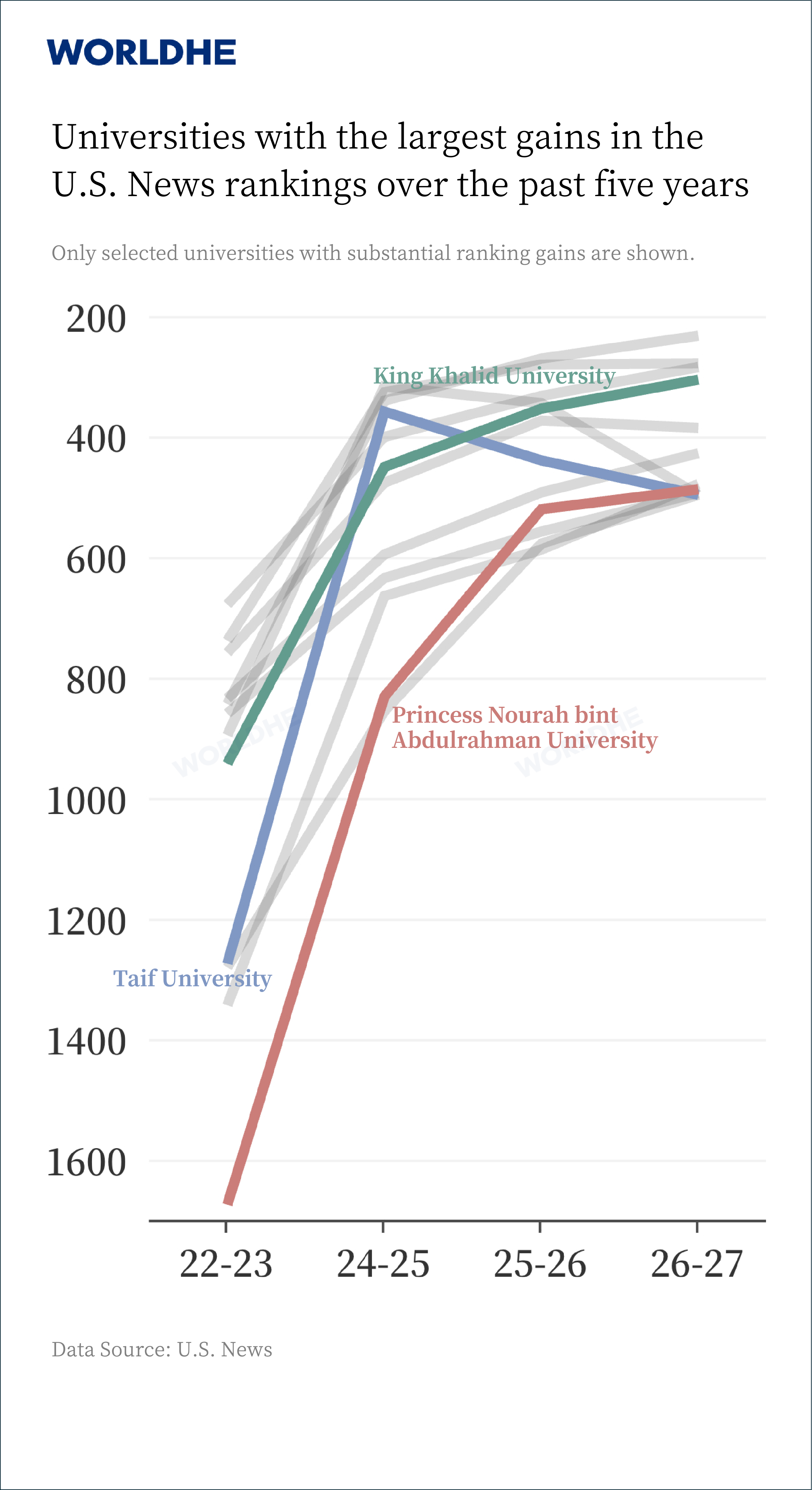
The U.S. News top 500 shows particularly strong upward momentum among universities in the Middle East.
Saudi Arabia’s Princess Nourah bint Abdulrahman University rose from 1,675th to 488th, a remarkable gain of 1,187 places. Taif University climbed 778 places, while King Khalid University gained 637 places.
In the United Arab Emirates, University of Sharjah, United Arab Emirates University and Khalifa University of Science and Technology all improved by more than 300 places.
The scale and speed of these gains may reflect a combination of recent policies across the region, including the recruitment of high-level international faculty, research partnerships with leading universities worldwide and performance-based incentives for research publication.
Among the U.S. News top 100, mainland Chinese universities have emerged as a particularly strong upward force. All 11 mainland Chinese universities in the top 100 have recorded notable gains over the five-year period.
Fudan University climbed from 116th to 49th, a gain of 67 places, breaking into the global top 50. Wuhan University rose 65 places to remain within the top 100, while Zhejiang University and Shanghai Jiao Tong University each gained more than 50 places, moving into the global top 40.
The rise of Tsinghua University is perhaps the most symbolic. It climbed from 23rd to sixth, entering the global top 10 for the first time. Its rise challenges the long-standing pattern in which the U.S. and UK dominated the U.S. News global top 10, and signals that China’s leading universities have firmly entered the ranks of the global elite.
City University of Hong Kong also made a notable leap, rising 73 places to 47th — the largest gain among universities in the U.S. News top 100.
The trend is again reversed among a number of U.S. universities. University of Oregon fell 176 places, University of New Mexico declined 160 places, and Iowa State University dropped 137 places.
These declines come amid broader changes affecting U.S. higher education, including fluctuations in international student enrolment, changes in the allocation of federal research funding and budget pressures facing some public universities.
Asian and Middle Eastern Universities Continue to Rise in THE
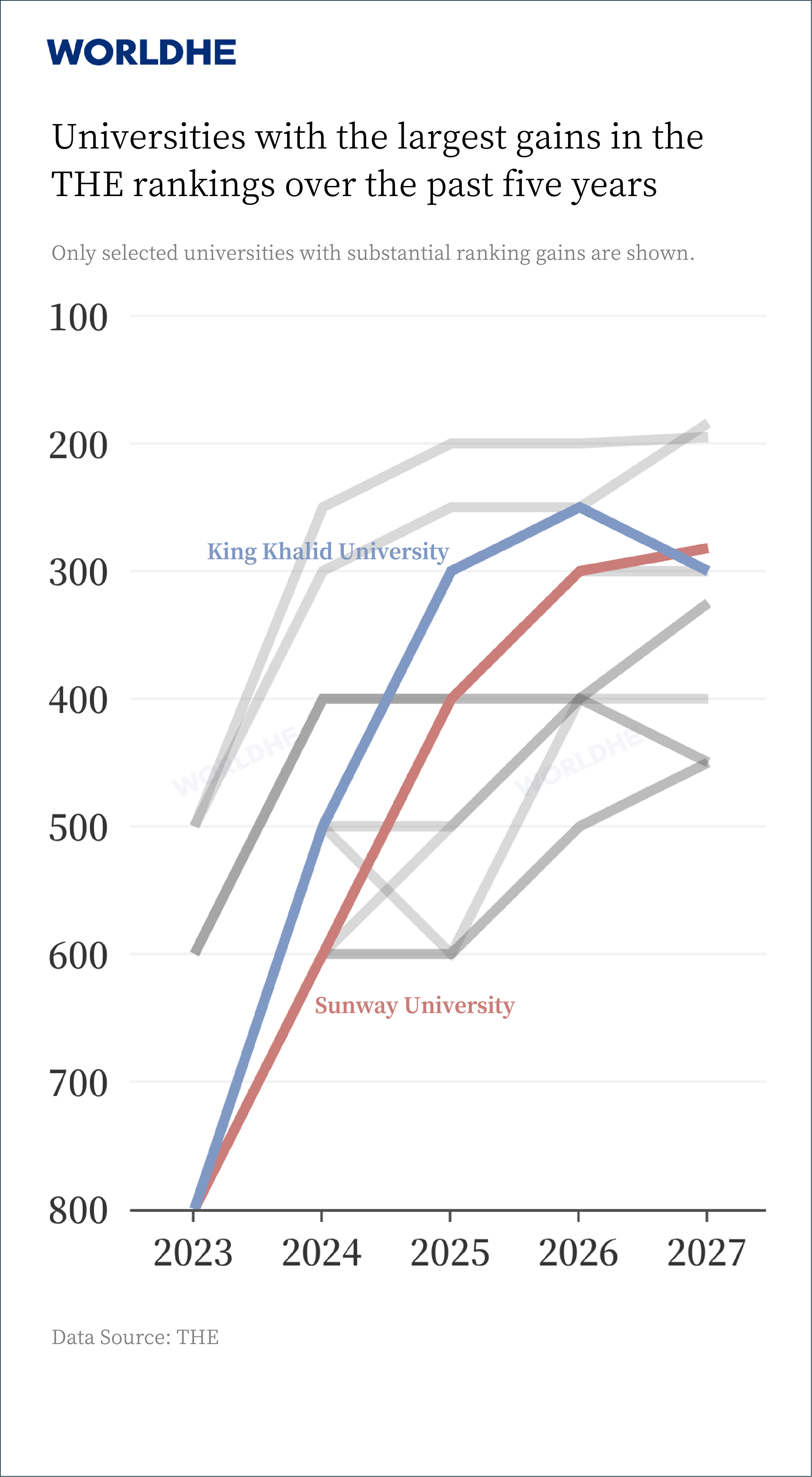
The THE top 500 presents another picture of shifting momentum, with universities in Asia and the Middle East making some of the strongest gains.
Malaysia’s Sunway University recorded the largest improvement, rising by roughly 600 places over five years. Saudi Arabia’s King Khalid University also made a substantial leap, moving from the 801–1000 band to 301–325.
Mainland Chinese universities, meanwhile, have emerged as the most systematic source of upward momentum in the THE rankings over the past five years.
A total of 32 Chinese universities improved their positions, with 26 gaining more than 30 places and an average improvement of 161 places.
Donghua University and Northeastern University both moved from the 801–1000 band into the 451–500 range. Beihang University climbed from the 501–600 band into the global top 200, reaching 185th place.
By contrast, many mid-tier universities in traditional destinations for international students — including the United States, Australia, the UK, France and Belgium — have remained broadly flat or slipped modestly.
In the United States, University of South Florida (Tampa) fell from the 201–250 band to 401–450. Australia’s University of Canberra dropped from 251–300 to 401–450, while the UK’s University of Dundee declined from 201–250 to 326–350.
As these institutions lose ground, their positions are increasingly being taken by universities in Asia and the Middle East.
A Shift in the Geography of Global Higher Education
The academic centre of gravity in global higher education is undergoing a meaningful geographical shift.
The rise and fall of universities across the three major rankings offers a window into the different trajectories of higher education systems around the world. But rankings are never an end in themselves. A change in the weighting of a single indicator can produce substantial swings in institutional positions.
Rankings are perhaps best understood as moving markers rather than fixed measures of institutional strength — useful for identifying broad trends, but prone to sudden changes as methodologies evolve.
For universities, the more important challenge is therefore not simply to move up the rankings, but to find a sustainable strategic direction amid a rapidly changing global higher education landscape.
Data note
All data are sourced from the official QS, THE and U.S. News World University Rankings. Five-year changes are calculated based on the difference in ranking positions between the 2023 and 2027 editions. The analysis is based on quantifiable ranking data and does not constitute a comprehensive assessment of the overall strength of individual universities.


TRENDING
The Global Higher Education Map Is Shifting: The Universities on the Rise — and in Retreat
Data & Rankings
The Global Higher Education Map Is Changing: Winners, Rising Powers and New Entrants
Data & Rankings
MIT Overtakes Harvard as U.S. and China Dominate September Nature and Science Output
Data & Rankings
From Training Talent to Winning Nobels: The Universities Behind the Laureates
Data & Rankings
Getting Older, Crossing Disciplines: What Nobel Prize Data Reveal
Data & Rankings