
Michigan’s 15 Public Universities Lose 5,223 Students as Enrollment Hits Decade Low


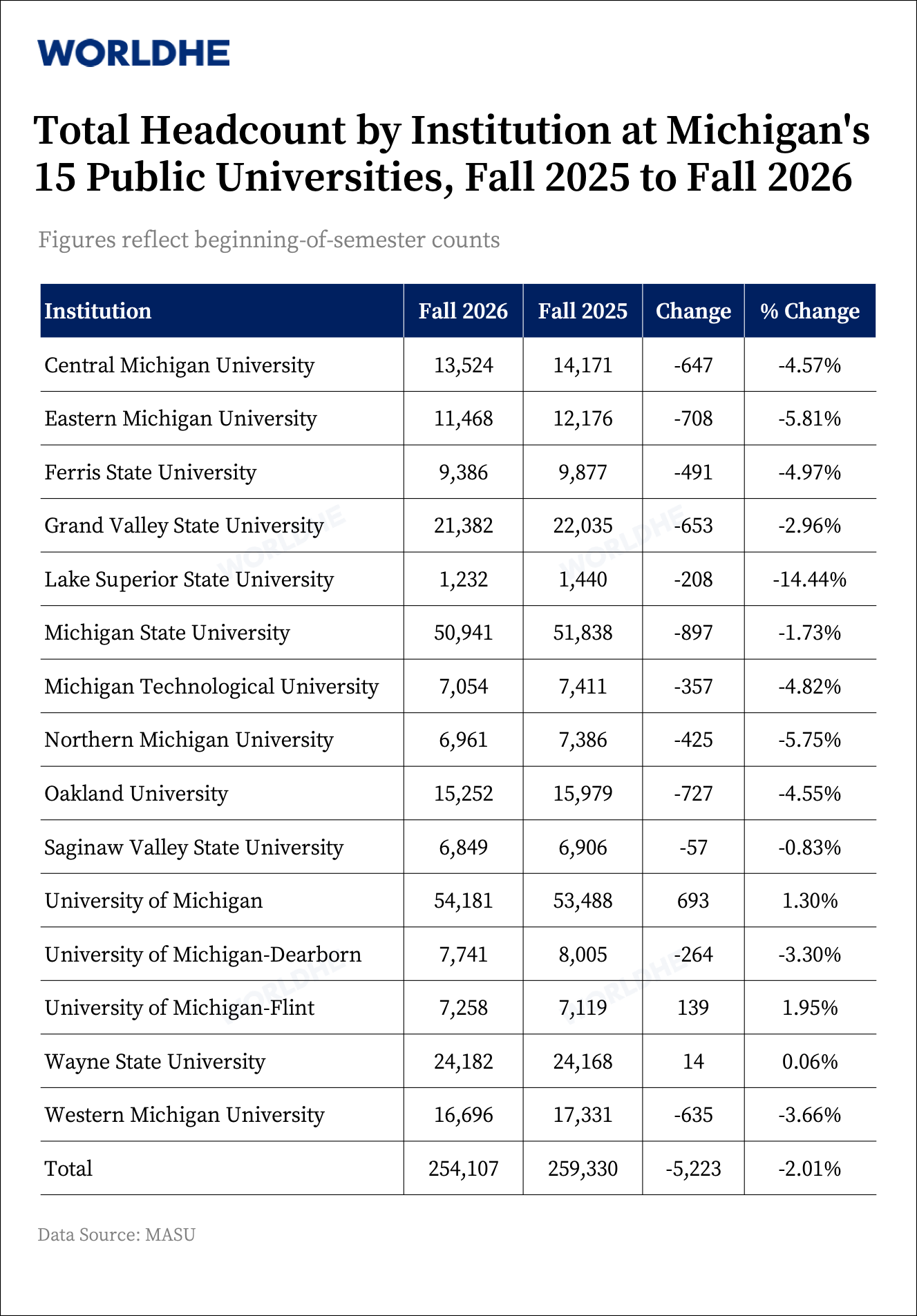
Enrollment at Michigan's 15 public universities fell by 5,223 students, or 2%, this fall, according to preliminary figures that put total headcount at its lowest level in at least a decade and reverse a modest recovery the sector had built since 2022.
This fall's headcount was 254,107, down from 259,330 in fall 2025, the Michigan Association of State Universities reported Oct. 21. The decline erases the 1.1 percent gain the system posted between 2022 and 2025, when enrollment climbed from 256,396 to 259,330. Over the past decade, enrollment across the 15 institutions has fallen 12.6 percent, or 36,631 students, from 290,738 in fall 2017.
Only three institutions grew. The University of Michigan added 693 students, or 1.3 percent, to reach 54,181 — a record for the Ann Arbor campus. UM-Flint added 139 students, or 1.95 percent, to 7,258, and Wayne State University edged up by 14 students, a 0.06 percent increase, to hold essentially flat at 24,182.
The other 12 institutions all lost ground. Lake Superior State University, the smallest of the 15, posted the steepest percentage decline, falling 14.4 percent from 1,440 to 1,232 students. Michigan State University recorded the largest loss in absolute terms, shedding 897 students, or 1.7 percent, to 50,941 — a single-institution drop larger than the combined gains at all three growing campuses, which totaled 846.
Eastern Michigan University fell 708 students, or 5.8 percent; Oakland University lost 727, or 4.6 percent; Central Michigan University lost 647, or 4.6 percent; and Northern Michigan University lost 425, or 5.8 percent. Five other institutions declined between 3 and 5 percent.
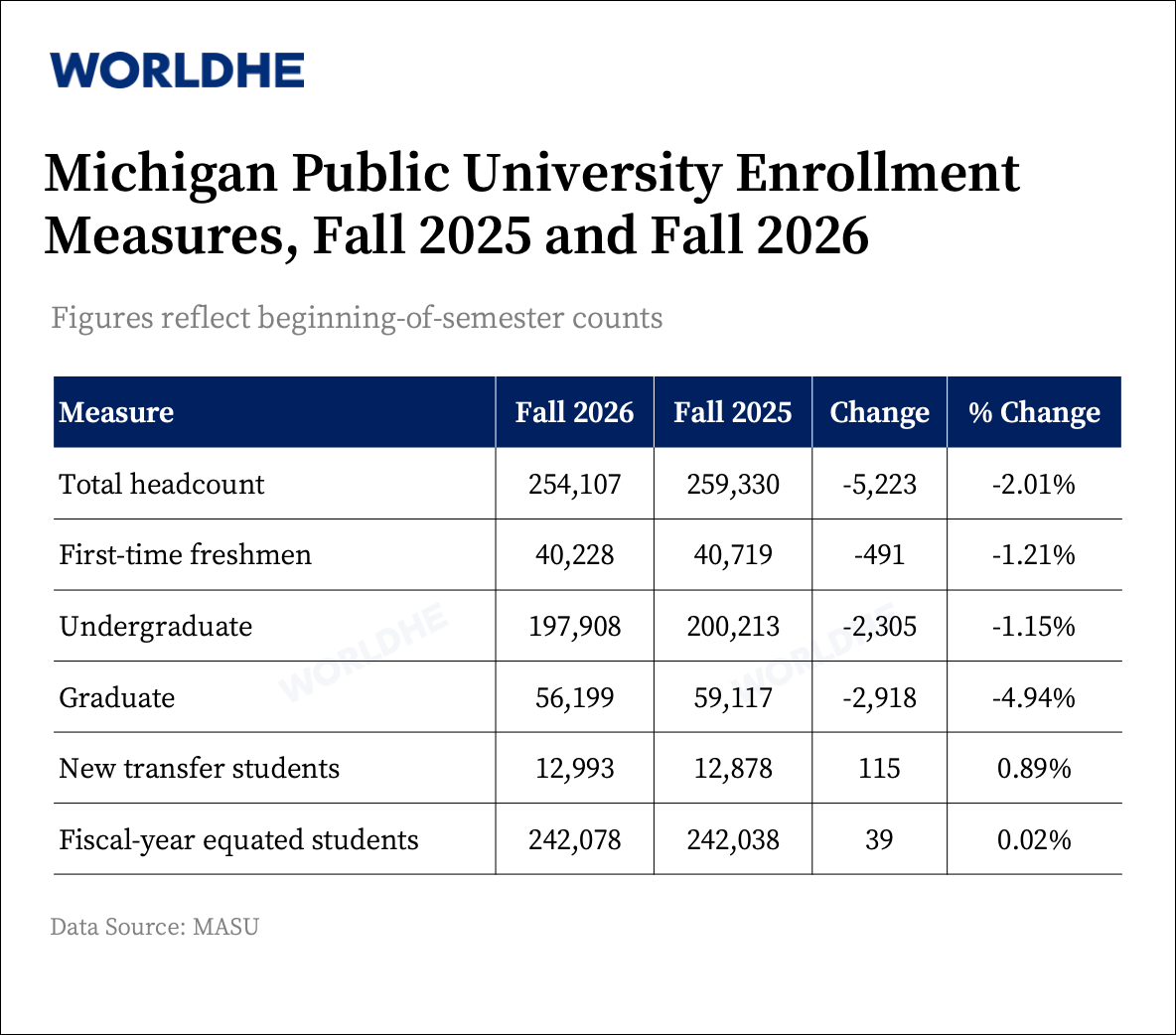
Graduate programs absorbed the heaviest losses. Graduate headcount fell by 2,918 students, or 4.9 percent, to 56,199 — a decline roughly four times the 1.2 percent drop among undergraduates, who fell by 2,305 to 197,908. Only UM-Flint, which rose from 1,585 to 1,649, and Saginaw Valley State University, which rose from 543 to 552, added graduate students. First-time freshmen declined 1.2 percent to 40,228.
Two indicators moved in the opposite direction. New transfer students rose 0.9 percent to 12,993, and fiscal-year equated students — a measure that better reflects tuition revenue than headcount — was essentially flat at 242,078, up just 39. The gap suggests the losses were concentrated among part-time and non-full-time students, muting the immediate revenue impact below what the headline decline implies.
Daniel Hurley, chief executive of MASU, attributed the drop to two structural forces: a shrinking pipeline of high school graduates — "certainly not unique to Michigan; most states are affected by an aging demographic" — and federal visa policy that has alternately halted and slowed international enrollment, a key source of graduate students. He called that policy "remarkably short-sighted," with "negative implications for higher ed, for students, for employers, for innovation."
Hurley said state investments such as the Michigan Achievement Scholarship had kept the decline from being steeper. "If the state hadn't more robustly partnered with these institutions, these figures would be much more austere with implications for the state's social and financial ecosystem," he said. But he acknowledged a "visibility issue," noting that higher education is cheaper now than 15 years ago while it has a higher return on investment — a case he said has not been fully made to young adults, parents or the state at large.
The outlook points lower still. WICHE, the Western Interstate Commission for Higher Education, projects Michigan's high school graduating classes will shrink by about one-fifth between 2023 and 2041. Hurley said national comparison data have not been released, but he expects Michigan to outperform its regional peers. "Other Midwestern states would likely love to be where Michigan is at," he said.


TRENDING
The Global Higher Education Map Is Shifting: The Universities on the Rise — and in Retreat
Data & Rankings
The Global Higher Education Map Is Changing: Winners, Rising Powers and New Entrants
Data & Rankings
MIT Overtakes Harvard as U.S. and China Dominate September Nature and Science Output
Data & Rankings
From Training Talent to Winning Nobels: The Universities Behind the Laureates
Data & Rankings
Getting Older, Crossing Disciplines: What Nobel Prize Data Reveal
Data & Rankings