
Harvard leads new National Academy of Medicine members with 13 elected


The US National Academy of Medicine (NAM) has elected 90 regular members and 10 international members, recognising researchers, clinicians and other leaders for contributions to health, medicine and public health.
The new members were announced on 19 October during NAM’s annual meeting. Election to the academy is considered one of the highest honours in the health and medical sciences and recognises individuals who have demonstrated outstanding professional achievement and a commitment to service.
“I am thrilled to welcome these outstanding health and medicine leaders into the National Academy of Medicine,” said NAM president Monica M. Bertagnolli.
“Their extraordinary talent and commitment to advancing evidence-based guidance and solutions for our country’s greatest health care challenges will strengthen our efforts to improve health for all,” she said.
New members are elected by existing NAM members through a process that recognises major contributions to medical science, healthcare and public health.
The newly elected members bring NAM’s total membership to more than 2,600, including more than 200 international members.
Harvard leads university affiliations
Harvard University had the largest number of newly elected regular members, with 13 individuals associated with the university and its affiliated hospital system.
Johns Hopkins University had seven new regular members, followed by the University of Pennsylvania with six and Columbia University with five.
The University of Colorado Anschutz and the University of Washington each had four new members, while the University of California, Los Angeles (UCLA) and the University of California, San Francisco (UCSF) each had three.
The university affiliations illustrate the strong representation of major US academic medical centres among the new NAM members. Many researchers and physicians at leading universities also hold appointments at affiliated hospitals and health systems.

International members span nine universities
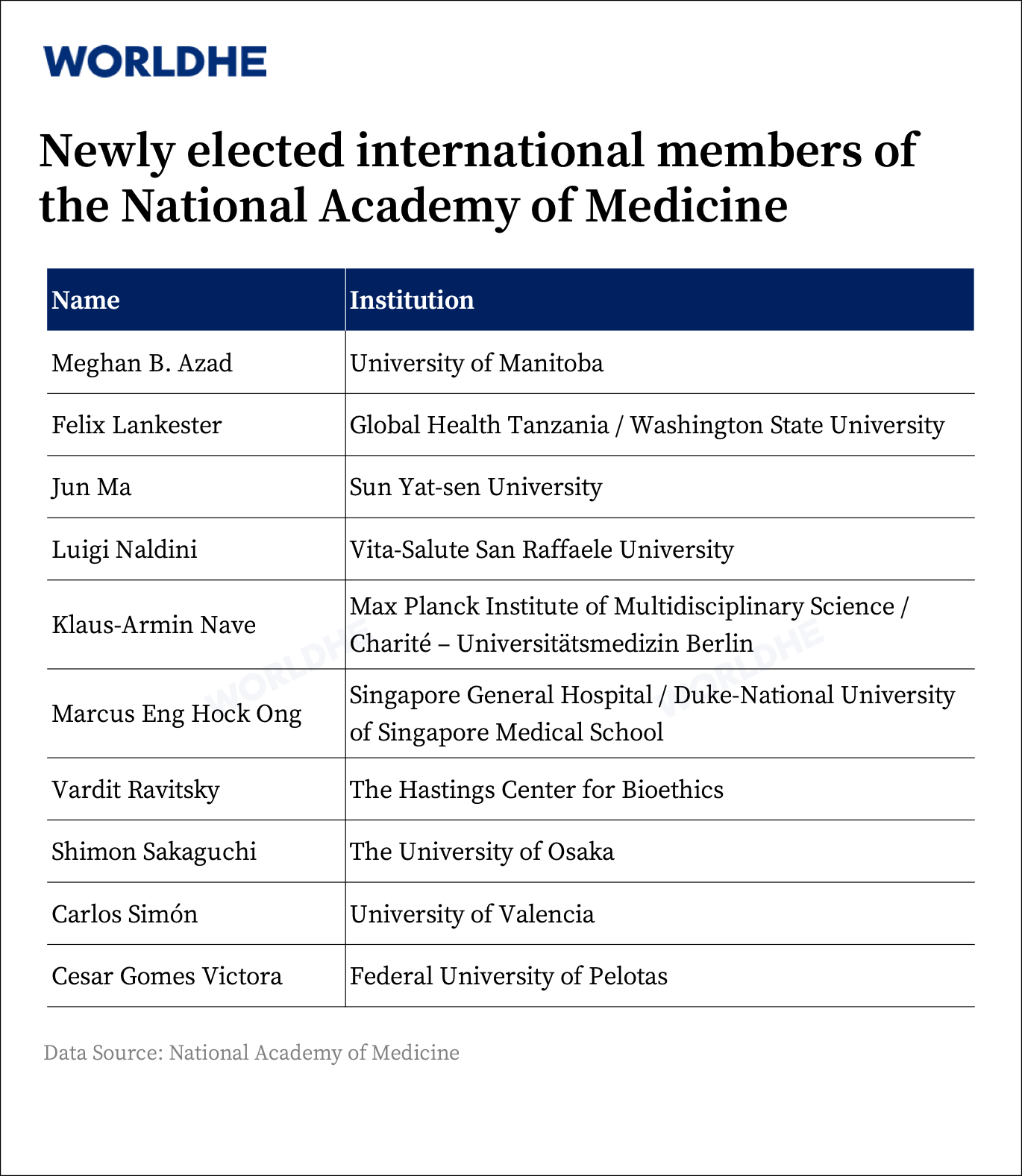
The 10 newly elected international members are affiliated with universities and medical institutions across North America, Europe and Asia.
Their affiliations include the University of Manitoba, Washington State University, Sun Yat-sen University, Vita-Salute San Raffaele University, Charité – Universitätsmedizin Berlin, Duke-NUS Medical School, the University of Osaka, the University of Valencia and the Federal University of Pelotas.
The international cohort reflects NAM’s broader global membership and includes expertise spanning medicine, public health, biomedical research and related fields.
NAM’s membership is intentionally designed to draw expertise from beyond the health professions. Its Articles of Organization require at least one-quarter of members to come from fields outside the health professions, including law, engineering, social sciences and the humanities.
Founded in 1970 as the Institute of Medicine by the National Academy of Sciences, NAM is one of three US national academies, alongside the National Academy of Sciences and National Academy of Engineering.
The academies provide independent analysis and advice on major issues in science, medicine, health and public policy. They also support education and research, recognise significant contributions to knowledge and seek to strengthen public understanding of science, technology, engineering and mathematics.
Election to NAM also carries a commitment to contribute voluntary service to activities of the National Academies, including work to inform policy and address complex challenges in health and medicine.


TRENDING
The Global Higher Education Map Is Shifting: The Universities on the Rise — and in Retreat
Data & Rankings
The Global Higher Education Map Is Changing: Winners, Rising Powers and New Entrants
Data & Rankings
MIT Overtakes Harvard as U.S. and China Dominate September Nature and Science Output
Data & Rankings
From Training Talent to Winning Nobels: The Universities Behind the Laureates
Data & Rankings
Getting Older, Crossing Disciplines: What Nobel Prize Data Reveal
Data & Rankings