
WorldHE NS Watch: Harvard and MIT Publish Five NS Papers in One Week


As global competition in scientific research continues to intensify, publication output in Nature and Science has become one of the key benchmarks for evaluating a university's capacity for original innovation and its international academic influence.
WorldHE continuously tracks the latest weekly and rolling 12-month publication data from universities worldwide, using Nature and Science output to provide a dynamic view of the evolving global higher education and research landscape.
Click here to access the complete university NS publication data.
Global University NS Publications: August 3–9, 2026
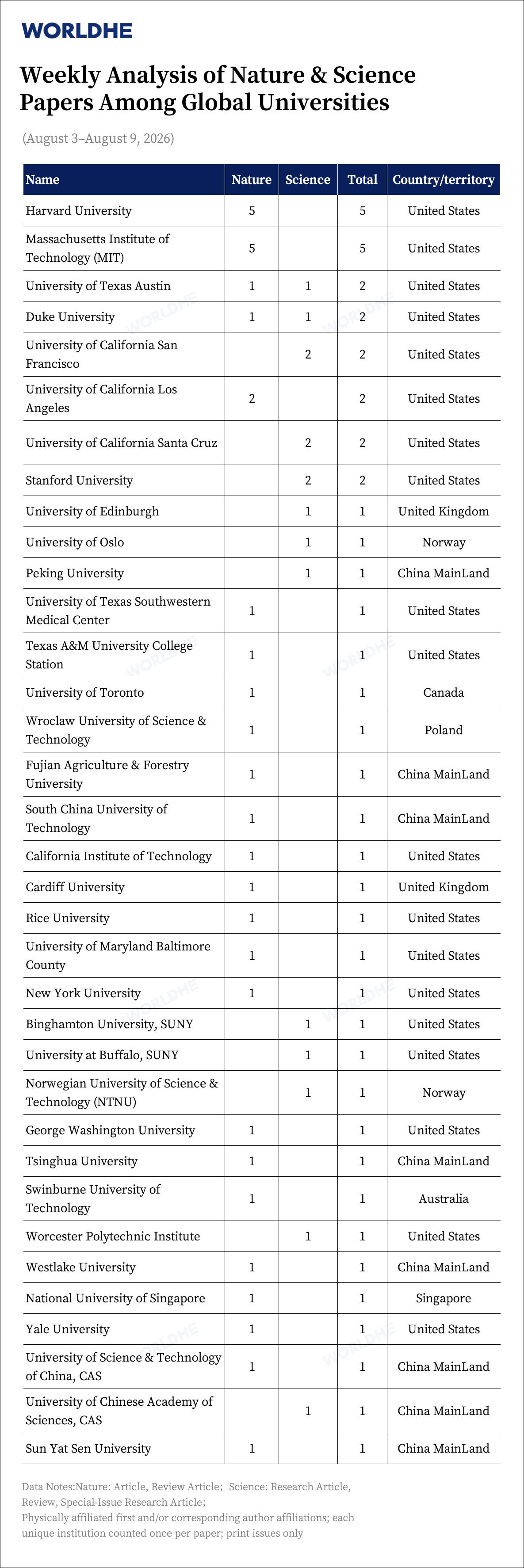
Global university output in Nature and Science eased slightly from the surge seen the previous week, with 35 universities publishing NS papers.
The United States accounted for 19 of them, far ahead of other countries and regions. China Mainland contributed eight universities, maintaining its strong position in high-impact research output.
Harvard University and the Massachusetts Institute of Technology (MIT), two of the United States' leading research universities, each published papers in Nature, contributing to a combined five Nature papers during the week.
Notably, four of the five papers came from the Broad Institute of MIT and Harvard, covering cutting-edge areas including targeted protein degradation, cancer functional genomics, cancer modeling, and neuroimmunology. The output highlights the Broad Institute's global standing as a leading research center in biotechnology.
The University of Texas at Austin, Duke University, the University of California, San Francisco, the University of California, Los Angeles, the University of California, Santa Cruz, and Stanford University each published two NS papers during the week.
All two papers from UC San Francisco, UC Santa Cruz, and Stanford were published in Science, making their weekly performance particularly notable.
Global University NS Rankings: August 9, 2025–August 9, 2026
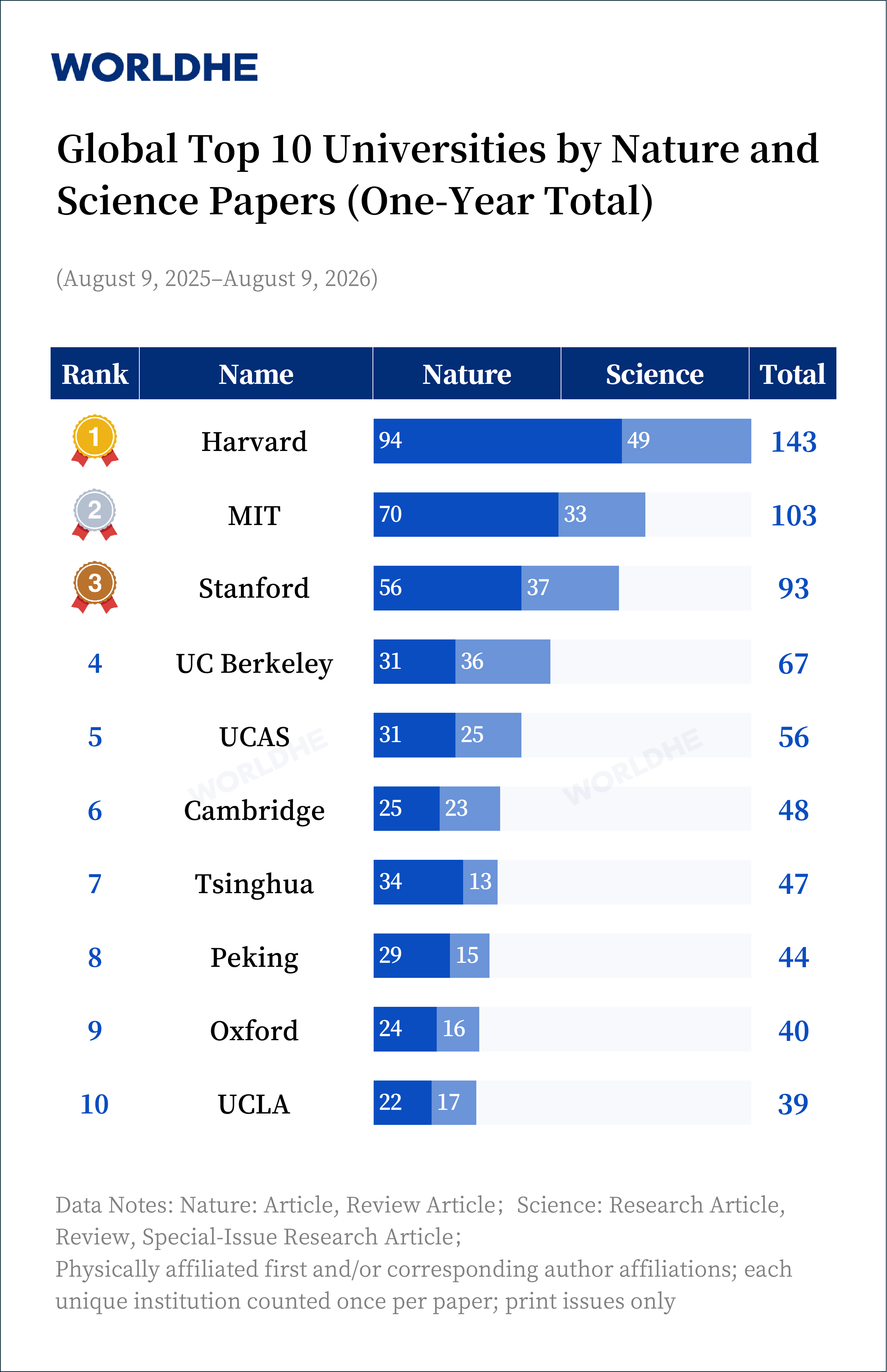
Over the past 12 months, 68 universities worldwide have published at least 10 papers in Nature or Science, underscoring the increasingly intense competition among leading research institutions.
Among the Top 10 universities by combined Nature and Science output, the United States accounts for five institutions, China Mainland for three, and the United Kingdom for two, forming the current leading tier of global top-journal publishing.
Harvard University remains the clear global leader with 143 papers, including 94 in Nature and 49 in Science. Harvard leads all universities in publication output in both journals. It was also the corresponding-author institution on 140 papers, meaning Harvard researchers served as corresponding authors on nearly every publication—an indication of its exceptional capacity for independent research leadership.
MIT has now surpassed the 100-paper mark, ranking second globally with 103 papers. Stanford University followed with 93 papers, putting the three institutions together in an elite research cluster at or near the 100-paper level.
The University of California, Berkeley ranked fourth with 67 NS papers. Although its overall output remains below the top three, Berkeley is the only university in the global top 10 to publish more Science papers (36) than Nature papers (31). Its Science output ranks second among universities, behind only Harvard, reflecting its long-standing strengths in astrophysics, neuroscience, and evolutionary biology.
The University of Chinese Academy of Sciences, a university in China Mainland, ranked fifth globally with 56 papers, making it the highest-ranked non-U.S. university.
The University of Cambridge ranked sixth with 48 papers, followed by Tsinghua University with 47. Peking University, the University of Oxford, and the University of California, Los Angeles (UCLA) also placed among the global top 10.
Click here to access the complete university NS publication data.
Methodology
For Nature, only publications classified as Article and Review Article were included. For Science, the analysis includes Research Article, Special-Issue Research Article, and Review.
Only the physically affiliated first author was counted as the first author. All corresponding-author affiliations were included, with each affiliated institution counted once. If the first-author institution and the corresponding-author institution were the same, the publication was counted only once for that institution.
Only formally published articles were included in the analysis. Advance online publications and papers in pre-publication status were excluded.
Further Reading
WorldHE NS Watch: 165 Universities Published in Nature and Science in July


TRENDING
Where Fields Medalists Studied and Worked?
Data & Rankings
Which Universities Are Producing the Next Nobel Laureates? The Breakthrough Prize Offers Some Clues
Data & Rankings
MIT Tops QS World Rankings for 15th Straight Year
Data & Rankings
Harvard Tops U.S. News Global University Rankings
Data & Rankings
2026 Fields Medal Winners Announced: Four Mathematicians Honored
Research & Innovation