
WorldHE NS Watch: 165 Universities Published in Nature and Science in July


Nature and Science, the world's most influential and authoritative multidisciplinary scientific journals, have long served as the premier platforms for publishing major scientific discoveries and breakthrough research.
WorldHE continuously tracks the latest and annual publication data of universities worldwide in Nature and Science (NS), offering a unique lens through which to observe the evolving landscape of global higher education and scientific research.
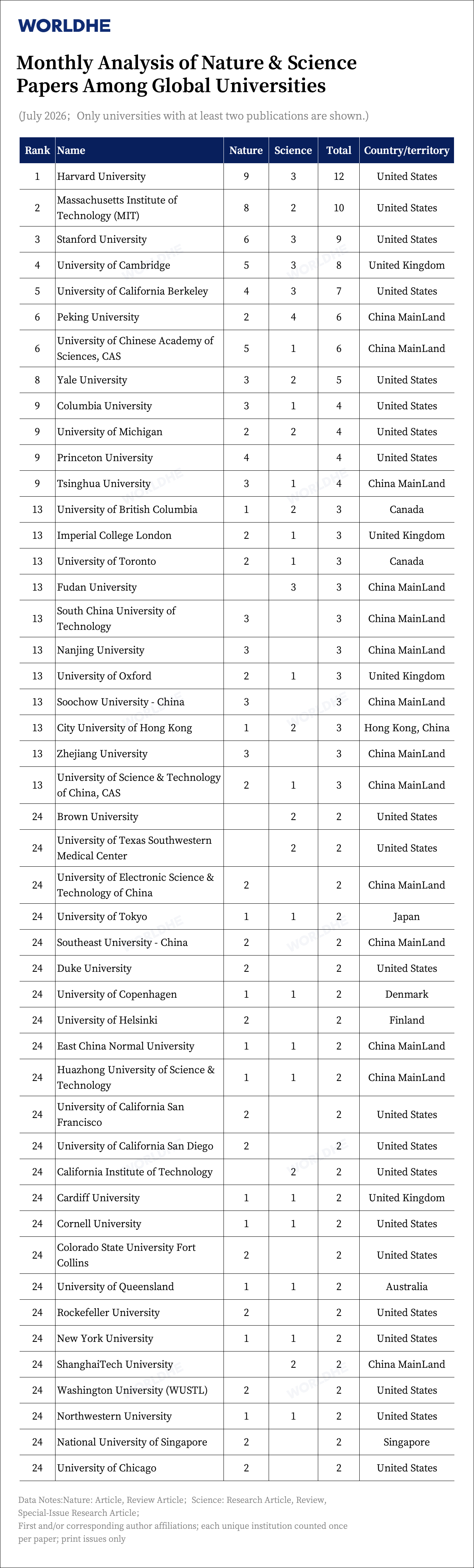
As the opening month of the second half of the year, July saw universities around the world deliver another strong wave of research output in Nature and Science. A total of 165 universities published NS papers during the month. Among them, two institutions published more than 10 papers, while another two maintained a remarkable pace by publishing NS papers every week throughout July.
165 Universities Published NS Papers in July
From a geographical perspective, the 165 universities publishing NS papers in July were distributed across 24 countries. China accounted for 51 institutions, including 47 universities in China Mainland, two in Hong Kong, China, and two in Taiwan, China, while the United States contributed 48 universities. Together, China and the United States represented approximately 60% of all publishing institutions. The two countries have firmly established themselves as the dual global leaders in top-tier journal publications, with their university sectors demonstrating research vitality far exceeding that of other national research systems.
The top three positions in July's NS publication rankings were all occupied by U.S. universities, closely mirroring the year-to-date standings. Harvard University retained the top spot with 12 publications, including nine in Nature, the highest monthly Nature output among all universities worldwide. Massachusetts Institute of Technology (MIT) followed with 10 publications, making Harvard and MIT the only two institutions to publish 10 or more NS papers in July. Stanford University ranked third with nine publications, with the three universities forming a clear top tier.
The University of Cambridge delivered an especially impressive performance, climbing to fourth place with a total of eight publications—five in Nature and three in Science—demonstrating strong momentum. The University of California, Berkeley ranked fifth with seven papers, continuing its consistent strength in interdisciplinary research.
Other universities publishing five or more NS papers included Peking University, the University of Chinese Academy of Sciences, and Yale University, together forming the backbone of this month's high-output institutions. Notably, Peking University published four Science papers, the highest monthly Science output among all universities worldwide, further underscoring the dominant position of China and the United States among the world's most productive research institutions.
July Highlights
Several universities stood out in July's NS rankings with distinctive research achievements.
Behind Harvard University's total of 12 publications was an extraordinary publishing rhythm, with four NS papers appearing in each of three consecutive weeks. These studies spanned cutting-edge topics including dendritic cells, targeted protein degradation, tertiary lymphoid structures (TLSs), and AI-redesigned proteases.
The University of Cambridge and Peking University were the only two universities to publish NS papers every week throughout July, demonstrating exceptional consistency in research output. Cambridge's publications focused on interdisciplinary topics such as the Hormone Cell Atlas, fibroblasts, and the complex dynamics of Earth's interior. Meanwhile, on July 2, Peking University published a Science paper reporting the world's first millisecond-scale neuromorphic dynamical system chip based on phase-change memristors, marking a major breakthrough in next-generation neuromorphic computing hardware. Science simultaneously published a Perspective article praising the work as "representing a conceptual shift toward physics-driven computing."
In terms of research leadership, most July publications listed the universities as corresponding-author institutions. Particularly noteworthy were the University of California, Berkeley, Princeton University, and Nanjing University, each of which achieved full leadership across all of their published papers, serving as both the first-author and corresponding-author institution in every case. This reflects their strong capabilities in research organization, resource integration, and leadership in international collaboration.
Methodology
For Nature, only articles classified as Article and Review Article are included. For Science, the included document types are Special-Issue Research Article, Research Article, and Review. Each affiliation of the first author and corresponding author is counted once. If the first-author affiliation and corresponding-author affiliation are the same institution, it is counted only once. The statistics include only formally published papers and exclude advance online publications.
Further Reading
WorldHE NS Watch: Global Nature & Science Publications Surge Last Week


TRENDING
Where Fields Medalists Studied and Worked?
Data & Rankings
MIT Tops QS World Rankings for 15th Straight Year
Data & Rankings
Harvard Tops U.S. News Global University Rankings
Data & Rankings
2026 Fields Medal Winners Announced: Four Mathematicians Honored
Research & Innovation
ICM 2026 Leak Reveals Possible Fields Medal Winners
Research & Innovation