
US-China Research Papers Down 40%


Recently, Nature reported that on July 15, U.S. Republican Representative John Moolenaar, chairman of the House Select Committee on China, chaired a congressional hearing on U.S. research funding. The hearing came just one week after the U.S. National Science Foundation (NSF) announced a new policy prohibiting NSF-funded American scientists from collaborating with international institutions that the federal government has designated as posing a threat to U.S. national security—a list that includes several of China's leading universities.
During the hearing, Moolenaar praised the NSF's new policy and urged other U.S. research agencies represented at the hearing to adopt similar restrictions.
By contrast, representatives from other agencies took a more cautious stance. Officials from the National Institutes of Health (NIH) and the Department of Energy (DOE) said their agencies are reviewing the NSF's approach, while emphasizing that both organizations already have their own research security oversight mechanisms in place.
Democrats argued that although scientific collaboration with China carries legitimate risks, the Trump administration's cuts to staffing and funding at U.S. research agencies are making the situation worse. Rebecca Keiser, head of the NSF's Office of Research Security Policy and Strategy, confirmed during the hearing that her office currently has only five staff members, down from ten in 2024, before President Trump took office.
Over the past two decades, as China's global influence has grown, scientific cooperation between the United States and China has become increasingly strained. During Trump's first term, the administration launched the controversial China Initiative, under which a number of Chinese American scholars were arrested. Many of those cases were later dropped or dismissed.
In Trump's second term, Republicans have adopted an even more aggressive stance toward limiting scientific cooperation with China. They have repeatedly called on the Department of Energy to prohibit ethnically Chinese researchers who are not U.S. citizens from working at U.S. national laboratories. Last year, Moolenaar attempted to advance the SAFE Research Act, but the bill failed to pass. The proposed legislation would have barred federal research funding for U.S. researchers who had collaborated within the previous five years with scientists affiliated with Chinese entities designated as "restricted."
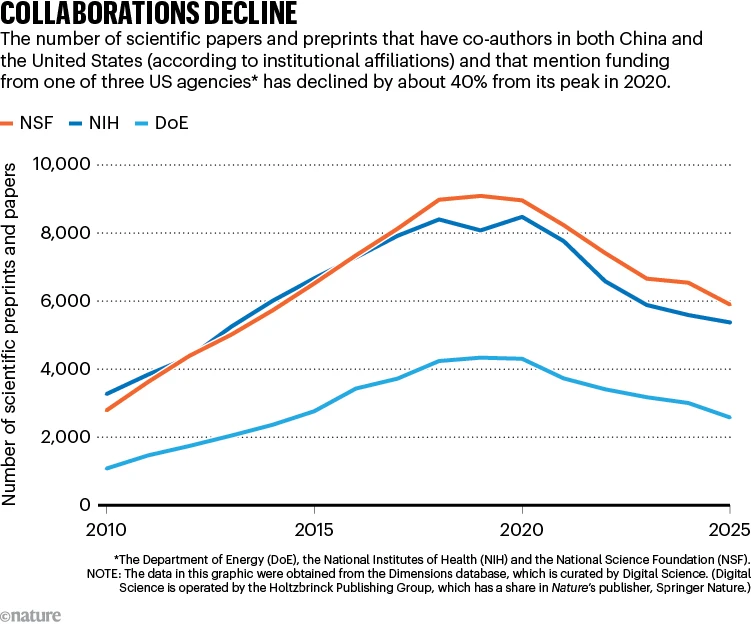
Growing political pressure in the United States is already having a tangible impact on U.S.–China scientific collaboration. A Nature analysis found that between 2020 and 2025, the number of preprints and research papers co-authored by U.S. and Chinese researchers and funded by the DOE, NIH, or NSF declined by approximately 40%.
A genetics researcher at Guilin Medical University said that most U.S. researchers he knows who previously collaborated with Chinese partners have now scaled back or ended those partnerships. As a result, there are now virtually no active U.S.–China collaborative projects in his field. Chinese scientists, however, continue to maintain strong research partnerships with colleagues in Europe and other regions.
Steven Kivelson, a physicist at Stanford University, warned that policies such as the NSF's would sever productive international collaborations and ultimately harm the development of fundamental research in the United States, while being unlikely to achieve their intended objectives. As he put it: "So this notion that having Chinese nationals coming to US campuses opens us up to intellectual-property theft is just completely wrong."


TRENDING
MIT Overtakes Harvard as U.S. and China Dominate September Nature and Science Output
Data & Rankings
From Training Talent to Winning Nobels: The Universities Behind the Laureates
Data & Rankings
Getting Older, Crossing Disciplines: What Nobel Prize Data Reveal
Data & Rankings
Harvard Leads the Citation Laureates Rankings as Nobel Prize Season Approaches
Data & Rankings
Good University Guide 2027: St Andrews Takes No. 1 as Imperial Climbs Three Places
Data & Rankings