
Packard Awards Nearly $1 Million Each in Unrestricted Funding to 20 Young Researchers


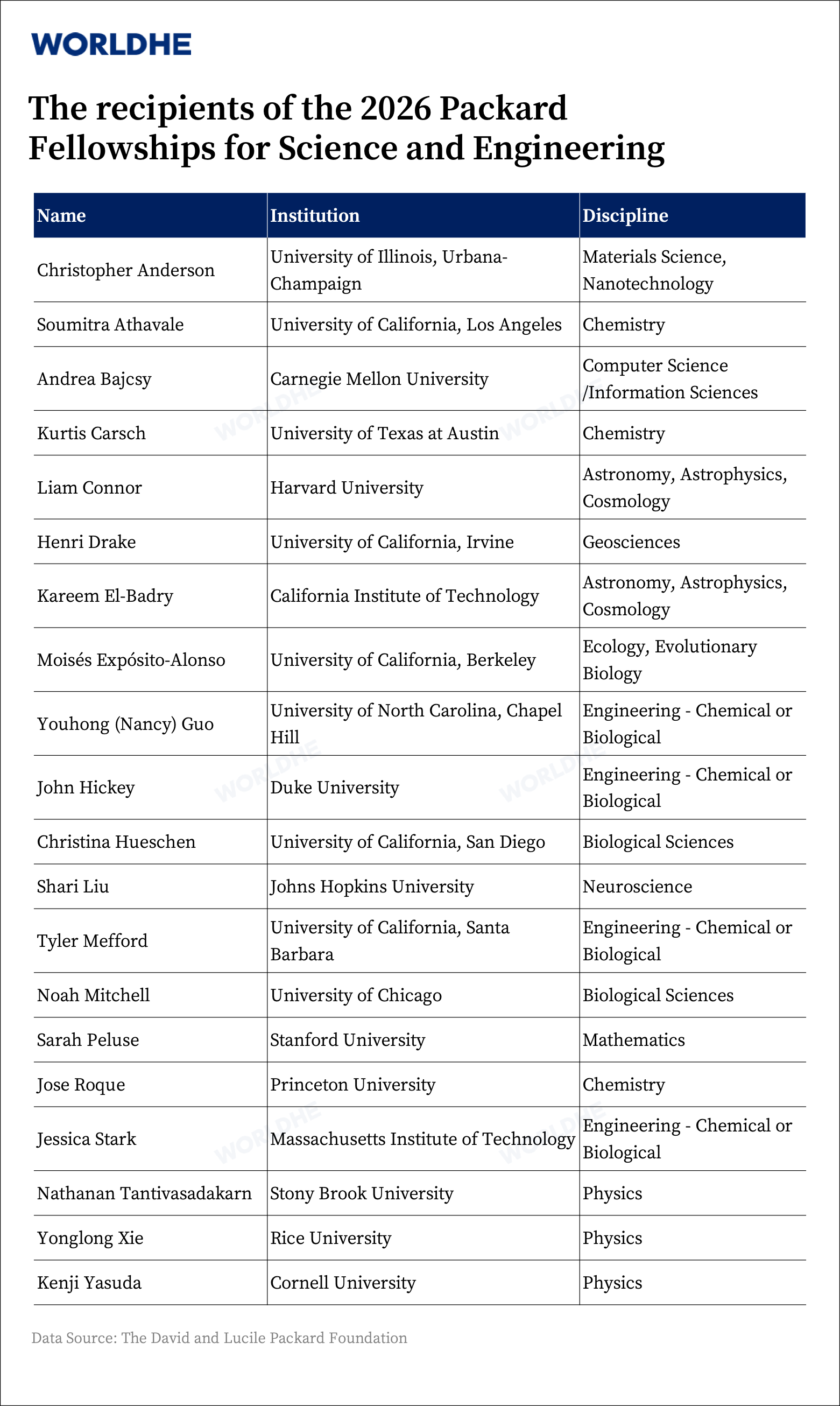
The David and Lucile Packard Foundation on October 15 announced the 2026 class of Packard Fellowships for Science and Engineering, awarding 20 early-career researchers at 20 universities across the United States a total of roughly $19.7 million in unrestricted support over the next five years.
Each Fellow receives $985,834 — an unusually large sum for a fellowship at this career stage — with no restrictions on how it is spent. The foundation deliberately leaves the allocation to the researchers themselves, who may direct the money toward new equipment, additional lab members, conference travel, or child care during the demanding first years of running an independent group.
"The scientists, engineers, and mathematicians in this class are asking ambitious questions about our bodies, our planet, and the technologies shaping our future," said Nancy Lindborg, president and CEO of the Packard Foundation. "At a time of significant uncertainty in the research landscape, flexible, long-term support for early-career researchers matters more than ever."
The 2026 class spans 20 institutions, one Fellow apiece. The University of California system claims five Fellows across four campuses — Los Angeles, Irvine, Berkeley, San Diego and Santa Barbara — more than any other university system in the country. The remaining 15 Fellows are spread one each across the rest of the list: the University of Illinois, Urbana-Champaign; Carnegie Mellon University; the University of Texas at Austin; Harvard University; the California Institute of Technology; the University of North Carolina, Chapel Hill; Duke University; Johns Hopkins University; the University of Chicago; Stanford University; Princeton University; the Massachusetts Institute of Technology; Stony Brook University; Rice University; and Cornell University.
The announcement lands at a moment of anxiety in American academic research. In 2026 the foundation created the Packard Fellows Emergency Relief Fund, a $3.3 million rapid-response effort administered by the Science Philanthropy Alliance that helped 42 existing Fellows sustain their research teams through disruptions in federal funding — an unusual intervention for a philanthropy that has historically focused on forward-looking bets rather than bridge financing.
The foundation also said it will increase fellowship award amounts again beginning with the 2027 class, following this year's expansion of support.
"What is exciting about supporting researchers at this early stage of their career is that some of their most important discoveries are impossible to anticipate," said Richard Alley, chair of the Packard Fellowships Advisory Panel and himself a 1991 Packard Fellow. "This year's Fellows combine deep expertise with the curiosity and ambition to take their fields into entirely new directions."
About the Packard Fellowships for Science and Engineering
The program, now in its 38th year, was inspired by David Packard's conviction that the success of Hewlett-Packard, which he co-founded, grew out of breakthroughs made in university laboratories. Each year the foundation invites 50 universities to nominate two faculty members apiece. A 12-member advisory panel of internationally recognized scientists and engineers evaluates the nominations and recommends Fellows to the foundation's board of trustees for approval.
Since 1988, the Packard Foundation has awarded more than $550 million through the program to 755 scientists and engineers from 55 universities. Former Fellows have gone on to receive Nobel Prizes in Chemistry and Physics, Fields Medals, Alan T. Waterman Awards, Breakthrough Prizes and Kavli Prizes, and to be elected to the National Academies of Sciences, Engineering, and Medicine.


TRENDING
MIT Overtakes Harvard as U.S. and China Dominate September Nature and Science Output
Data & Rankings
From Training Talent to Winning Nobels: The Universities Behind the Laureates
Data & Rankings
Getting Older, Crossing Disciplines: What Nobel Prize Data Reveal
Data & Rankings
Harvard Leads the Citation Laureates Rankings as Nobel Prize Season Approaches
Data & Rankings
Good University Guide 2027: St Andrews Takes No. 1 as Imperial Climbs Three Places
Data & Rankings