

From MIT to Chicago: The Universities Powering Nobel Economics


On October 12, the final Nobel Prize of the 2026 season — the Prize in Economic Sciences — was awarded to Robert E. Hall and Michael Woodford “for microeconomic foundations of macroeconomic stabilisation.”
With the announcement, this year’s Nobel Prize season has come to a close. As part of its coverage, WorldHE has reviewed the institutions where Nobel laureates were affiliated at the time of their awards, as well as the universities where they earned their undergraduate, master’s and doctoral degrees, covering the period from 1997 to 2026.
This analysis focuses on the Nobel Prize in Economic Sciences.
US Universities Dominate the Nobel Economics Landscape
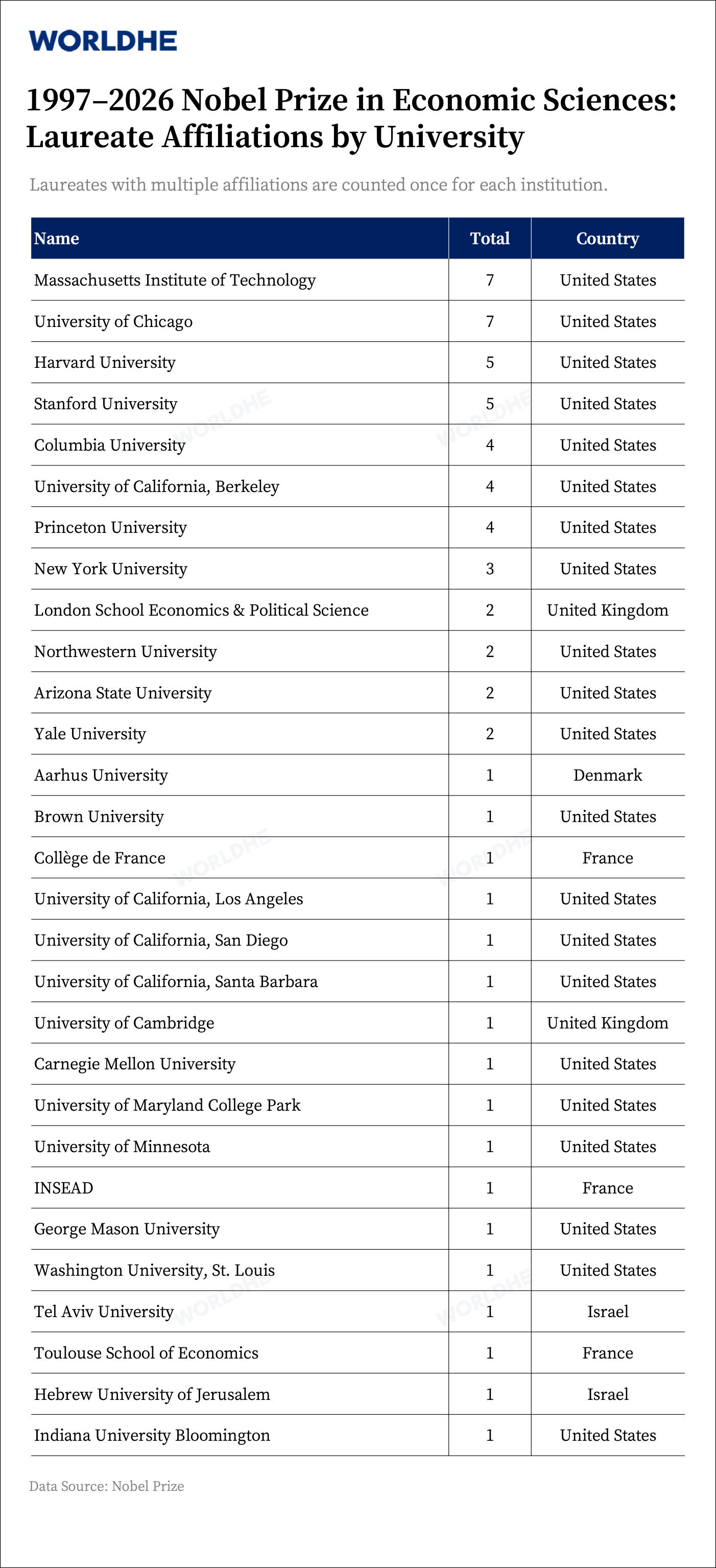
US universities have maintained a clear dominance in the Nobel Prize in Economic Sciences. Over the past three decades, US institutions accounted for approximately 85% of all laureate affiliations in the dataset, and every university with three or more laureates was American.
MIT and the University of Chicago lead with seven laureates each. Both have built exceptionally strong research ecosystems across economic theory, econometrics, macroeconomics, microeconomics and related interdisciplinary fields.
Harvard and Stanford each have five laureates, while Columbia, UC Berkeley and Princeton have four each. New York University has three.
The 2026 laureates further illustrate this concentration: Robert E. Hall is a professor at Stanford University, while Michael Woodford is a professor at Columbia University.
The pattern is closely linked to the way modern economics develops. The discipline relies heavily on academic communities, where leading scholars attract talented researchers from around the world and sustain long-term research networks. Universities, by their very nature, provide the institutional setting for these communities to develop and produce research over time.
Beyond the leading US institutions, several universities have also emerged as internationally influential economics centers, including the London School of Economics and Political Science in the UK, Collège de France and Toulouse School of Economics in France, Aarhus University in Denmark, and the Hebrew University of Jerusalem and Tel Aviv University in Israel.
US Universities Also Lead in Training Future Laureates
The dominance of US universities extends beyond where laureates work to where they were educated.
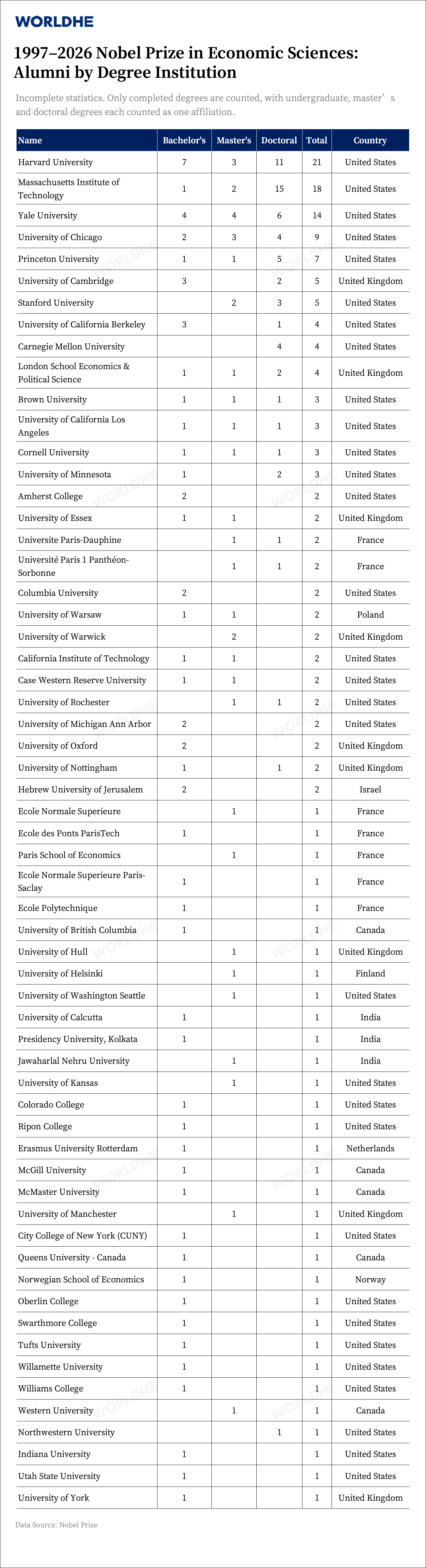
Among the 60 universities worldwide that had educated Nobel Economics laureates in the dataset, 31 were in the United States.
Harvard leads with 21 alumni affiliations, including seven bachelor’s, three master’s and 11 doctoral degrees. MIT follows with 18, including 15 PhD alumni — the highest doctoral total among all universities in the dataset.
Yale has 14 alumni affiliations, with a relatively balanced distribution across undergraduate, master’s and doctoral degrees.
The University of Chicago has nine, Princeton seven, while Cambridge and Stanford have five each. UC Berkeley, Carnegie Mellon and the London School of Economics each have four.
Notably, all four of Carnegie Mellon’s laureate alumni earned PhDs there, underscoring the university’s strength in advanced economics research training.
The two 2026 laureates also reflect these academic networks. Both Hall and Woodford earned PhDs in Economics from MIT. Hall previously earned his undergraduate degree in Economics from UC Berkeley, while Woodford earned a bachelor’s degree from the University of Chicago before studying at Yale and subsequently completing his economics PhD at MIT.
A Self-Reinforcing Academic Ecosystem
The data point to a powerful cycle at the top of the economics field.
Universities such as MIT, Chicago, Harvard, Stanford and Princeton have not only produced Nobel-caliber research; they have also built highly successful systems for training future economists.
Their advantage comes from combining research excellence, strong academic communities and talent development — creating a self-reinforcing ecosystem in which leading scholars attract new talent, train future researchers and generate influential research.
Over three decades of Nobel Economics data, this combination has helped a small group of universities establish a remarkably durable position at the center of the global economics research landscape.
Data note: Institutional names have been standardized where universities have undergone clear mergers or name changes; where historical institutions have split into independent universities, their original names are retained. Alumni are counted by degree earned, with each bachelor’s, master’s and doctoral degree counted separately. If a laureate held positions at multiple institutions at the time of the award, each institution is counted once. The data were manually collected and should be considered an incomplete statistical sample.


TRENDING
From Training Talent to Winning Nobels: The Universities Behind the Laureates
Data & Rankings
MIT Overtakes Harvard as U.S. and China Dominate September Nature and Science Output
Data & Rankings
Getting Older, Crossing Disciplines: What Nobel Prize Data Reveal
Data & Rankings
Harvard Leads the Citation Laureates Rankings as Nobel Prize Season Approaches
Data & Rankings
Good University Guide 2027: St Andrews Takes No. 1 as Imperial Climbs Three Places
Data & Rankings