

US DOE awards $159 million to 12 Genesis Mission projects


The US Department of Energy (DOE) has awarded $159 million to 12 Phase II projects under the Genesis Mission, bringing universities, national laboratories and industry together to use artificial intelligence and advanced computing to accelerate scientific discovery.
Announced on 8 October, the awards build on the Genesis Mission portfolio launched in July and are intended to develop new capabilities using what the DOE calls “Super Intelligence” (SI) for science.
Seven US universities are leading newly funded projects: the University of California, San Diego; Massachusetts Institute of Technology (MIT); University of California, Irvine; University of Illinois Urbana-Champaign; University of Washington, Seattle; Harvard University; and Northeastern University.
The awards bring the total number of Phase II Genesis Mission projects to 14, including two previously announced projects: GridFM 2.0, supported by the DOE’s Office of Electricity, and Prometheus, supported by the Office of Nuclear Energy.
President Donald Trump launched the Genesis Mission in November 2025 to accelerate scientific discovery and strengthen US leadership in science, medicine and technology.
“These projects represent a critical step in turning the promise of Super Intelligence for science into transformative scientific capability,” said DOE Under Secretary for Science Darío Gil.
The Phase II teams have already demonstrated the potential of integrating SI with scientific expertise, data and computing, Gil said. The new awards will allow researchers to expand those efforts and develop new capabilities to address complex national science and technology challenges.
By connecting researchers with advanced AI systems, supercomputing, scientific data and DOE research infrastructure, the Genesis Mission aims to accelerate research across areas ranging from fusion energy and biotechnology to quantum computing, particle physics and advanced materials.
Universities lead projects across key research areas
The 12 newly funded projects span a broad range of scientific and technological fields.
The University of California, San Diego will lead Decoding the RNA Structurome to Secure AI Advantage for the Bioeconomy, which aims to expand the RNA structure database fivefold to train SI models capable of supporting the development of more resilient crops and sustainable microbes.
MIT will lead Lattice Quantum Chromodynamics (LQCD) at the Intelligence Frontier, integrating SI with supercomputing calculations in fundamental particle physics to accelerate research into the basic building blocks of matter.
At the University of California, Irvine, the Multi-agent AI Expert for Subsurface Reasoning and Optimization (MAESTRO) project will develop an SI platform to map, stimulate and manage deep underground reservoirs, with the goal of expanding access to geothermal energy.
The University of Illinois Urbana-Champaign will lead AI-extended Interfacial Separations (AXIS), which will use SI to design more efficient electrochemical processes for extracting critical rare-earth elements from domestic sources.
The University of Washington, Seattle will lead a project focused on overcoming barriers in computational enzyme design through improved sequence-structure ensemble modelling. The work aims to develop foundational SI tools for predicting and designing functional enzymes.
Harvard University will lead Application-Aware Error Correcting Codesign for Scientific Quantum Computing (ASQC), combining SI with advanced quantum hardware to address challenges in quantum error correction.
Northeastern University will lead Agentic Assistance for Advanced Rare Isotope Separator Operations at the Facility for Rare Isotope Beams (FRIB). The project will develop an intelligent automated assistant to streamline the safe operation and tuning of the facility's particle separator, potentially freeing hundreds of hours of research time each year.
Industry and national laboratories will lead the remaining projects.
Commonwealth Fusion Systems will lead a project to develop an AI-enabled digital twin platform for a fusion demonstration device, with the aim of simulating and optimising operations and accelerating the path towards commercial fusion energy.
Fermilab will lead Accelerating Extreme Environment Specs-to-Silicon (AXESS), using SI to design rugged, high-performance microchips for extreme environments including space, high-radiation settings and ultra-cold conditions.
Lawrence Berkeley National Laboratory will lead The Multi-office Accelerator Team Core (MOAT-Core), which will develop a shared SI platform for national laboratories to autonomously design and operate particle accelerators more efficiently.
Argonne National Laboratory will lead An Iterative Framework of AI-Assisted Scientific Development and Optimization (AI4HPC), aimed at modernising, optimising and verifying scientific software used in supercomputing.
Oak Ridge National Laboratory will lead a project on AI-empowered Design of Functional Quantum Magnets, developing a physics-informed SI framework to design new quantum magnets based on desired properties. Potential applications include quantum sensing, low-power electronics and other quantum technologies.
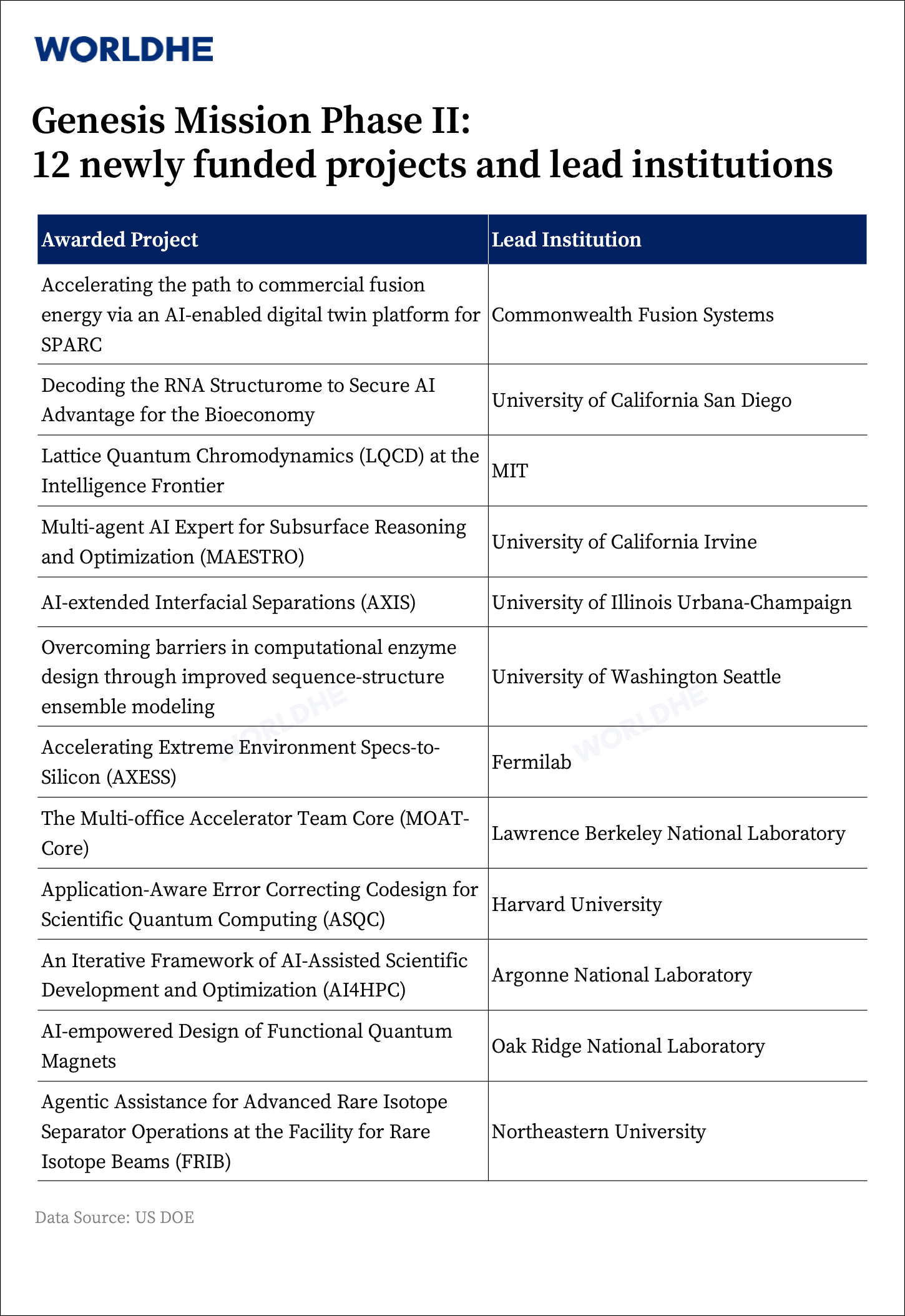
The DOE said the projects demonstrate how SI can be combined with scientific expertise, large-scale computing and research infrastructure to address some of the country's most complex scientific challenges.
The initiative also reflects a growing emphasis on closer collaboration among universities, national laboratories and industry in developing AI-enabled research capabilities.
For universities, the programme provides access to national research infrastructure and opportunities to work alongside government laboratories and technology companies on large-scale scientific problems.
The DOE said the Genesis Mission will continue to build capabilities at the intersection of AI, scientific data and high-performance computing, with the broader goal of strengthening US leadership at the frontiers of science and technology.


TRENDING
From Training Talent to Winning Nobels: The Universities Behind the Laureates
Data & Rankings
MIT Overtakes Harvard as U.S. and China Dominate September Nature and Science Output
Data & Rankings
Getting Older, Crossing Disciplines: What Nobel Prize Data Reveal
Data & Rankings
Harvard Leads the Citation Laureates Rankings as Nobel Prize Season Approaches
Data & Rankings
Good University Guide 2027: St Andrews Takes No. 1 as Imperial Climbs Three Places
Data & Rankings