

No Single Path to a Nobel: Where Literature Laureates Studied


On October 8, the 2026 Nobel Prize in Literature was awarded to Canadian author Anne Carson “for her bold and inventive oeuvre that, in playful dialogue with the classical tradition, has created new forms for contemporary literature.”
Unlike the Nobel Prizes in the natural sciences, the Literature Prize recognizes an individual writer’s creativity rather than the achievements of a research institution. Yet universities remain important spaces where writers develop their intellectual foundations, humanities training and cultural identities.
WorldHE reviewed the undergraduate, master’s and doctoral institutions attended by Nobel Literature laureates from 1997 to 2026. At least 31 universities across multiple continents had educated Nobel Literature laureates during this period.
The pattern is strikingly different from that of many scientific Nobel Prizes: literary talent is not concentrated in a small group of universities, but emerges across diverse national, linguistic and cultural traditions.
The UK Leads, but the Map Is Global
The UK had the highest number of laureate alumni, with seven affiliations across universities including the University of Kent, the University of East Anglia, Canterbury Christ Church University, the Royal Central School of Speech and Drama, and the University of Oxford.
This reflects the country’s longstanding strength in literary studies, creative writing, drama and language education.
But the wider picture is global. Nobel Literature laureates have also studied at Yonsei University in South Korea, the University of Cape Town in South Africa, Beijing Normal University and Beijing Foreign Studies University in China, the University of Warsaw in Poland, and Istanbul University in Türkiye.
Anne Carson, the 2026 laureate, completed her bachelor’s, master’s and doctoral studies in Classics at the University of Toronto. Her work combines poetry, translation and classical scholarship, illustrating how humanities education can provide a foundation for literary experimentation.
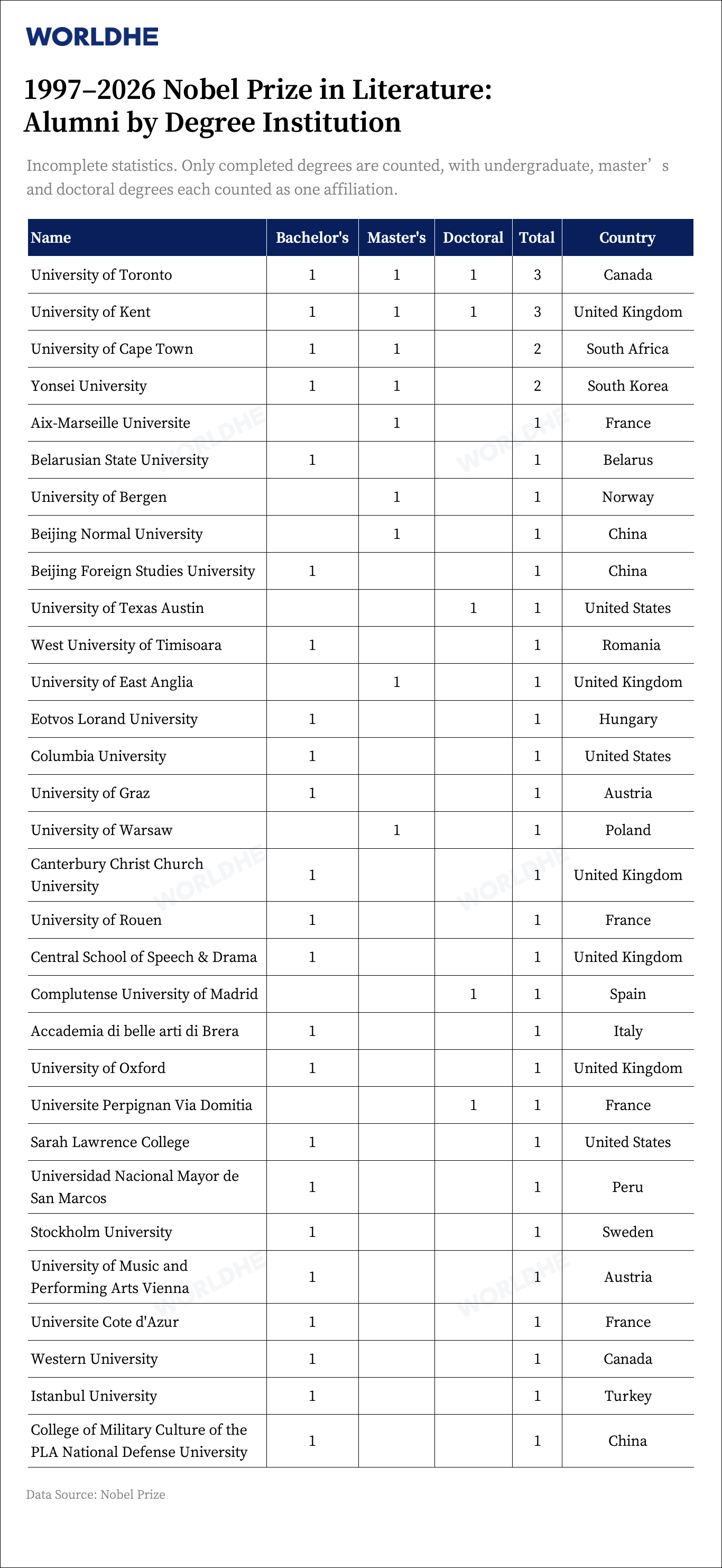
The diversity of laureates’ educational backgrounds points to a simple conclusion: there is no standardized university pathway to literary excellence.
What universities can provide is not a formula for producing Nobel laureates, but an environment where independent thinking, cultural exchange and experimentation with language can flourish.
That may be one of the most valuable roles of humanities education: creating the conditions for new voices and new forms of expression to emerge.


TRENDING
From Training Talent to Winning Nobels: The Universities Behind the Laureates
Data & Rankings
MIT Overtakes Harvard as U.S. and China Dominate September Nature and Science Output
Data & Rankings
Getting Older, Crossing Disciplines: What Nobel Prize Data Reveal
Data & Rankings
Harvard Leads the Citation Laureates Rankings as Nobel Prize Season Approaches
Data & Rankings
Good University Guide 2027: St Andrews Takes No. 1 as Imperial Climbs Three Places
Data & Rankings