
China Has the Research. Now It Wants to Build the Journals.


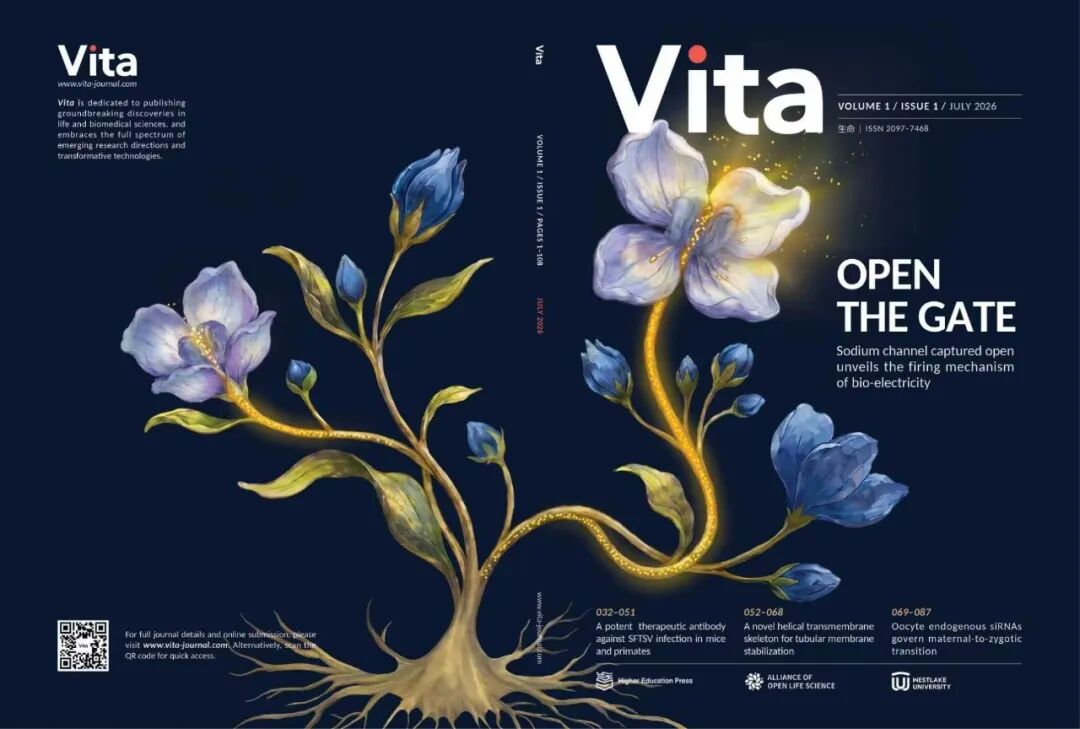
The first print issue of Vita, a China-led journal series in the life sciences, has recently been published, marking the official launch of the flagship journal alongside five companion titles. Launched under the leadership of Westlake University, Vita is positioned as a top-tier international journal covering life sciences and biomedicine. Westlake University President Shi Yigong and Li Dangsheng, former editor-in-chief of Cell Research, serve as its editors-in-chief.
Since the beginning of this year, a growing number of leading Chinese scientists have launched new academic journals. In April, qScience, co-founded and co-edited by Westlake University Chair Professor Pei Duanqing and several internationally renowned scientists, was officially launched. In May, AI Horizons, with Eastern Institute of Technology, Ningbo President Chen Shiyi as its founding editor-in-chief, was launched in Hangzhou. In June, Data Express, the first English-language data journal in China, was launched under the editorship of ecologist Yu Guirui. In August, Peking University launched National Materials, with Peking University Chair Professor and Chinese Academy of Sciences academician Zhang Jin and Nobel Prize-winning physicist Konstantin Novoselov serving as its founding co-editors-in-chief.
At the same time, media reports indicate that China’s independently developed global scientific citation database has completed the cross-language integration of major Chinese-, English- and Japanese-language journals and is expected to enter trial operation by the end of this year. China is also developing its own directory of world-class scientific and technological journals and an accompanying evaluation framework, which are expected to be unveiled next year and offer a China-developed approach to assessing leading journals worldwide.
China’s scientific journals are entering a new spring.
More than 90% of China’s SCI papers are published in overseas journals
Why are an increasing number of Chinese scientists turning to journal publishing? In part, the answer may lie in the huge gap between China’s enormous volume of research output and the relatively limited capacity of its domestic scientific journals to publish it.
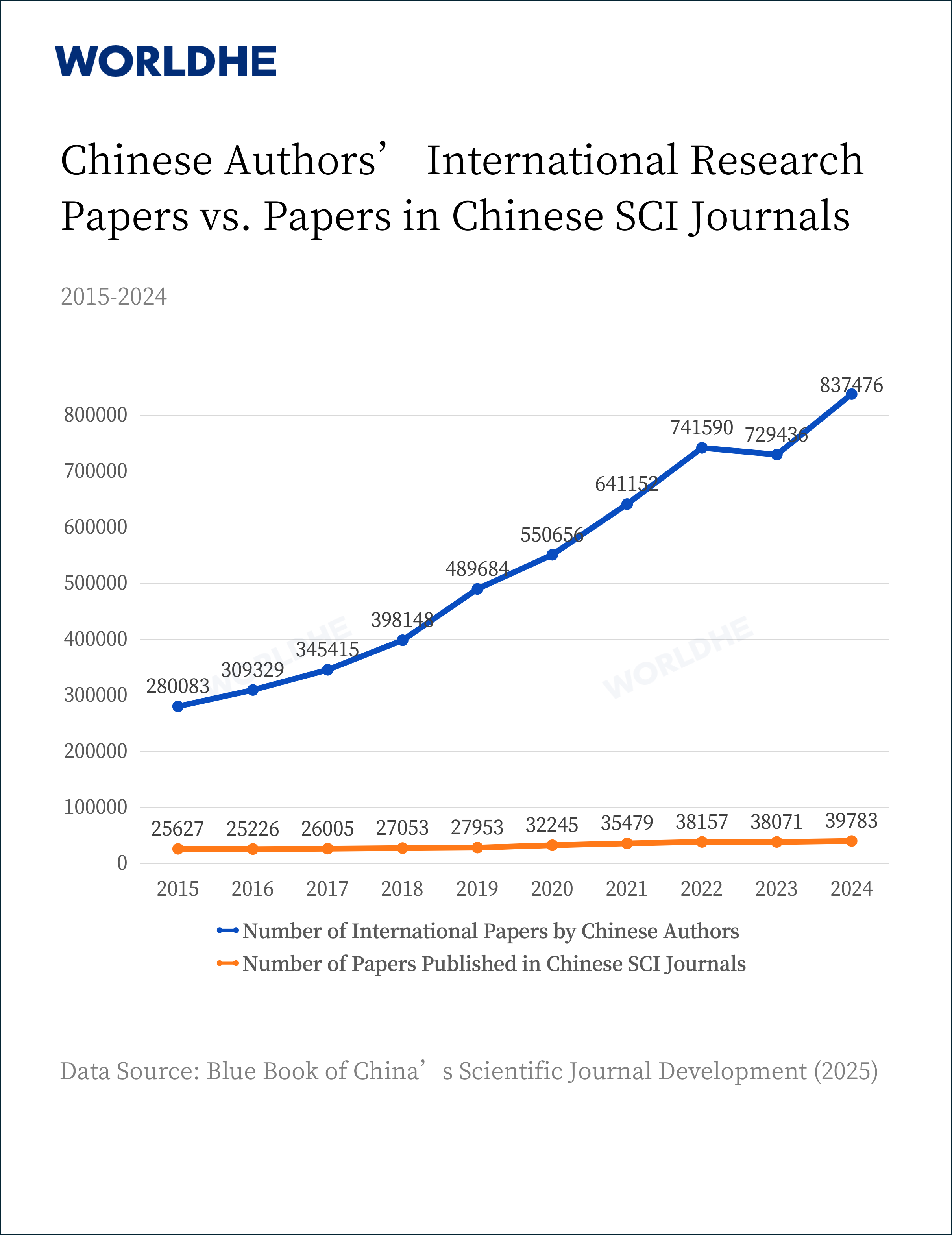
According to the Blue Book of China’s Scientific Journal Development (2025), Chinese authors published more than 830,000 international research papers in 2024, accounting for 36.38% of the global total and ranking first worldwide—nearly twice the number published by U.S. authors.
Yet hundreds of thousands of research papers produced in China each year are still published primarily in overseas journals. Data show that in 2024, more than 95% of papers by Chinese scholars were published in journals outside China.
This means that while China is a global powerhouse in research output, its domestic journal system has far less capacity than is needed to absorb the country’s growing scientific production. It also lacks a sufficient number of internationally influential, world-class journals.
This imbalance has developed into something of a structural pattern. An article published by China’s Qiushi Journal noted that for a long period, Chinese basic research was characterized by a “two ends abroad” problem: research topics were sourced from foreign academic journals, instruments and equipment were imported from overseas, and once results were obtained, researchers paid to publish them in foreign journals and on overseas platforms.
In terms of research publishing, this “two ends abroad” model can lead to the outflow of high-quality research and substantial waste of research funding, while weakening China’s academic autonomy and influence in setting global research agendas.
According to the 2024 Global OA Journals and APC Monitoring Report released by the National Science Library of the Chinese Academy of Sciences, Chinese authors published 313,500 papers in 6,276 open-access (OA) journals, paying approximately RMB 6.474 billion in article processing charges (APCs).
Accelerating the development of world-class domestic scientific journals has therefore become an imperative for China.
“Building high-level domestic journals is not only an important step toward improving China’s academic publishing system; it will also help China participate more deeply in the co-development of global academic rules,” said Professor Cheng Zongming of Nanjing Agricultural University, founder of the leading journal Horticulture Research.
China backs the drive to build world-class journals
In recent years, the Chinese government has rolled out a series of policies and committed substantial funding to accelerate the development of “world-class scientific and technological journals,” creating an unprecedented opportunity for Chinese scientists to establish and run journals.
In August 2019, the Chinese government issued guidelines on cultivating world-class scientific and technological journals, setting a goal for China’s scientific journal sector to enter the world’s top tier in overall strength by 2035, with a number of internationally competitive journal brands and publishing groups to be established.
One month later, the China Association for Science and Technology launched the China Association for Science and Technology Excellence Action Plan for Science and Technology Journals. Implemented on five-year cycles, the program supports flagship journals, key journals, emerging journals, new journals launched from a high starting point, and journal-cluster pilot projects. Its goal is to help nearly 300 journals reach international standards and increase the number of top-ranked journals in major disciplines sixfold.
In 2024, the second phase of the Excellence Action Plan was significantly expanded. The number of English-language single-journal projects increased from 150 to 200, Chinese-language projects from 100 to 200, and journal-cluster pilots from five to 13. The focus shifted from elevating individual journals to building a broader publishing ecosystem and strengthening the sector as a whole.
Today, 65 Chinese journals rank among the top 5% globally in their respective disciplines, while 25 have reached the top position in academic influence within their fields. Compared with five years ago, those figures represent increases of 160% and 257%, respectively, marking a significant step forward.
How can Chinese journals go global?
Yet even after cultivating a growing group of high-level academic journals, China still faces a difficult question: How can these journals establish a truly global presence?
Statistics from 2018 showed that 75% of China’s English-language academic journals had chosen to work with overseas publishers. Even today, partnering with international publishers remains the dominant route for Chinese English-language journals seeking to reach global audiences.
The strategy can help Chinese scientific journals quickly gain access to international distribution and publishing networks, but it also comes with substantial partnership costs. More fundamentally, it raises concerns about data sovereignty and the risk of breaking the chain of academic communication. Although journals retain backups of their original data, the online versions processed by publishers are stored on the publishers’ platforms. “How they process and manage the data is something over which we have limited control,” Xu Jun, executive editor of Friction, a leading tribology journal ranked No. 1 globally in its field, said previously.
In an effort to reclaim greater control over academic publishing and dissemination, Chinese scientific journals have in recent years stepped up efforts to build independent publishing platforms and improve the internationalization and clustering of journal operations.
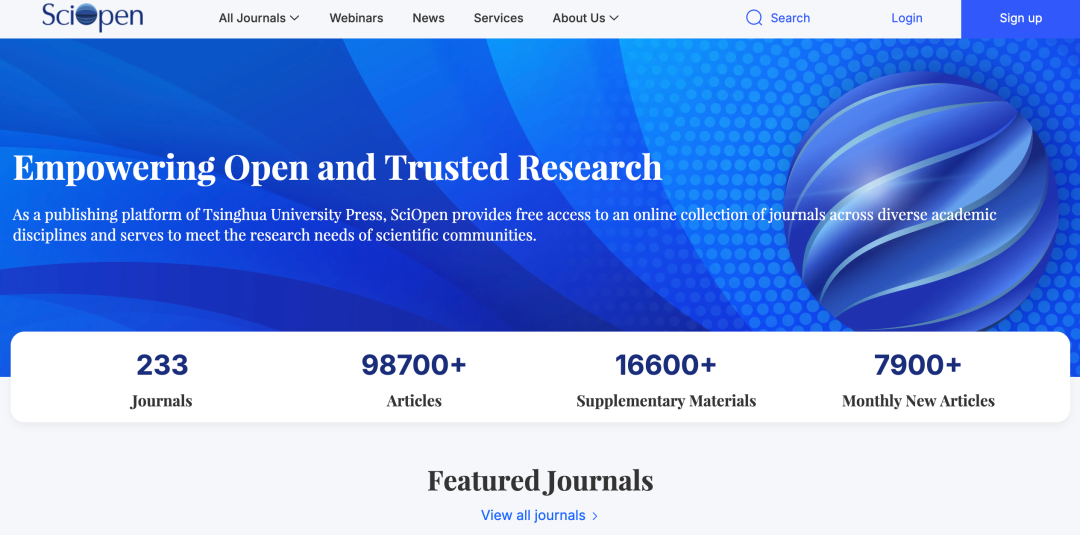
For example, with support from the Excellence Action Plan, Tsinghua University Press began developing SciOpen, an international digital publishing platform for scientific journals, in late 2019. The platform went live in June 2022. As of July this year, SciOpen hosted more than 220 journals and nearly 90,000 papers, with an average of 15 million page views per month. Its users span more than 220 countries and regions, and visitors from outside China account for more than half of total traffic. Two leading journals, Nano Research and Friction, also began operating independently on SciOpen in early 2025.
Meanwhile, Chinese journals are experimenting with new publishing models. Vita, for example, plans to build a professional editorial team and uphold high academic standards to ensure the originality and authority of published research. It is also committed to open access without charging authors any OA or page fees, while returning to the fundamentals of scholarship by exploring a new model of evaluating journals based on the quality of individual papers.
The first three high-quality journals launched by Insight Press debuted together in April this year, exploring a new model of “scientist-led journal publishing.” Under the model, the platform provides professional operations and financial support, freeing scientists from a wide range of non-academic tasks such as typesetting, promotion and copyright management. Scientists, meanwhile, retain control over the journals’ academic standards and evaluation systems.
China’s drive to build world-class scientific and technological journals is well underway.


TRENDING
MIT Overtakes Harvard as U.S. and China Dominate September Nature and Science Output
Data & Rankings
From Training Talent to Winning Nobels: The Universities Behind the Laureates
Data & Rankings
Getting Older, Crossing Disciplines: What Nobel Prize Data Reveal
Data & Rankings
Harvard Leads the Citation Laureates Rankings as Nobel Prize Season Approaches
Data & Rankings
Good University Guide 2027: St Andrews Takes No. 1 as Imperial Climbs Three Places
Data & Rankings