
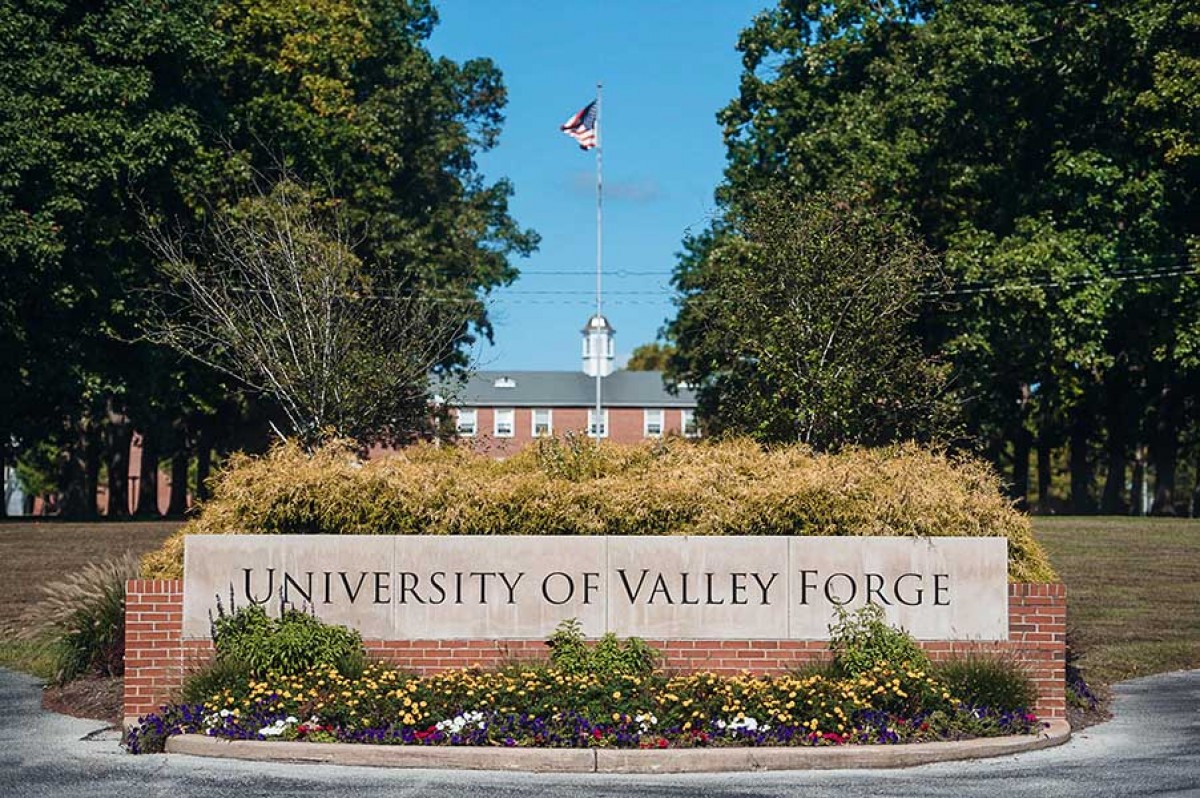
University of Valley Forge to Close


The University of Valley Forge, a private Christian institution in Pennsylvania founded in 1939, has announced that it will suspend academic operations at the conclusion of the Summer 2026 semester, becoming the latest casualty in a growing wave of financially distressed U.S. colleges.
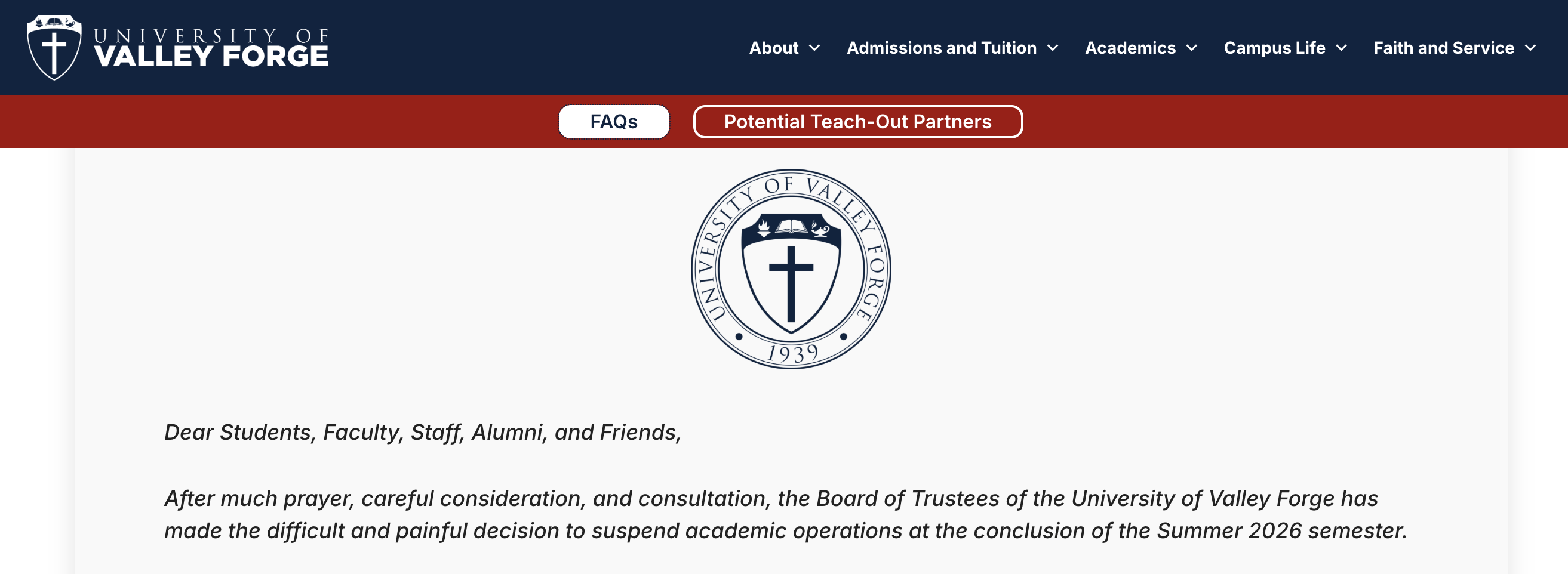
In a statement posted on the university's official website, the Board of Trustees said the decision came after years of efforts to stabilize the institution's finances.
"This decision follows extensive efforts to address the University's financial challenges, pursue strategic partnerships, and identify sustainable paths forward. These challenges have been well documented over several decades and were reflected in the recent action of the Middle States Commission on Higher Education, which placed the University on Show Cause status."
The Board said university personnel will remain in place to assist students with transferring to other institutions, preserve academic records, steward institutional assets, and oversee the university's remaining administrative responsibilities.
The University of Valley Forge enrolled 589 students in Fall 2024, the vast majority of them undergraduates.
Financial strain had been building for years. As early as fiscal year 2021, the university cited steep declines in net tuition revenue as a major factor behind its deteriorating financial position. According to its FY2021 audited financial statements—the most recent audit report the university has publicly released—its total debt had reached $30.8 million.
A Growing Wave of College Closures
The University of Valley Forge is far from an isolated case. Across the United States, an increasing number of colleges have announced closures or mergers in recent years as they struggle with declining enrollment, rising operating costs, and persistent financial challenges.
In May, Hampshire College, a private liberal arts institution with a six-decade history, announced that it would permanently close after the Fall 2026 semester, saying it no longer possessed the financial resources necessary to sustain full operations and meet its regulatory obligations.
According to the State Higher Education Executive Officers Association (SHEEO), 312 degree-granting institutions in the United States closed between 2008 and 2024. The outlook remains bleak. Consulting firm Huron estimates that 442 of the nation's 1,700 private nonprofit four-year colleges and universities could face closure or merger within the next decade.
For students, the consequences can be profound. Although institutions typically pledge to help students transfer elsewhere, the outcomes are often far less encouraging. A SHEEO study tracking 143,000 students affected by the closure of 467 campuses between 2004 and 2020 found that only 47% successfully transferred to another institution. Among those who did transfer, only about one in three ultimately earned a degree.
Demographic Headwinds
Demographic change has emerged as one of the most significant structural challenges facing American higher education.
The U.S. birth rate has been declining steadily since 2007, and the number of 18-year-olds has fallen by nearly 15% over the past decade. Since 2010, overall college enrollment has dropped by approximately 2.3 million students nationwide.
Shrinking enrollment, coupled with tighter government funding, has left many institutions increasingly dependent on tuition revenue. To offset mounting financial pressure, colleges have repeatedly raised tuition. Over the past three decades, tuition at U.S. colleges has nearly tripled, substantially outpacing inflation. Rising costs, however, have made higher education less affordable, further discouraging enrollment and reinforcing a cycle of declining student demand and worsening institutional finances.
Layoffs Become the New Normal
Closures and mergers are only part of the picture. Workforce reductions have also become an increasingly common response to financial strain.
Johns Hopkins University announced plans to eliminate 2,200 positions in March 2025 and has since cut an additional 110 jobs following reductions in federal research funding. Since the beginning of 2025, the University of Southern California has eliminated more than 900 positions, while Stanford University has cut at least 363 jobs and Northwestern University has reduced its workforce by 425 positions.
Meanwhile, federal policy changes could further complicate the outlook for American higher education.
According to The Wall Street Journal on July 30, the Trump administration is considering imposing a $100,000 fee on international students who wish to remain in the United States for employment after graduation. Beginning in September, a new student visa policy is also expected to take effect, limiting most international students to a maximum stay of four years.
If implemented, these measures could further weaken international demand for U.S. higher education at a time when many institutions are already grappling with declining domestic enrollment.
For colleges that have long relied on international students to offset demographic decline at home, the challenges ahead may become even more daunting.


TRENDING
MIT Overtakes Harvard as U.S. and China Dominate September Nature and Science Output
Data & Rankings
From Training Talent to Winning Nobels: The Universities Behind the Laureates
Data & Rankings
Getting Older, Crossing Disciplines: What Nobel Prize Data Reveal
Data & Rankings
Harvard Leads the Citation Laureates Rankings as Nobel Prize Season Approaches
Data & Rankings
Good University Guide 2027: St Andrews Takes No. 1 as Imperial Climbs Three Places
Data & Rankings