

Who Produces the Most Turing Award Winners?


The ACM A.M. Turing Award, often referred to as the "Nobel Prize of Computer Science," has been awarded annually since 1966 to individuals who have made fundamental contributions to the field of computing. Entering the 21st century, with the explosive growth of artificial intelligence, machine learning, and Internet technologies, the significance of the Turing Award has become even more pronounced.
To examine which universities are leading the development of computer science, we collected data from the official Turing Award website on the institutional affiliations of all 41 Turing Award laureates from 2000 to the present. We then conducted a systematic analysis of the universities represented among these affiliations. Some laureates held appointments at multiple institutions; in such cases, each affiliation was counted separately, including both full-time and adjunct professorships.
Our analysis shows that 27 of the 41 laureates were affiliated with universities at the time of receiving the award, representing a total of 20 universities. University-affiliated recipients therefore accounted for 66% of all laureates.
Massachusetts Institute of Technology (MIT) and Stanford University each produced six laureates, tying for first place and reinforcing their undisputed leadership in global computer science research. Notably, both institutions have not only built deep academic traditions over decades but have also continued to generate world-leading research in artificial intelligence and systems in recent years. Their dominance reflects the ongoing competition and complementarity between the research ecosystems of the U.S. East and West Coasts.
University of Oslo, University of Texas at Austin, and Université de Montréal form the second tier, each with two laureates. Among them, Université de Montréal is particularly noteworthy. The university is the academic home of Yoshua Bengio, one of the three pioneers of deep learning. The awarding of the 2018 Turing Award to the field of deep learning helped propel this Canadian institution onto the global stage.
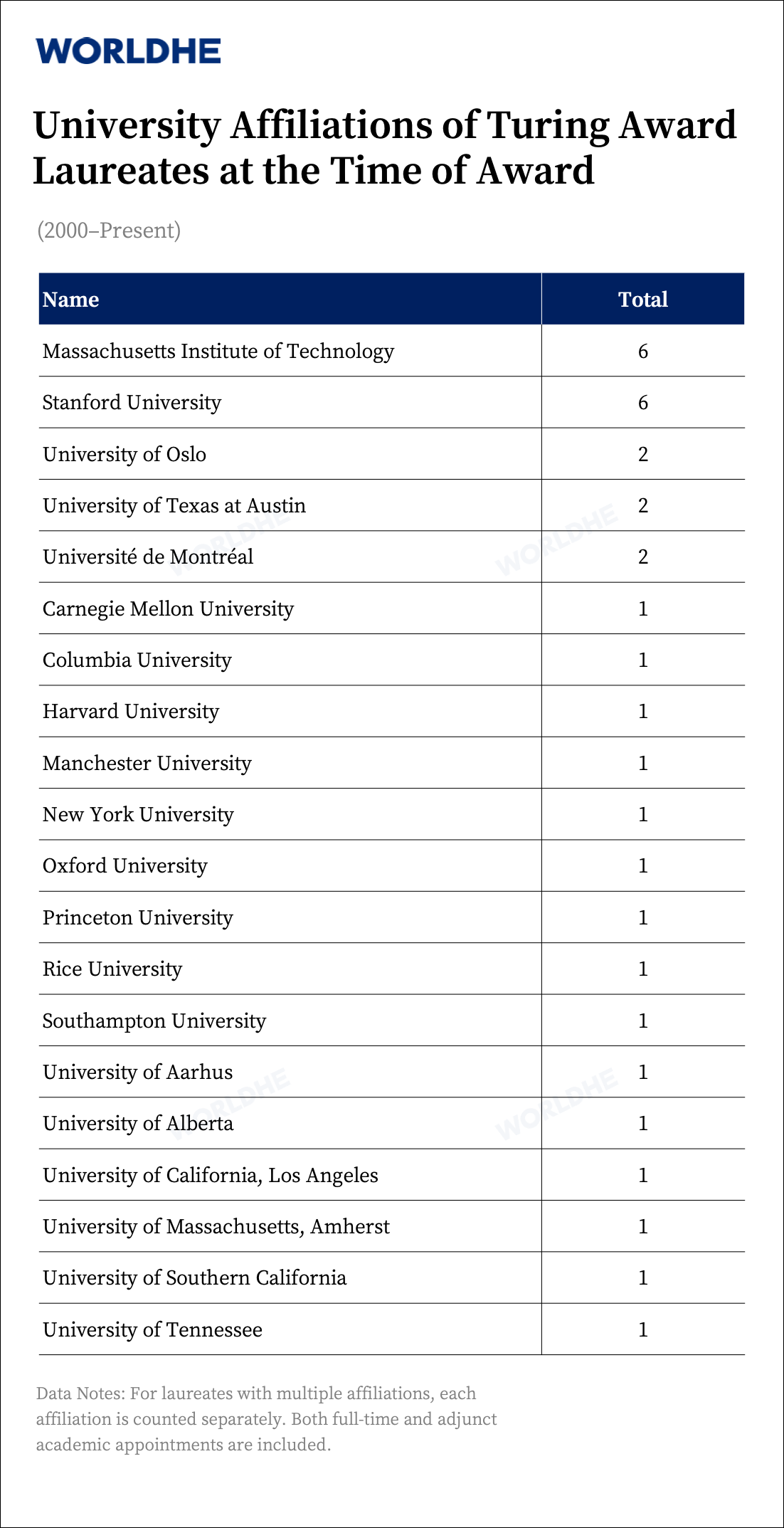
From a geographical perspective, the dominance of U.S. universities remains striking. Of the 20 universities represented in the ranking, approximately 65% are based in the United States, while around 80% of the laureates held positions at U.S. institutions. This highlights the long-standing institutional advantages and concentration of resources that have supported American leadership in fundamental computer science research.
At the same time, Canada’s sustained investment in artificial intelligence is beginning to pay dividends. Both Université de Montréal and University of Alberta appear in the ranking, with Canadian institutions collectively accounting for three laureates. In Europe, universities from the United Kingdom, Denmark, and Norway are represented, although their overall presence remains far smaller than that of the United States.
One particularly notable finding is the absence of Asian universities from this analysis. This gap reflects not only differences in historical accumulation but also a substantial opportunity for future growth. As countries such as China, South Korea, Japan, and Singapore continue their rapid rise in computer science research, the coming years may well see Asian universities achieve a breakthrough presence among future Turing Award laureates.
Data Note: The data are derived from the institutional affiliations listed in the biographies of Turing Award laureates on the official Turing Award website from 2000 to the present. The analysis counts the affiliations held by each laureate at the time the award was received. For laureates with multiple concurrent affiliations, each affiliation is counted separately. Both full-time and adjunct professorships are included in the statistics.


TRENDING
Harvard Dethroned as Zhejiang Takes Top Spot
Data & Rankings
Here's Who Runs the World's Top 50 Universities
Data & Rankings
Who Produces the Most Turing Award Winners?
Data & Rankings
Why Imperial Surpassed Oxford and Cambridge in QS Rankings
Top Universities
8 University Scholars Win 2026 Kavli Prize
Research & Innovation