

Global University Rankings 2026: Who Leads the World?


The internationally recognized QS World University Rankings, Times Higher Education World University Rankings (THE), and U.S. News Best Global Universities Rankings serve as important windows for observing shifts in the global standing of universities. In 2026, all three rankings have been released: QS ranked 1,501 universities, THE ranked 2,191, and U.S. News ranked 2,250.
Which universities lead comprehensively across all three rankings? Which countries and regions delivered standout performances? Based on the latest ranking data, we conducted a systematic review of both universities and countries/regions performance to present a panoramic view of the global university rankings landscape.
Among the three rankings, a group of universities consistently remains at the very top of the pyramid. Data show that 33 universities ranked within the global top 50 across all three lists. These institutions are highly concentrated in a small number of countries and territories: 15 in the United States, 6 in the United Kingdom, 4 in China mainland, 2 each in Hong Kong,China, Singapore, and Canada, and 1 each in Australia and Switzerland.
Among them, Massachusetts Institute of Technology, University of Oxford, Stanford University, and Harvard University all consistently ranked within the top 5 across all three rankings, demonstrating particularly outstanding overall strength. MIT ranked No.1 in QS and No.2 in both THE and U.S. News; Oxford took the top spot in THE; Harvard was most favored by U.S. News, ranking No.1 globally.In addition, University of Cambridge has maintained a solid position within the top 10 across all three rankings, ranking No. 6 in QS, No. 3 in THE, and No. 5 in U.S. News, respectively.
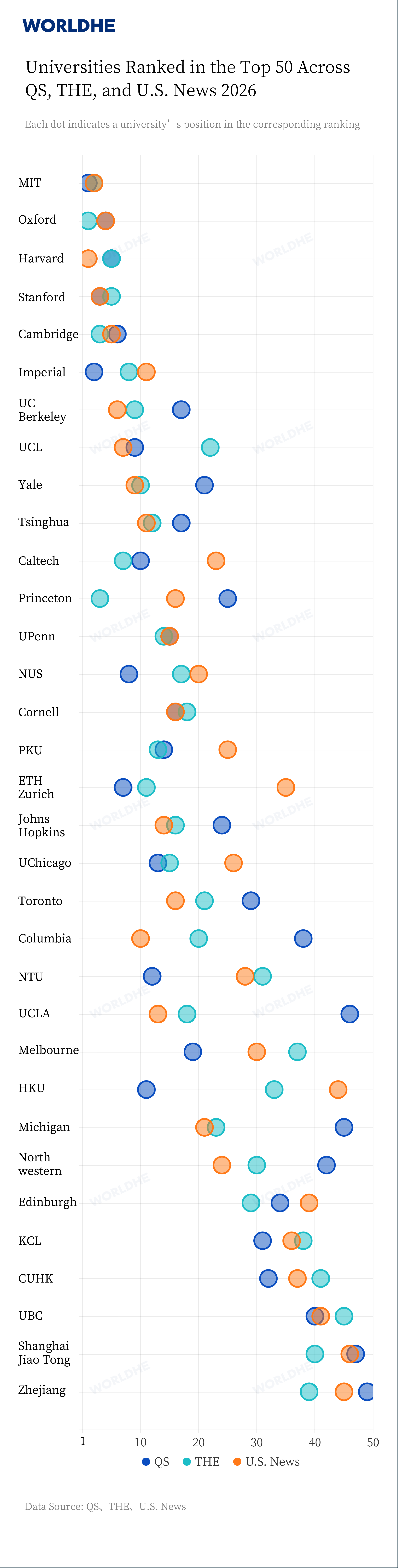
However, the same university often ranks quite differently across different lists. For example, University College London ranks as high as No.7 in U.S. News but drops to No.22 in THE; meanwhile, Caltech ranks No.7 in THE but only No.23 in U.S. News. Behind such ranking “misalignments” lie fundamental differences in methodology. QS places greater weight on employer reputation and internationalization; U.S. News emphasizes academic reputation and research output, particularly favoring comprehensive research universities with strong publication records in top journals; THE attempts to strike a balance between teaching and research.
Zooming out from elite universities to the broader landscape, the three rankings reveal a more multidimensional picture.
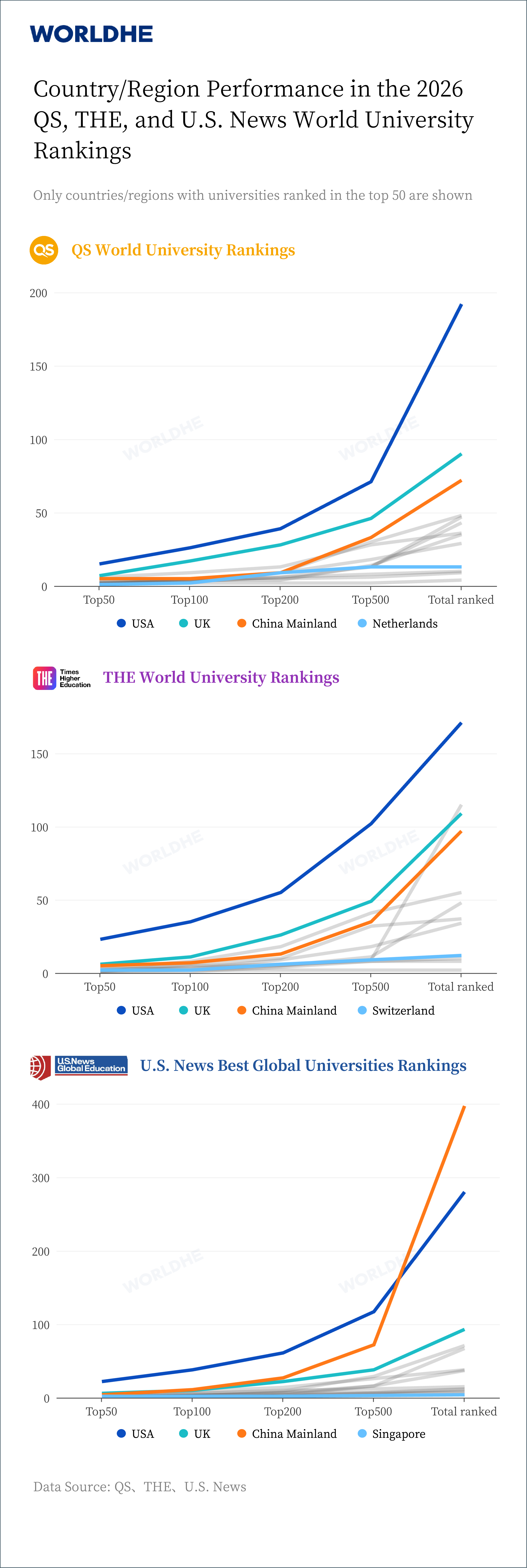
The United States leads by a wide margin in both the number of ranked institutions and their positions across all three rankings. In the QS top 50, U.S. universities account for 15 spots; in the THE top 50, 23 spots; and in the U.S. News top 50, 22 spots. More importantly, the U.S. advantage is not limited to the very top but is also reflected in its depth. Within the U.S. News top 200, 61 American universities are represented—more than double that of second-place China mainland (27)—highlighting the country’s overwhelming dominance in research reputation and academic influence.
The United Kingdom has relatively fewer universities overall, but its top institutions are highly concentrated. The UK has 7 universities in the QS top 50 and 6 each in the THE and U.S. News top 50. Universities such as Oxford, Cambridge, Imperial, and UCL are almost consistently ranked within the top 10 across major rankings. This pattern reflects the distinctly “elite-oriented” nature of British higher education.
Universities in China mainland represent the most closely watched rising force. China Mainland has 5 universities each in the QS and THE top 50, and 4 in the U.S. News top 50. Even more noteworthy, 27 China mainland’s universities rank within the U.S. News top 200, surpassing both the UK (22) and Germany (9), second only to the United States. This suggests that China’s international competitiveness in higher education is expanding from isolated peaks to broader systemic strength.
The Netherlands, Switzerland and Singapore are quintessential examples of “small but sophisticated”.In the QS rankings, all 13 ranked Dutch universities placed within the top 500, with 9 breaking into the top 200. In THE, among Switzerland’s 12 ranked institutions, 2 secured positions within the top 50 and 9 ranked in the top 500. In U.S. News, Singapore had only 4 ranked universities, yet 2 of them placed within the global top 50.
In sharp contrast is India. India has 54, 128, and 118 universities listed in QS, THE, and U.S. News respectively, reflecting impressive scale. However, only 10, 4, and 0 of these institutions rank within the top 500 in the respective rankings. This means that while India has a large number of ranked institutions, the vast majority are positioned near the lower end of global rankings, with relatively scarce top-tier resources.
However, rankings are merely tools, not answers. No single ranking can fully capture the complete picture of a university. They are more like mirrors, reflecting the preferences of the evaluators rather than the full reality of the institutions being evaluated. Therefore, rankings can serve as a starting point for understanding a university, but they should never be regarded as the final word.
Data Note: All data are based on the 2026 editions of the QS, THE, and U.S. News world university rankings. Universities are not ordered by priority and are for reference only. Charts display only universities ranked within the top 50 across all three rankings and selected countries/regions, and do not represent the full dataset.


TRENDING
Why Imperial Surpassed Oxford and Cambridge in QS Rankings
Top Universities
Here's Who Runs the World's Top 50 Universities
Data & Rankings
Global University Rankings 2026: Who Leads the World?
Data & Rankings
Five University Scholars Win $1.2M 2026 Shaw Prize
Research & Innovation
Weekly Analysis: Nature, Science Output Concentrates Among Elite Universities
Data & Rankings