

Which Universities Produce the Most Nobel Laureates?


Since its first award in 1901, the Nobel Prize has upheld the principle of “the greatest benefit to humankind” and has become one of the highest honors for global scientific research and academic innovation. The prize was originally established in five categories—physics, chemistry, physiology or medicine, literature, and peace—and was expanded in 1968 with the addition of the Memorial Prize in Economic Sciences.
From 1901 to 2025, the Nobel Prize has been awarded 633 times, with a total of 1,026 individuals and organizations receiving this distinction. A laureate’s affiliation at the time of the award is often regarded as a direct reflection of an institution’s research environment and ability to attract top talent. Based on the “Affiliation at the time of the award” data published on the official Nobel Prize website for all laureates from 1901 to 2025, we conducted a systematic analysis of university affiliations to identify which institutions have truly served as “cradles of Nobel laureates.”
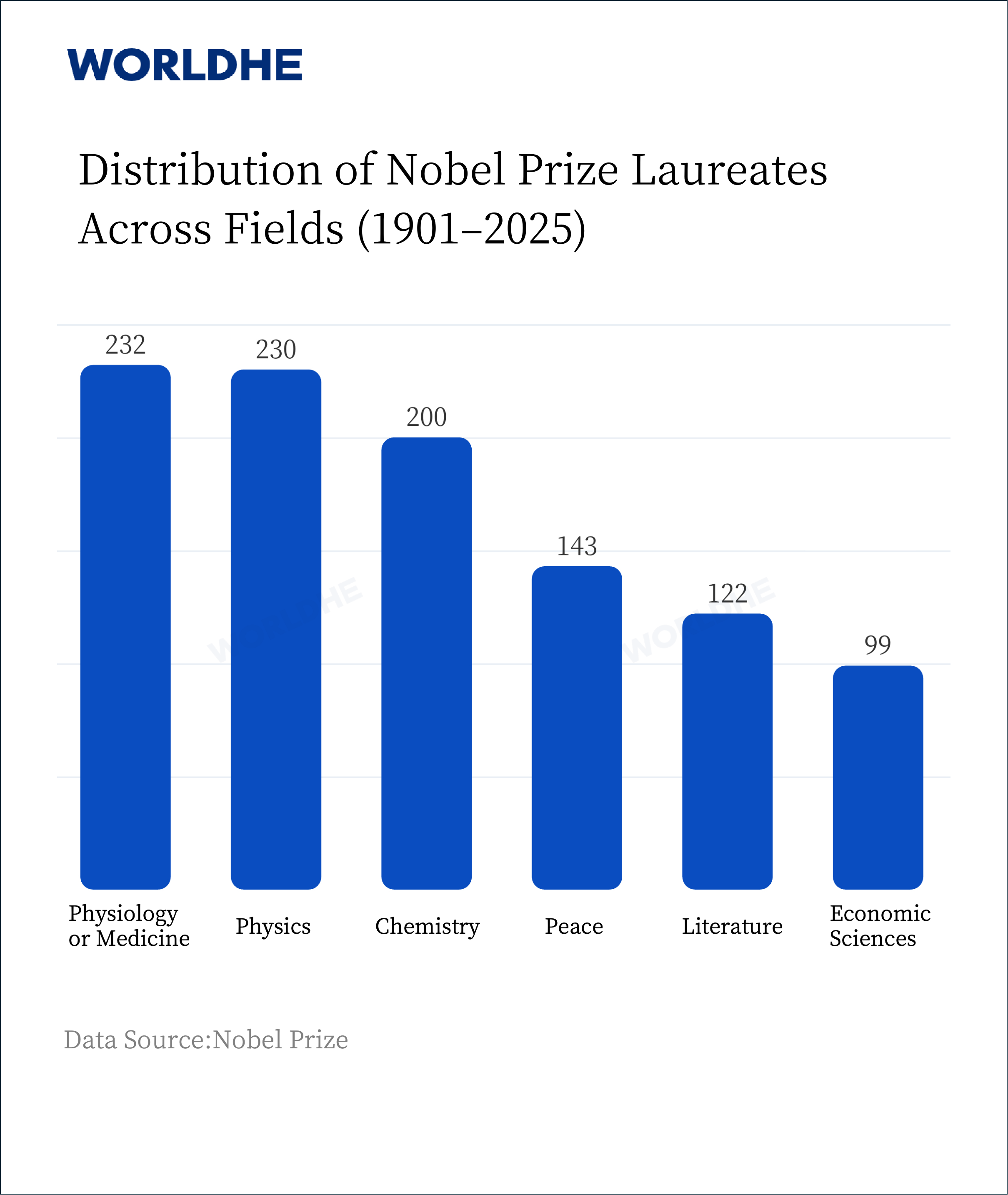
The data show that among the 1,026 Nobel laureates, 232 received the Prize in Physiology or Medicine, 230 in Physics, and 200 in Chemistry, with these prizes typically shared by two or three laureates. Due to its later establishment, the Memorial Prize in Economic Sciences has had only 99 laureates. In addition, 272 laureates—primarily from Literature and Peace—had no recorded institutional affiliation at the time of the award. Among the remaining 754 laureates with affiliation data, 598 were affiliated with universities, representing 171 institutions. University-affiliated laureates accounted for as much as 79% of the total. (If a laureate had multiple affiliations, each institution was counted separately.)
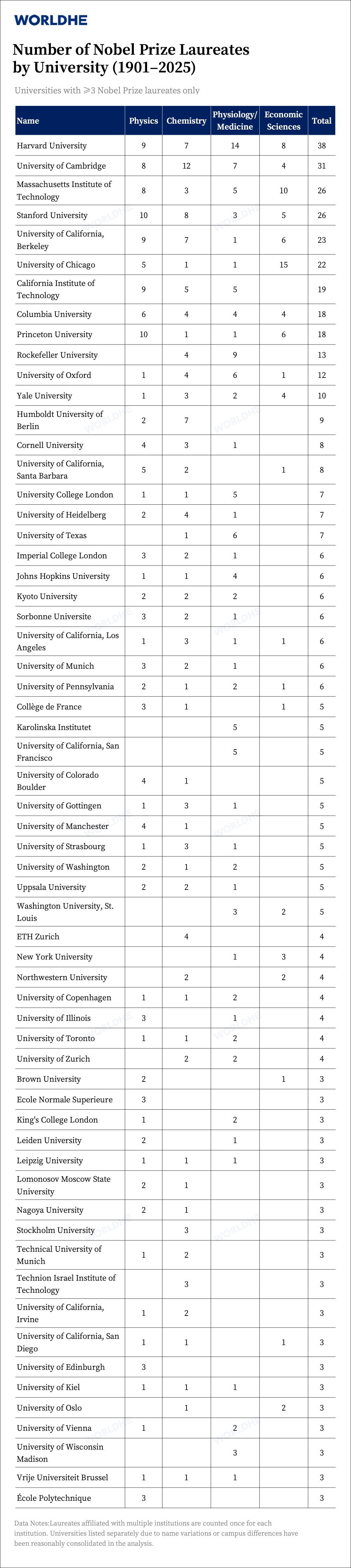
In terms of cumulative university-affiliated laureates, Harvard University ranks first globally with 38 counts, including 9 in Physics, 7 in Chemistry, 14 in Physiology or Medicine, and 8 in Economic Sciences, demonstrating both balanced and world-leading research strength. University of Cambridge follows with 31 counts, including 12 in Chemistry, 8 in Physics, and 7 in Physiology or Medicine, continuing the legacy of institutions such as the Cavendish Laboratory. Massachusetts Institute of Technology and Stanford University are tied for third with 26 counts each; MIT performs particularly strongly in Economic Sciences (10) and Physics (8), while Stanford excels in Physics (10) and Chemistry (8).
Other universities with 10 or more counts include University of California, Berkeley (23), University of Chicago (22), California Institute of Technology (19), Columbia University (18), Princeton University (18), Rockefeller University (13), University of Oxford (12), and Yale University (10).
Notably, universities with at least 10 cumulative counts contributed a total of 256 counts, accounting for 41% of all university-affiliated Nobel counts, highlighting a strong concentration effect among top institutions. Among the top 10 universities by Nobel counts, 8 are located in the United States, reflecting the country’s long-standing advantage in research infrastructure and academic environment.
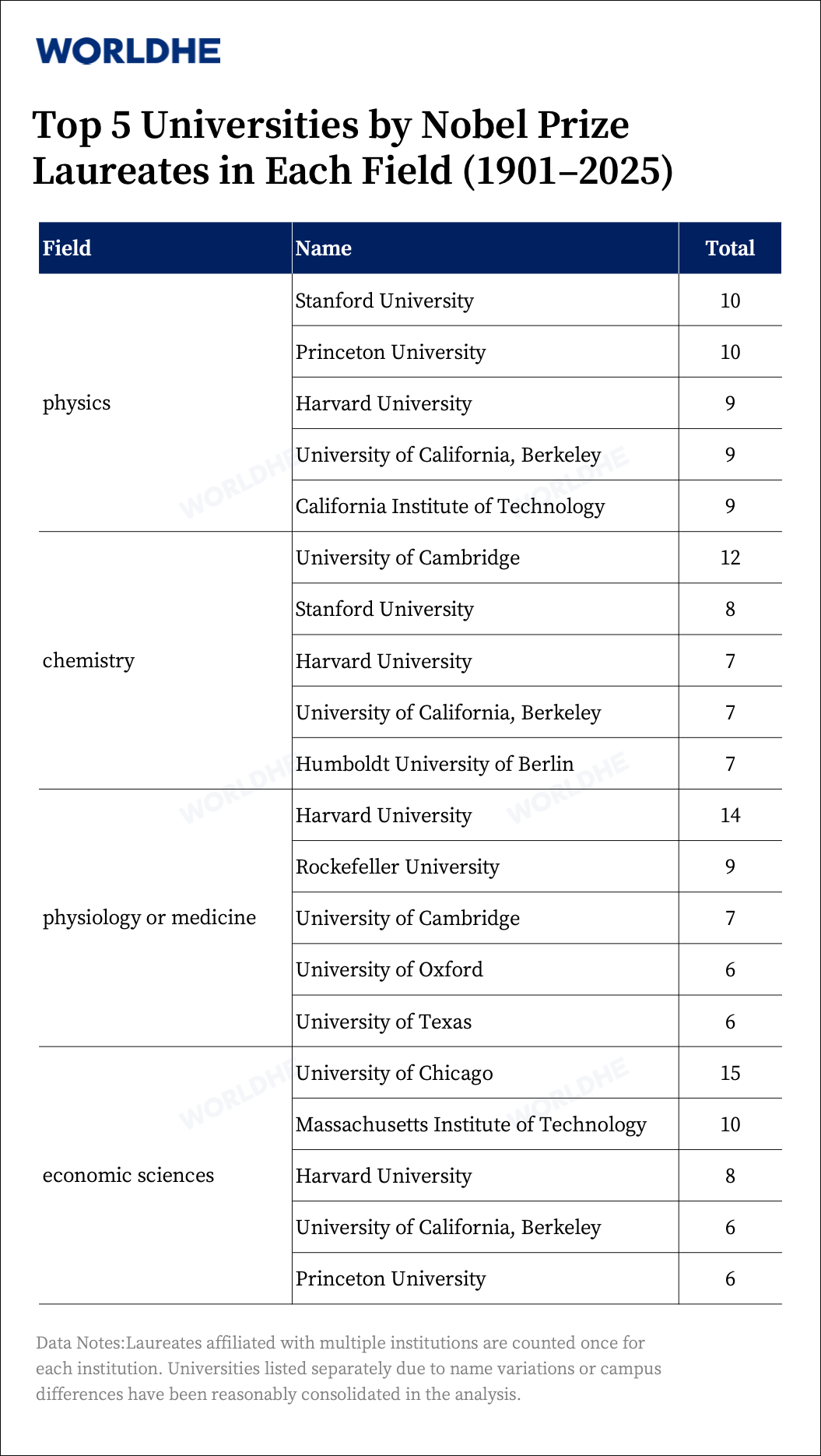
A closer look at Nobel Prize fields further reveals the distinct academic profiles of leading universities.
In Physics, Stanford University and Princeton University are tied for first with 10 counts each. In Chemistry, University of Cambridge ranks first with 12 counts, underscoring its enduring dominance in the basic sciences.
In Physiology or Medicine, Harvard University leads with 14 counts, followed by Rockefeller University with 9. Notably, all 13 of Rockefeller’s Nobel counts come exclusively from Physiology or Medicine and Chemistry, highlighting its strong specialization in the life sciences.
In Economic Sciences, the University of Chicago stands far ahead of all other institutions with 15 laureates, demonstrating the enduring influence of the Chicago School.
Because Nobel Prizes are often awarded with a substantial time lag—typically recognizing research conducted 20 to 30 years earlier—this analysis serves only as a lens through which to observe the global landscape of basic science and frontier research. Which university will produce the next generation of Nobel laureates? Only time will tell.
Data Notes: This analysis covers all Nobel laureates’ affiliations at the time of the award from 1901 to 2025. A total of 272 laureates had no recorded institutional affiliation. If a laureate was affiliated with multiple institutions, each institution was counted separately. Universities listed separately due to name variations or campus differences were reasonably consolidated during data analysis.


TRENDING
Why Imperial Surpassed Oxford and Cambridge in QS Rankings
Top Universities
Here's Who Runs the World's Top 50 Universities
Data & Rankings
Global University Rankings 2026: Who Leads the World?
Data & Rankings
Five University Scholars Win $1.2M 2026 Shaw Prize
Research & Innovation
Weekly Analysis: Nature, Science Output Concentrates Among Elite Universities
Data & Rankings