

Ten German Universities to Continue Excellence Funding


On March 16, the German Science Council announced that ten of the eleven institutions currently funded under the federal and state "Excellence Strategy" have been evaluated and received positive assessments. Starting January 1, 2027, the following institutions will receive funding for another seven years: RWTH Aachen University, the University of Bonn, the Berlin University Alliance (comprising Freie Universität Berlin, Humboldt-Universität zu Berlin, and Technische Universität Berlin), TU Dresden, Universität Hamburg, Heidelberg University, the Karlsruhe Institute of Technology (KIT), LMU Munich, the Technical University of Munich (TUM), and the University of Tübingen. The University of Konstanz did not meet the minimum required number of Clusters of Excellence to continue funding.
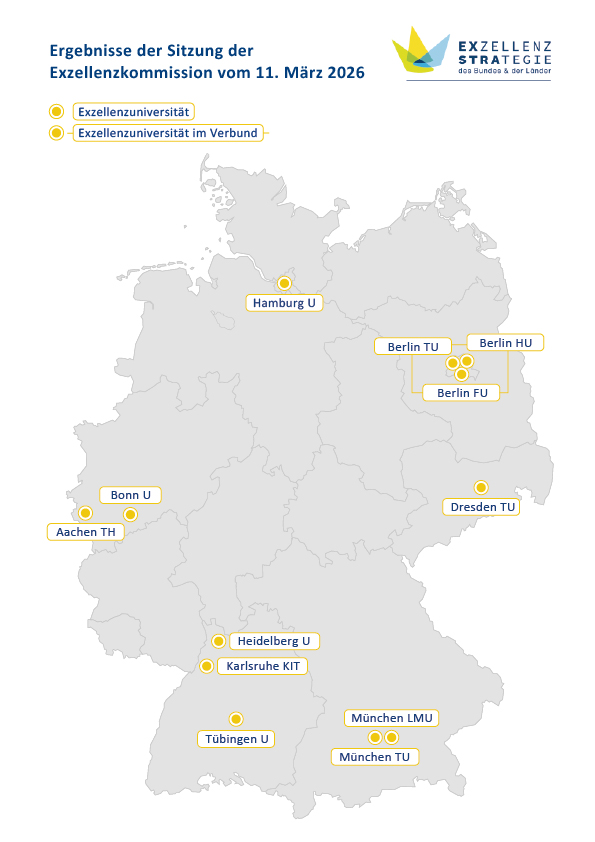
The decision was based on assessments by a Committee of Experts composed of international scientists and unanimously confirmed by the Excellence Commission. The commission includes the Committee of Experts and federal and state science ministers.
To ensure transparency and support a learning science system, the Committee of Experts' evaluations of each University of Excellence published on the German Science Council website.
The German Excellence Initiative (Exzellenzinitiative) is a program launched by the German Federal Ministry of Education and Research and the German Research Foundation to promote top-level research and academic innovation at German universities. The program funds outstanding universities, supports exceptional young researchers, strengthens cooperation between university projects, and enhances collaboration with international institutions.
In the first competition round in 2019, ten universities and one university consortium were selected for permanent funding under the "Universities of Excellence" line. To continue this funding, institutions must secure at least two Clusters of Excellence (three for consortia) and receive a positive evaluation every seven years.
After the Excellence Commission selected 70 Clusters of Excellence in May 2025 to receive funding starting January 1, 2026, it became clear that ten of the eleven sites still met the funding requirements. The University of Konstanz did not meet the minimum number of Clusters of Excellence.
For the 2027–2033 funding period, up to five additional Universities of Excellence or consortia can be funded through a science-driven selection process. In the first funding phase, total funding for this line was 148 million euros per year for eleven institutions.
An additional 60 million euros will be available for up to 15 institutions. Individual funding amounts range from 10 to 15 million euros annually for single universities and 15 to 28 million euros annually for consortia. The exact total for the upcoming phase will be determined after the decision on up to five additional Universities of Excellence, expected this October.


TRENDING
Why Imperial Surpassed Oxford and Cambridge in QS Rankings
Top Universities
Here's Who Runs the World's Top 50 Universities
Data & Rankings
Global University Rankings 2026: Who Leads the World?
Data & Rankings
Five University Scholars Win $1.2M 2026 Shaw Prize
Research & Innovation
Weekly Analysis: Nature, Science Output Concentrates Among Elite Universities
Data & Rankings