
China’s research rise puts talent and international collaboration at centre of next phase, NSFC chief says


China’s growing contribution to high-impact research reflects the country’s expanding pool of research talent and increasing investment in science, according to Dou Xiankang, president of the National Natural Science Foundation of China (NSFC) and an academician of the Chinese Academy of Sciences.
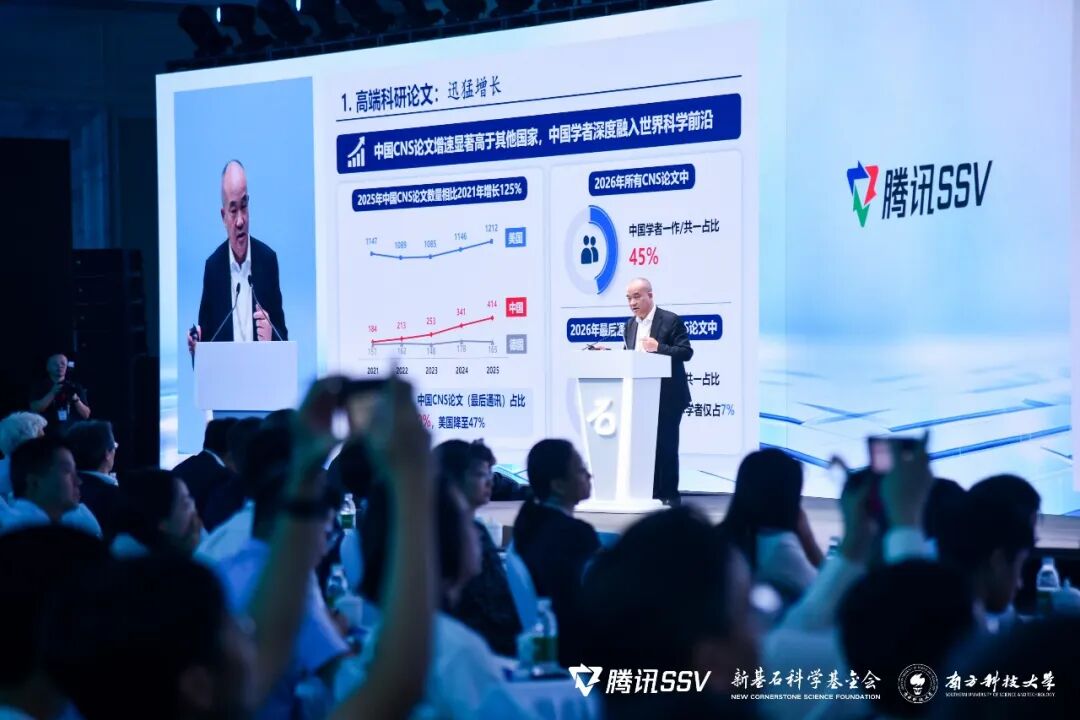
Speaking at the sixth New Cornerstone 50² Forum, held by the New Cornerstone Science Foundation in Shenzhen on 19 September, Dou outlined the current state of Chinese science and the reforms planned by the country’s main funding agency for basic and applied fundamental research.
China’s growing presence in top journals
Dou said that while individual papers are not sufficient to measure the strength of a country’s research system, publication patterns in leading journals can provide a useful indicator when considered at scale.
He cited data from the first half of 2026 showing that researchers in China accounted for around 20% of papers published in Cell, Nature and Science — collectively known as the CNS journals.
When looking only at papers for which the final corresponding author was based in China, the proportion was approximately 20%, compared with around 47% for the United States, according to figures presented by Dou.
However, he said the picture changes when the contribution of Chinese researchers working in international research teams is taken into account.
Among CNS papers with a US-based final corresponding author, Chinese researchers accounted for 39% of first or co-first authors. When papers with final corresponding authors based in Germany, the UK and Japan were also included, the proportion of papers with a Chinese first or co-first author rose to about 45%.
Using a broader measure of major contributors, Dou put the figure at approximately 56%.
Taken together, he argued, the figures suggest that Chinese researchers are now closely connected to a substantial share of the world’s highest-profile scientific research.
Talent at the centre of research breakthroughs
For Dou, the key question is what will determine China’s next phase of scientific development.
“The source of breakthroughs in scientific research is talent,” he said, arguing that China’s future research performance will depend increasingly on its ability to stimulate the creativity and initiative of its most innovative researchers.
He pointed to several developments underpinning China’s growing research capacity, including rapid economic growth, increased investment in science and research, more flexible research policies, the expansion of high-level academic staff at universities, and improvements in scientific infrastructure and instrumentation.
China has also seen a substantial increase in the number of internationally trained researchers returning to the country. Dou said that, by last year, the number of Chinese students going overseas to study and those returning had reached a dynamic balance — a development he described as evidence of the country’s growing scientific and economic strength.
Data presented by Dou also pointed to the growing scale of China’s active research community.
The number of active researchers publishing in leading international journals surpassed that of the US in 2021, he said, and is now around seven times the level in Japan.
Dou also highlighted the age profile of highly cited researchers. In China, researchers aged over 55 accounted for 44% of the group, those aged 40 to 55 for 47%, and those under 40 for 9%, a distribution he described as comparatively healthy among major research systems.
The figures form part of a broader shift in China’s research system towards greater support for younger scientists.
NSFC shifts funding towards early-career researchers
Dou outlined a series of reforms at the NSFC, which has become one of China’s principal funding bodies for basic research, applied fundamental research and frontier interdisciplinary research following reforms to the country’s national research system.
Funding has increasingly shifted towards younger researchers. According to Dou, almost 90% of NSFC-funded projects this year are led by early-career researchers, while researchers under the age of 45 account for around 75% of total funding.
The NSFC has also expanded its Young Scientists Fund (Category C), which is designed to provide early-career researchers with an initial opportunity to establish an independent research programme.
An additional RMB36 billion has been allocated to the programme this year, supporting 12,046 more projects and representing an increase of more than 50%, Dou said.
A further reform introduced this year creates a separate track within the Young Scientists Fund Category A for researchers under 35, or women under 38. The first cohort includes 44 researchers.
Dou said the selected researchers would receive support under a “5+5+5” model, with funding designed to provide longer-term continuity.
“We do not conduct any short-cycle target assessment. We assess only one thing: whether you are in the laboratory,” he said.
The approach reflects an attempt to give promising young researchers greater time and flexibility to pursue high-risk or longer-term research, rather than subjecting them to frequent short-term performance assessments.
Expanding international research collaboration
Dou also highlighted the NSFC’s efforts to expand its international funding and research partnerships.
In addition to supporting collaboration between Chinese and overseas researchers, the foundation is seeking to attract international doctoral students to China.
“We hope that students from technologically advanced Western countries, particularly those studying the natural sciences, will be able to come to China to complete their PhDs,” Dou said.
The NSFC and China’s Ministry of Education are jointly working on the initiative, he added, expressing confidence that it would produce further results in the near future.
The proposals reflect a broader effort to position China not only as a major source of scientific research and talent, but also as a destination for international researchers and doctoral students.


TRENDING
Good University Guide 2027: St Andrews Takes No. 1 as Imperial Climbs Three Places
Data & Rankings
From Lasker to Nobel: The Universities Behind Biomedical Breakthroughs
Data & Rankings
Before the Nobel: Which Universities Are Leading in Biomedical Breakthroughs?
Data & Rankings
WorldHE NS Watch: Harvard, MIT and Stanford Lead Global Nature and Science Output in August
Data & Rankings
Where Fields Medalists Studied and Worked?
Data & Rankings