

Canadian Academy of Health Sciences Elects 59 New Fellows for 2026


The Canadian Academy of Health Sciences (CAHS) has elected 59 new Fellows for 2026, recognizing a diverse group of leaders whose expertise spans clinical care, biomedical research, public health, health systems, Indigenous health, social sciences, health policy, education and community engagement.
The new Fellows come from a range of disciplines, sectors and regions across Canada, reflecting the breadth of the country’s health sciences community.
“Each year, the election of new Fellows strengthens the depth and diversity of expertise within our Academy,” said Dr. Elham Emami, chair of the Fellowship Committee. “The 2026 cohort reflects the remarkable breadth of Canada’s health sciences community and the many ways in which leadership, innovation, and service contribute to improving the health and well-being of Canadians.”
Election to CAHS is considered one of the highest honours in Canada’s health sciences community. Fellows are nominated and elected by their peers based on distinguished achievements and sustained contributions to advancing knowledge, improving health and shaping healthier societies.
The Fellowship also carries an ongoing service commitment. Beyond recognition of their individual achievements, Fellows contribute to CAHS assessments, strategic initiatives and public policy advice. Their work helps the Academy evaluate emerging health challenges and provide evidence-based recommendations to decision-makers across Canada.
“Election to CAHS is both a recognition of exceptional achievement and a call to service,” said Dr. Jan Sargeant, president of CAHS.
“Our Fellows contribute not only through their individual leadership and scholarship, but also through the collective work of the Academy. By bringing together diverse expertise and perspectives, they help generate the evidence, insight, and guidance needed to strengthen health and health systems in Canada,” Sargeant said.
Universities Account for the Majority of New Fellows
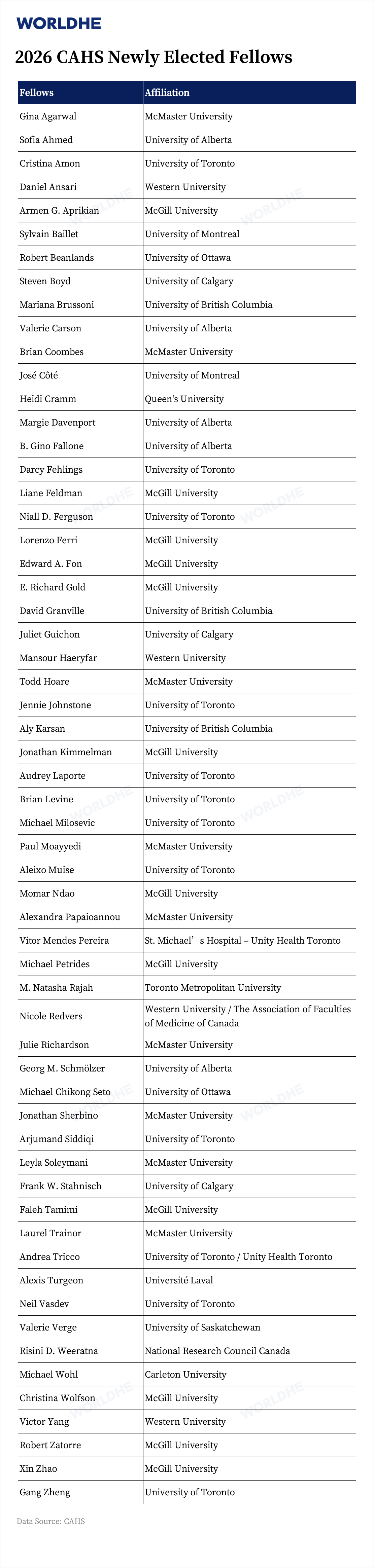
Higher education institutions account for the overwhelming majority of the 2026 cohort. Fifty-seven of the 59 new Fellows are affiliated with universities, representing 14 institutions across Canada.
McGill University and the University of Toronto lead the institutional rankings, with 12 new Fellows each.
McMaster University follows with nine new Fellows, underscoring the university’s strong presence in health and biomedical research.
The University of Alberta and Western University also recorded significant representation, with five and four new Fellows, respectively.
The concentration of new Fellows within universities highlights the central role of higher education institutions in Canada’s health sciences research ecosystem, from biomedical discovery and clinical research to public health, health policy and health systems.
2026 CAHS Fellows
The complete list of the 59 newly elected Fellows for 2026 is as follows:
About the Canadian Academy of Health Sciences
The Canadian Academy of Health Sciences brings together leading health and biomedical scientists and scholars from across Canada. Its Fellows represent a wide range of disciplines and institutions, including universities, health-care organizations and research institutes.
Through assessments, strategic initiatives and policy advice, CAHS draws on this expertise to examine complex health challenges and develop evidence-informed recommendations intended to improve the health and well-being of Canadians.


TRENDING
Before the Nobel Prizes: Which Universities Are Leading the Pipeline of Future Laureates?
Data & Rankings
Where Fields Medalists Studied and Worked?
Data & Rankings
Which Universities Are Producing the Next Nobel Laureates? The Breakthrough Prize Offers Some Clues
Data & Rankings
MIT Tops QS World Rankings for 15th Straight Year
Data & Rankings
Harvard Tops U.S. News Global University Rankings
Data & Rankings