
U.S. Higher Education Workforce Shrinks Sharply as Colleges Continue to Cut Staff


The U.S. higher education workforce contracted sharply in 2025, with both full-time and part-time staff headcounts falling significantly from the previous year, according to the latest data from the College and University Professional Association for Human Resources (CUPA-HR).
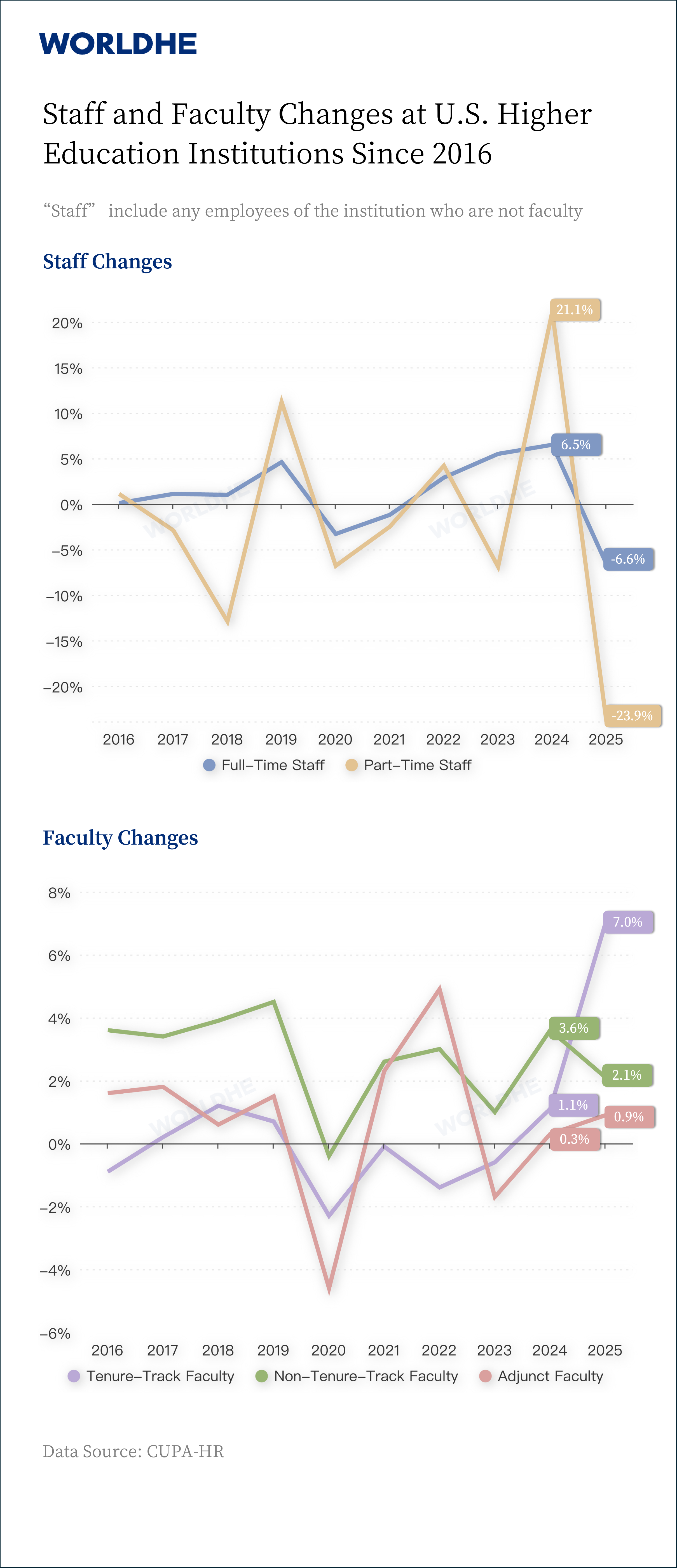
CUPA-HR’s latest report, The Size of the Higher Ed Workforce Changes, shows a sharp reversal from the workforce growth recorded in 2024. Full-time staff headcount fell 6.6% in 2025, ending a multiyear period of growth that peaked at 6.5% in 2024.
The decline was even steeper among part-time employees, whose headcount plunged 23.9% in 2025. That followed an unprecedented 21.1% increase in 2024.
The sharp reversal highlights the greater volatility of part-time employment in higher education compared with full-time positions. It also suggests that colleges and universities broadly reduced staffing levels in 2025, with part-time employees bearing the brunt of the cuts.
Faculty employment, however, moved in the opposite direction, with headcounts increasing across all categories.
The most notable growth came among tenure-track faculty, whose numbers rose 7.0% from the previous year. That marked the largest single-year increase since 2016 and represented a significant acceleration from the 1.1% growth recorded in 2024. Meanwhile, growth among non-tenure-track faculty slowed to 2.1%, down from 3.6% the previous year.
It was the first time in the decade covered by the data that the growth rate for tenure-track faculty surpassed that of non-tenure-track faculty.
Adjunct faculty also saw modest growth in 2025, with headcount increasing 0.9%. That marked a second consecutive year of slow but steady growth, following a 0.3% increase in 2024.
CUPA-HR’s latest figures are based on data collected as of November 1, 2025. The trend may have continued into 2026, as many colleges and universities have continued to reduce their workforces in an effort to address projected budget deficits for fiscal year 2027.
In June, Johns Hopkins University eliminated approximately 110 positions as it responded to cuts in federal research funding. The university described the layoffs as a “last resort,” with most of the affected employees working in administrative roles.
In a statement, Johns Hopkins said that as the scale of federally funded research programs continues to shrink, the infrastructure and support systems built around those programs must also be adjusted.
The university had already implemented a series of significant cost-cutting measures last year, including a hiring freeze, suspending annual salary increases for employees earning more than $80,000, reducing nonessential spending, eliminating vacant positions, and cutting planned capital spending by 20% over the next five years.
With colleges and universities still under pressure from shrinking federal research funding, tighter budgets and rising operating costs, the U.S. higher education workforce could contract further in 2027.


TRENDING
Before the Nobel Prizes: Which Universities Are Leading the Pipeline of Future Laureates?
Data & Rankings
Where Fields Medalists Studied and Worked?
Data & Rankings
Which Universities Are Producing the Next Nobel Laureates? The Breakthrough Prize Offers Some Clues
Data & Rankings
MIT Tops QS World Rankings for 15th Straight Year
Data & Rankings
Harvard Tops U.S. News Global University Rankings
Data & Rankings