
European Academy of Engineering Reveals 2026 Members


Recently, the official website of the European Academy of Engineering (EAE) has been gradually updating the list of newly elected members for the year 2026.
Membership in the European Academy of Engineering represents one of the highest academic honors in the international engineering science and technology community. The European Academy of Engineering was founded in 1992 in Gothenburg, Sweden, by members of the engineering academies of France, Germany, the United Kingdom, Italy, Spain, and Switzerland. It operates independently of any individual country or government and represents the academic authority in the fields of engineering and technology across Europe.
Currently, the European Academy of Engineering has more than 390 members from 25 countries worldwide, covering a wide range of engineering disciplines, including civil engineering, mechanical engineering, electronics, chemical engineering, biological engineering, medical engineering, artificial intelligence, and other fields. Its members include recipients of 37 Nobel Prizes, 29 Fields Medals, 17 Turing Awards, and other internationally renowned honors. The election of academy members is conducted through a rigorous peer-review process, with candidates selected from nearly ten million engineering and technology scholars worldwide, resulting in an extremely low acceptance rate.
The European Academy of Engineering consists of 13 Engineering Classes, namely:
- Fundamental Sciences and Mathematical Sciences (F.M.S.)
- Computer Science and Information Technology (C.S.E.)
- Electronics and Electrical Engineering (E.E.E.)
- Mechanical Engineering and Materials (M.M.E.)
- Chemical Engineering (C.H.E.)
- Biomedical Engineering (B.M.E.)
- Civil and Environmental Engineering (C.V.E.)
- Energy and Resource Engineering (E.R.E.)
- Aerospace and Transportation Engineering (A.T.E.)
- Agriculture and Food Engineering (A.F.E.)
- Industrial and Manufacturing Engineering (I.M.E.)
- Metallurgy and Materials Engineering (M.A.E.)
- Process Systems Engineering and Engineering Management (P.S.E.)
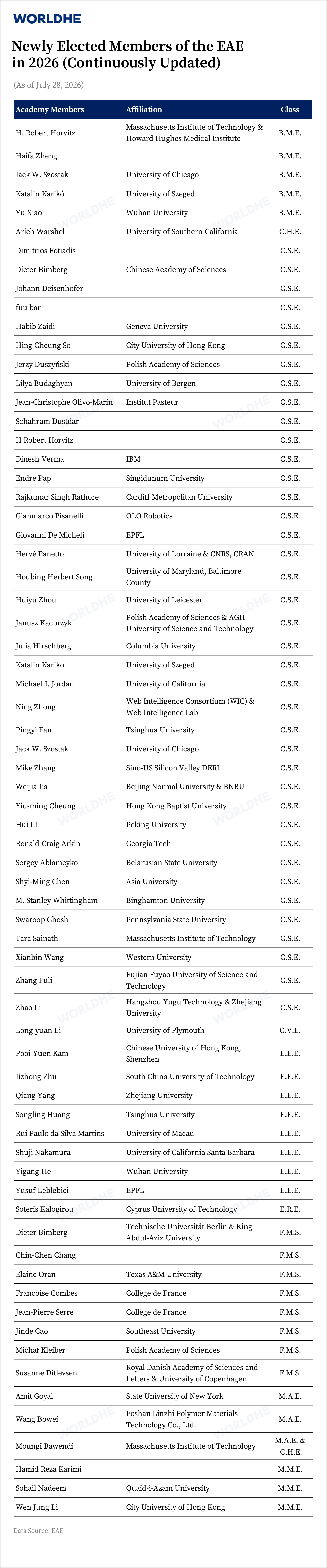
The 13 Engineering Classes conduct their member elections independently. As of July 28, the official website has announced 69 newly elected members for the year 2026. Among them, Massachusetts Institute of Technology (MIT) has three newly elected members, while City University of Hong Kong, EPFL, Tsinghua University, University of Chicago, University of Szeged, Collège de France, Wuhan University, and Zhejiang University each have two newly elected members.
In addition, the updated list of 2026 EAE newly elected members includes several internationally renowned scholars and distinguished award recipients, including Jack W. Szostak, recipient of the 2009 Nobel Prize in Physiology or Medicine; Moungi G. Bawendi, recipient of the 2023 Nobel Prize in Chemistry; Katalin Karikó, recipient of the 2023 Nobel Prize in Physiology or Medicine; Johann Deisenhofer, recipient of the 1988 Nobel Prize in Chemistry; M. Stanley Whittingham, recipient of the 2019 Nobel Prize in Chemistry; H. Robert Horvitz, recipient of the 2002 Nobel Prize in Physiology or Medicine; Shuji Nakamura, recipient of the 2014 Nobel Prize in Physics; Arieh Warshel, recipient of the 2013 Nobel Prize in Chemistry; and Fields Medalist Jean-Pierre Serre, among other distinguished scholars.
The detailed list of newly elected members is as follows:


TRENDING
Good University Guide 2027: St Andrews Takes No. 1 as Imperial Climbs Three Places
Data & Rankings
From Lasker to Nobel: The Universities Behind Biomedical Breakthroughs
Data & Rankings
Before the Nobel: Which Universities Are Leading in Biomedical Breakthroughs?
Data & Rankings
WorldHE NS Watch: Harvard, MIT and Stanford Lead Global Nature and Science Output in August
Data & Rankings
Where Fields Medalists Studied and Worked?
Data & Rankings