

U.S. PhD Admissions Plunge as Research Funding Shrinks


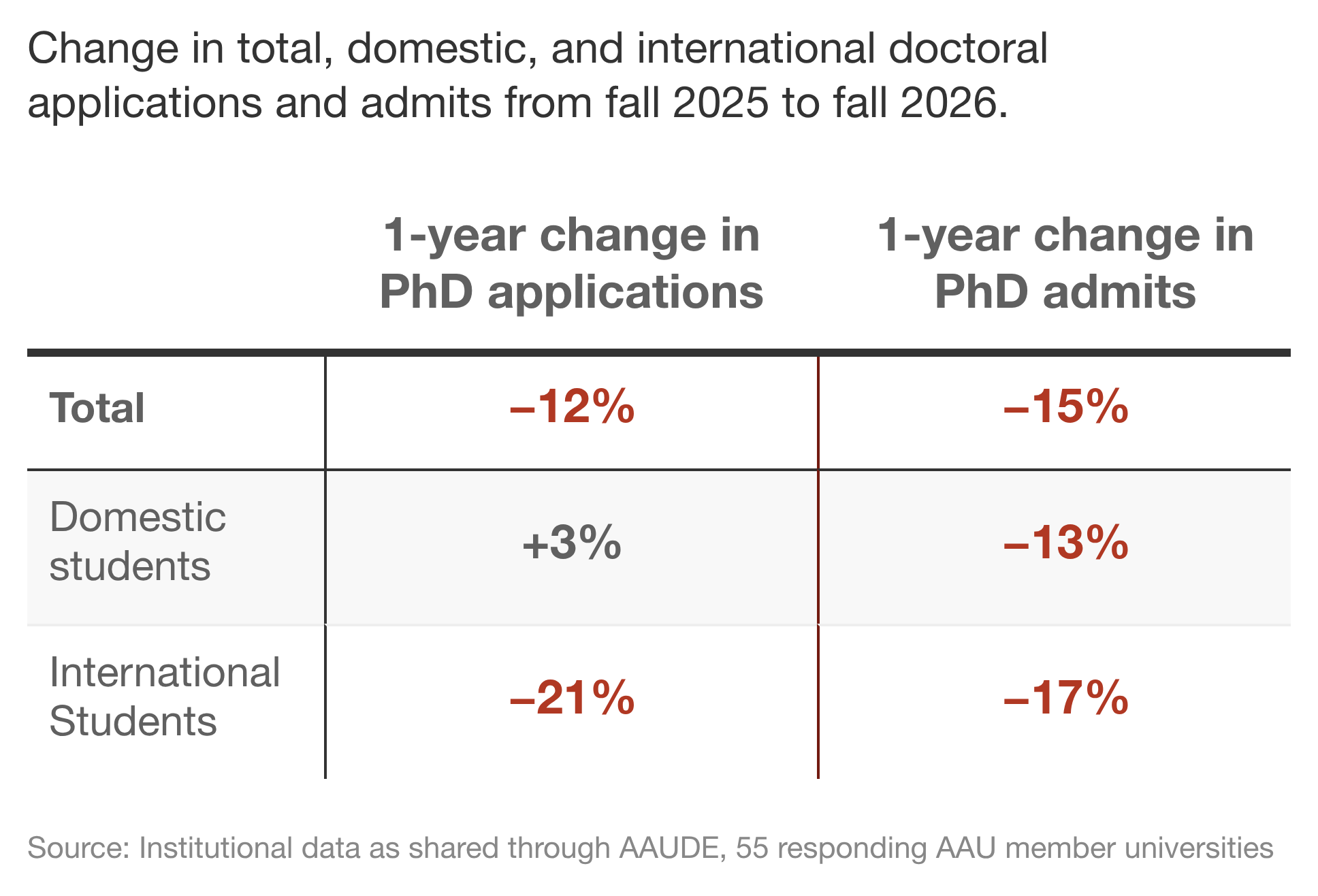
Data collected by the Association of American Universities Data Exchange (AAUDE) from 55 member institutions of the Association of American Universities (AAU) show that doctoral admissions—a key indicator of universities’ ability to enroll new PhD students—fell by 15% overall in fall 2026 compared with the previous year.
At the same time, while applications from domestic students to doctoral programs increased by 3%, applications from international students declined by 21%.
The decline has been even more pronounced at some universities. According to The New York Times, the California Institute of Technology expects to enroll 40% fewer new graduate students this fall, while the Massachusetts Institute of Technology anticipates about 20% fewer new graduate students.
The AAU attributes the decline in graduate admissions directly to the financial uncertainty facing universities as a result of declining and increasingly unpredictable federal research funding.
Since the beginning of last year, federal research agencies such as the National Institutes of Health (NIH) and the National Science Foundation (NSF) have terminated previously awarded grants, faced proposals from the current administration for substantial budget cuts, and slowed the pace of new grant awards despite receiving adequate congressional appropriations. These agencies are among the primary sources of research funding for U.S. universities.
Meanwhile, changes in U.S. immigration policy have made international students feel less welcome, while universities in other countries have intensified their efforts to recruit international STEM talent. Together, these developments appear to have reduced international students’ interest in pursuing doctoral education in the United States.
The result has been a broad contraction in doctoral training capacity across research universities. Indeed, many institutions have gone so far as to suspend doctoral admissions altogether, turning away highly qualified applicants—including those in strategically important fields such as artificial intelligence, quantum computing, and advanced engineering.
The disruption also extends to students already well advanced in their doctoral studies. PhD candidates whose research has been derailed by abrupt grant terminations and delayed funding renewals have been forced to abandon their original dissertation projects, seek new faculty advisors, and, in some cases, postpone completion of their degrees by more than a year.
The AAU concludes with a stark warning: as PhD admissions continue to decline, the United States faces the alarming prospect of losing an entire generation of scientific talent. The global scientific leadership that the United States has spent decades building is now at risk.


TRENDING
Before the Nobel Prizes: Which Universities Are Leading the Pipeline of Future Laureates?
Data & Rankings
Where Fields Medalists Studied and Worked?
Data & Rankings
Which Universities Are Producing the Next Nobel Laureates? The Breakthrough Prize Offers Some Clues
Data & Rankings
MIT Tops QS World Rankings for 15th Straight Year
Data & Rankings
Harvard Tops U.S. News Global University Rankings
Data & Rankings