
Who Leads the World's Top Universities?


As the chief executive of a university, the president represents the institution externally while overseeing its operations internally. They are the "key minority" whose decisions shape the university's strategic direction. Presidents of the world's leading universities, in particular, rank among the most influential figures in global higher education.
Following the release of the QS World University Rankings 2027, and coinciding with the appointments of new presidents at California Institute of Technology, Columbia University, and Northwestern University on July 1, WorldHE compiled data on the presidents of the top 50 universities in the latest QS rankings. The analysis examines their highest academic qualifications, alma maters, disciplinary backgrounds, interdisciplinary experiences, and age profiles, revealing a portrait of today's leaders of elite universities.
The findings show that they are predominantly scholars in their sixties holding doctoral degrees, most of whom were trained in the natural or social sciences. Nearly half are also serving as presidents of their own alma maters.
The Alumni Network Behind the Presidents of the QS Top 50 Universities
According to publicly available information, 47 of the 50 presidents (94%) hold doctoral degrees. Only two have a master's degree as their highest qualification, while one holds only a bachelor's degree.
Where did these university presidents study?
WorldHE collected information on the bachelor's, master's, and doctoral institutions attended by all 50 presidents in an effort to map the alumni network behind the world's leading universities.
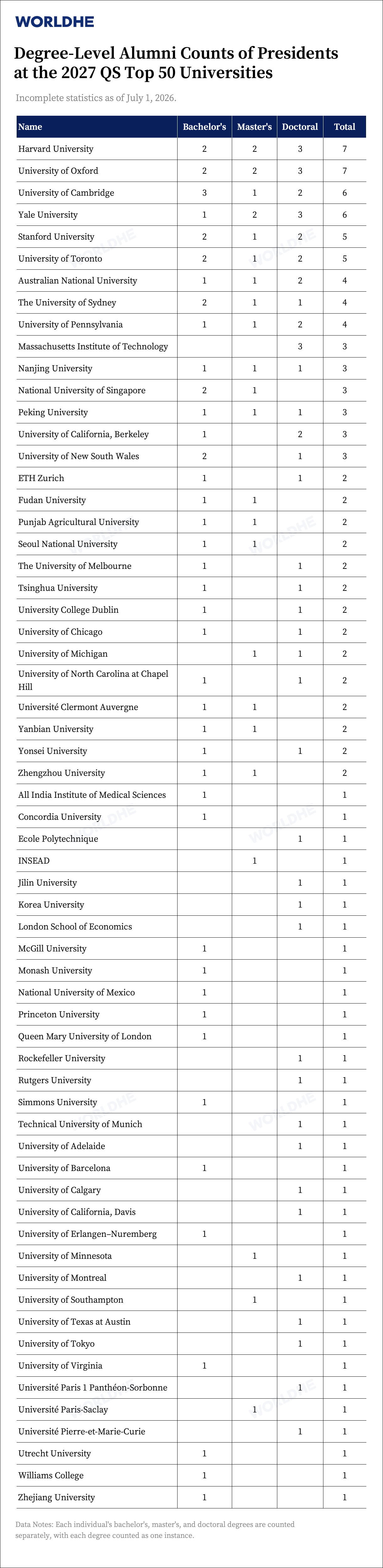
The results show that Harvard University and the University of Oxford each account for seven degree records among the presidents, consisting of two bachelor's degrees, two master's degrees, and three doctorates respectively.
They are followed by the University of Cambridge and Yale University, each with six degree records. Cambridge contributed three bachelor's degrees, one master's degree, and two doctorates, while Yale accounts for one bachelor's degree, two master's degrees, and three doctorates.
Stanford University and the University of Toronto each contributed five degree records.
Other universities with three or more degree records include Australian National University, the University of Sydney, the University of Pennsylvania, Massachusetts Institute of Technology, Nanjing University, National University of Singapore, Peking University, the University of California, Berkeley, and the University of New South Wales.
Although the list is still dominated by institutions from the United States and the United Kingdom, the presence of Nanjing University, National University of Singapore, and Peking University highlights the growing influence of Asian universities—particularly those in China mainland—in cultivating future leaders of global higher education.
The educational journeys of these presidents also foreshadowed their future careers.
Among the 50 presidents, 20 currently lead their own alma maters. Presidents who return to their alma mater often possess a deep understanding of the institution's traditions and culture, while externally appointed leaders tend to bring broader experience and fresh perspectives gained from other universities.
Academic Backgrounds of Presidents at the QS Top 50 Universities
WorldHE also compiled the academic disciplines studied by all 50 presidents at the bachelor's, master's, and doctoral levels. The disciplines were classified according to the International Standard Classification of Education: Fields of Education and Training 2013 (ISCED-F 2013) developed by the UNESCO Institute for Statistics.
The disciplinary distribution reveals a clear concentration of academic backgrounds among university presidents.
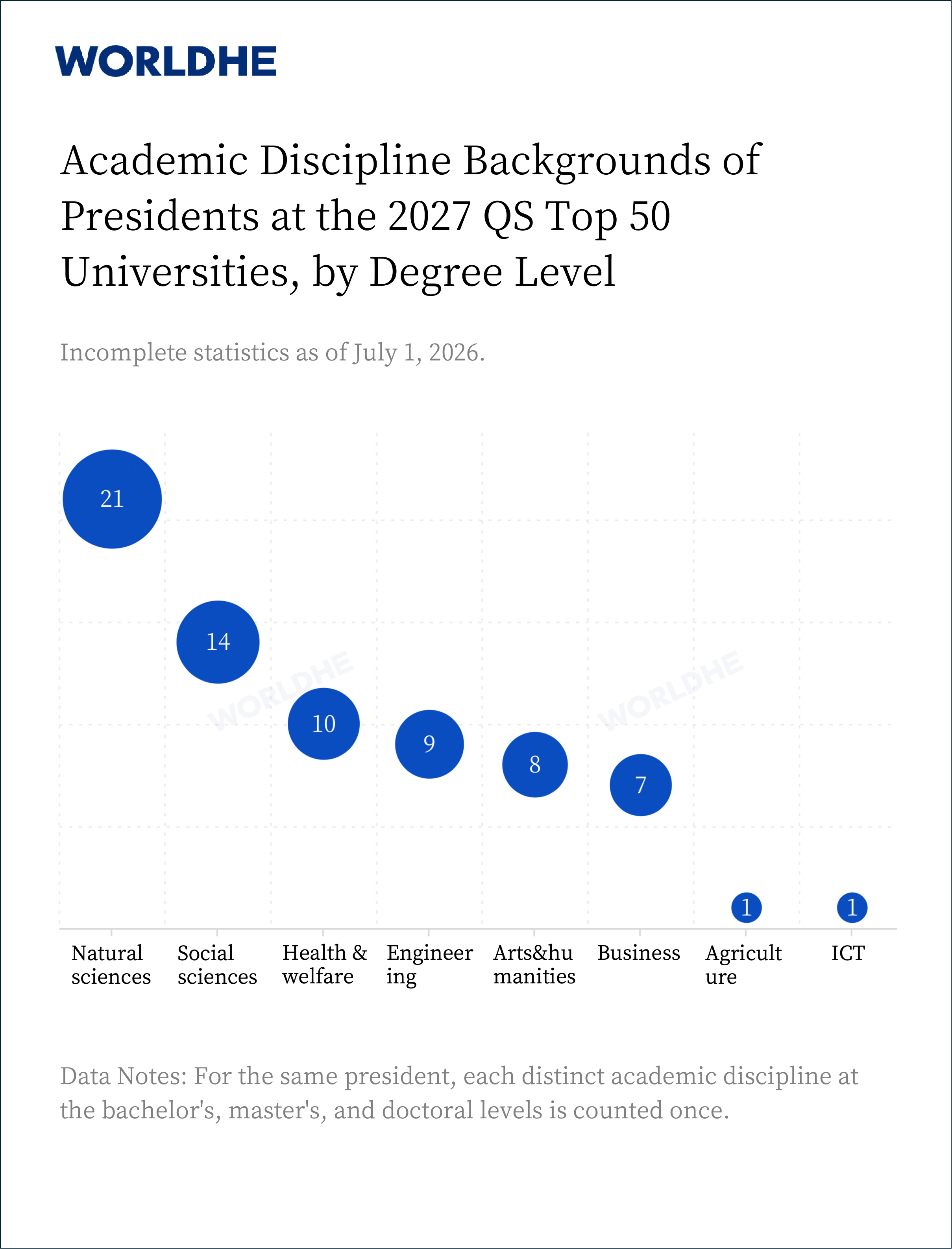
The largest group—21 presidents—has backgrounds in Natural sciences, mathematics and statistics, accounting for nearly half of the sample and underscoring the enduring importance of fundamental research in academic leadership.
The second most common field is Social sciences, journalism and information, represented by 14 presidents, followed by Health and welfare, with 10 presidents.
These findings suggest that, alongside the traditional dominance of the natural sciences, social sciences and health-related disciplines are becoming increasingly prominent pathways to university leadership, reflecting the growing emphasis universities place on public engagement, social impact, and health-related challenges.
At the same time, interdisciplinary academic training has become an increasingly significant characteristic of university presidents.
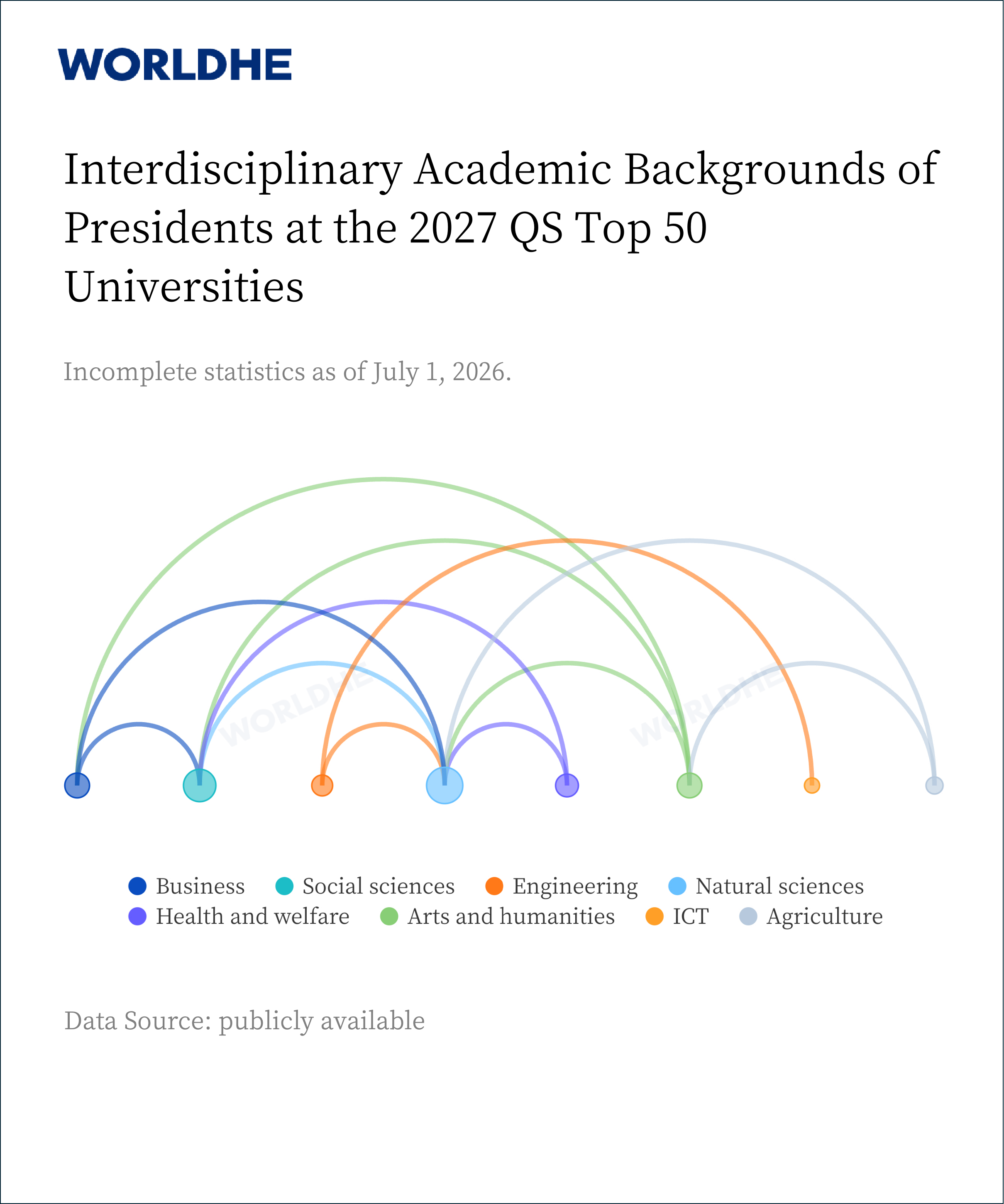
The data show that 19 presidents pursued degrees spanning multiple disciplinary fields across their bachelor's, master's, and doctoral education.
Among these interdisciplinary leaders, the most common combination is Business, administration and law together with Social sciences, journalism and information, shared by four presidents. This combination reflects the growing integration of management, public communication, governance, and legal expertise in university leadership.
The second most common combinations are Engineering, manufacturing and construction with Natural sciences, mathematics and statistics, and Health and welfare with Natural sciences, mathematics and statistics, each represented by three presidents.
These interdisciplinary pathways are far from coincidental. They reflect the increasing demand for integrated expertise in modern university governance.
As universities confront increasingly complex challenges, effective leadership requires individuals capable of bridging the boundaries between the natural sciences, social sciences, and professional disciplines.
Notes
1. Information on university presidents was manually collected from publicly available sources. Data on some presidents' educational backgrounds and academic disciplines remain incomplete; therefore, the analysis should be regarded as incomplete. Degree statistics are reported by degree records rather than by individuals. If a president earned bachelor's, master's, and doctoral degrees from the same university, that institution is counted three times. For disciplinary statistics, if all of a president's degrees belong to the same discipline, the discipline is counted once. If a president studied in two or more different disciplines, each discipline is counted once.
2. The disciplinary categories used in this analysis follow the broad field definitions of the International Standard Classification of Education: Fields of Education and Training 2013 (ISCED-F 2013) established by the UNESCO Institute for Statistics. The disciplines included are Natural sciences, mathematics and statistics (abbreviated as Natural sciences), Social sciences, journalism and information (Social sciences), Health and welfare, Engineering, manufacturing and construction (Engineering), Arts and humanities, Business, administration and law (Business), Agriculture, forestry, fisheries and veterinary (Agriculture), and Information and Communication Technologies (ICT).


TRENDING
MIT Tops QS World Rankings for 15th Straight Year
Data & Rankings
Harvard Tops U.S. News Global University Rankings
Data & Rankings
Global Nature and Science Leaders, H1 2026
Data & Rankings
Nobel Laureate Omar M. Yaghi Joins Tsinghua Full-Time
Top Universities
Top-Ranked Journals in Each JCR Category: 2026 Rankings Released
Research & Innovation