

Oxford Leads Royal Society’s 2026 New Fellows


On May 27 local time, the Royal Society, the UK’s national academy of sciences, announced the results of its 2026 Fellowship elections, with 93 Fellows and 1 Honorary Fellow elected this year.
According to the Society, “This year’s cohort includes pioneers and leaders across a range of scientific fields, from astronomy and cancer research to mathematics and biotechnology.” Among this year’s newly elected Fellows and Honorary Fellows, 26% are women. The new Fellows come from 20 institutions across the UK, including the University of Lancaster, the University of Southampton, and BirdLife International. They have also been elected from countries around the world, including Kenya, Japan, and Mexico.
An analysis of the institutional affiliations of the 93 newly elected Fellows shows that 70 of them are affiliated with universities. These Fellows come from 45 universities in total, meaning that university-affiliated members account for as much as 75% of the cohort, highlighting the dominant role of universities in scientific research. (If a Fellow has multiple affiliations, each institution is counted separately.)
The University of Oxford had the largest number of newly elected Fellows this year, with 12 scholars successfully elected, demonstrating its leading position in scientific research in the UK. The University of Cambridge followed with 7 newly elected Fellows, also delivering an impressive performance. Harvard University, University College London, and the University of California, Berkeley each had 3 scholars elected.
The California Institute of Technology, the Massachusetts Institute of Technology, Queen Mary University of London, the University of Chicago, the University of Manchester, the University of Sheffield, the University of Toronto, and the University of Washington each had 2 scholars elected.
In addition, 32 other universities each had 1 scholar elected.
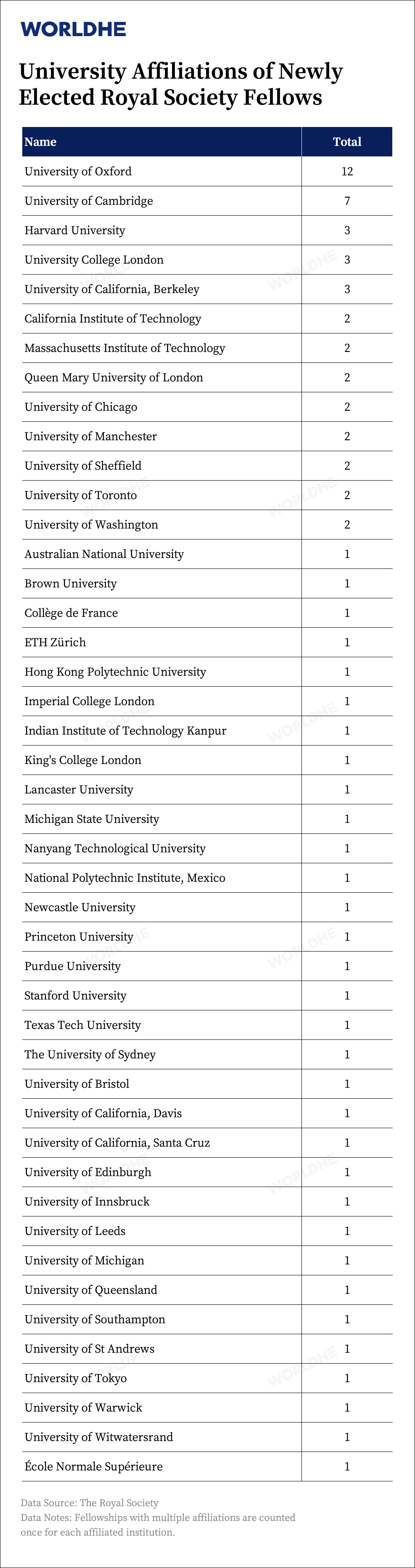
It is also worth noting that Dame Anne Rafferty was elected as an Honorary Fellow this year. She previously served as the former Chancellor of the University of Sheffield.
Sir Paul Nurse, President of the Royal Society, said: “Our Fellowship is strengthened not only by individual distinction, but by the diversity of perspectives and experiences its members bring. This incoming cohort highlights the truly international character of contemporary science and underscores the vital role that plays in achieving breakthroughs that benefit us all.”
About the Royal Society
The Royal Society’s fundamental purpose, reflected in its founding Charters of the 1660s, is to recognise, promote and support excellence in science and to encourage the development and use of science for the benefit of humanity.
As an independent Fellowship made up of the most eminent scientists, engineers and technologists from across the scientific landscape, the Society recognises excellence and elects Fellows from all over the world. Fellows are elected for life through a peer review process on the basis of excellence in science. There are currently approximately 1,900 Fellows, including around 85 Nobel Laureates. Each year up to 109 Fellows (including up to 24 via the Foreign Membership route) are elected from a group of around 800 candidates who are proposed by the existing Fellowship.


TRENDING
MIT Tops QS World Rankings for 15th Straight Year
Data & Rankings
Harvard Tops U.S. News Global University Rankings
Data & Rankings
Global Nature and Science Leaders, H1 2026
Data & Rankings
Nobel Laureate Omar M. Yaghi Joins Tsinghua Full-Time
Top Universities
Top-Ranked Journals in Each JCR Category: 2026 Rankings Released
Research & Innovation