
Eight Scholars Named 2026 Brown Investigators with $2M Grants


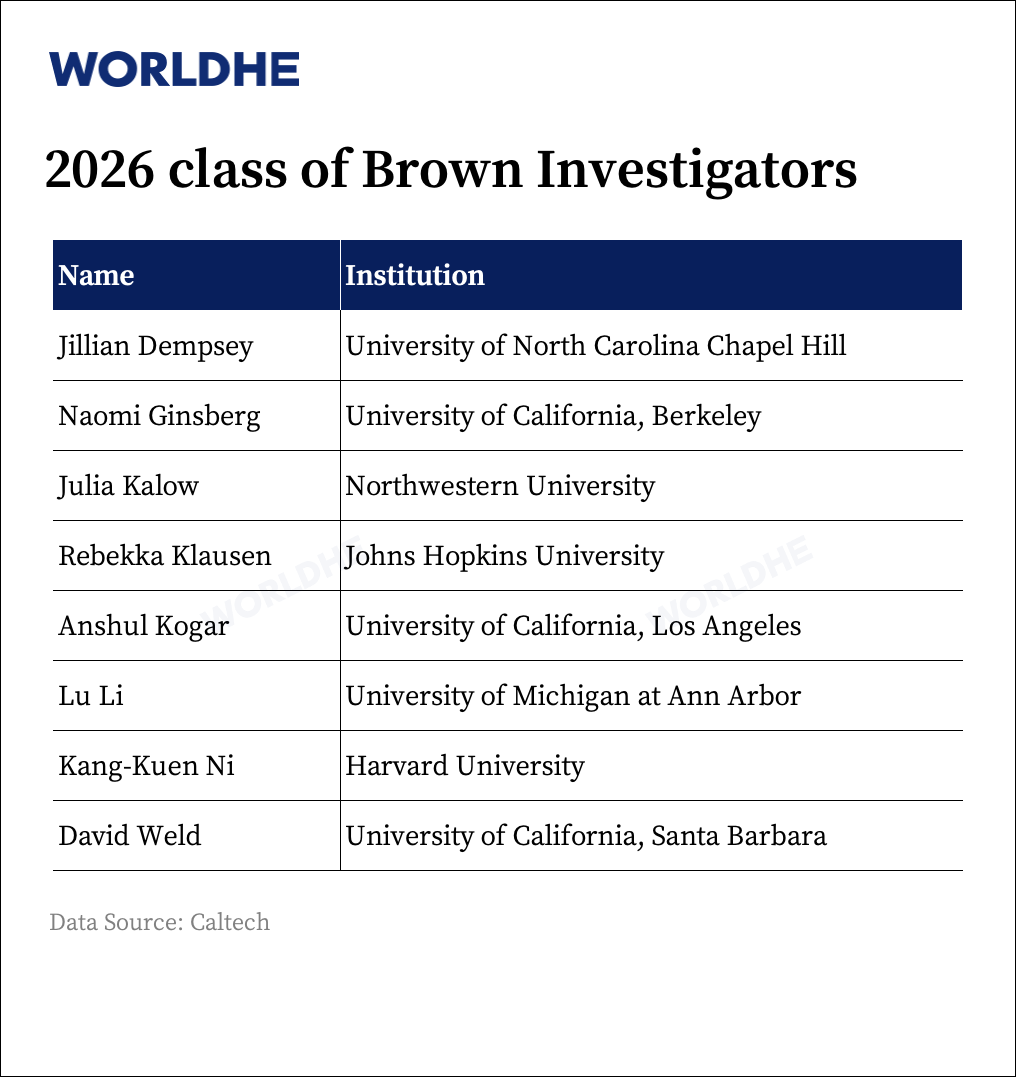
On May 18,The Brown Institute for Basic Sciences at Caltech announced the 2026 class of Brown Investigators. The cohort, the third to be selected through the Brown Institute for Basic Sciences, comprises eight distinguished mid-career faculty working on fundamental challenges in the physical sciences, particularly those with potential long-term practical applications in chemistry and physics. Each investigator will receive up to $2 million over five years.
The eight scholars come respectively from University of North Carolina at Chapel Hill, University of California, Berkeley, Northwestern University, Johns Hopkins University, University of California, Los Angeles, University of Michigan, Harvard University, and University of California, Santa Barbara.
The 2026 investigators are as follows:
"My hope is that these awards will provide talented mid-career researchers with stable and secure funding at a moment of their career when they are poised to make a significant impact in their field, giving them time to focus and develop their line of thinking," says entrepreneur, philanthropist, and Caltech alumnus Ross M. Brown (BS '56, MS '57), who established the Brown Institute for Basic Sciences at Caltech in 2023 through a $400-million gift to the Institute.
Brown established the Investigator Awards in 2020 through the Brown Science Foundation in support of the belief that scientific discovery is a driving force in the improvement of the human condition. The Brown Institute for Basic Sciences at Caltech seeks to advance fundamental science discoveries with the potential to seed breakthroughs that benefit society.
Including this year's cohort, a total of 37 investigators have been named to date; 24 have been installed over the past three years under the auspices of the Brown Institute for Basic Sciences at Caltech.
Previous awardees include Hailiang Wang of Yale University, who is working on new methods to convert inorganic waste molecules, such as CO2 and NOx, into valuable organic compounds; Kerri A. Pratt of the University of Michigan, for research to discover the chemical compounds and chemical mechanisms in the Arctic's rapidly warming atmosphere; and Robert Knowles of Princeton University, to explore a novel hypothesis for the evolution of homochirality—the presence in nature of only one of two mirror-image forms of biomolecules.
To determine the new cohort, 24 research universities from across the United States were invited to nominate faculty members who had earned tenure within the last 10 years and who are doing innovative fundamental research in the physical sciences. Nominees were then evaluated by an independent scientific review board that recommended grant winners. In administering the program, Caltech refrains from nominating its own scientists for Brown Investigator Awards. In return, the Institute draws other funds from the Brown gift to support fundamental research in chemistry and physics.


TRENDING
MIT Tops QS World Rankings for 15th Straight Year
Data & Rankings
Harvard Tops U.S. News Global University Rankings
Data & Rankings
Global Nature and Science Leaders, H1 2026
Data & Rankings
Nobel Laureate Omar M. Yaghi Joins Tsinghua Full-Time
Top Universities
Top-Ranked Journals in Each JCR Category: 2026 Rankings Released
Research & Innovation