

China's Rise Reshapes U.S. News Global University Rankings


Recently, one of the world's most influential university evaluation systems, the 2026–2027 U.S. News Best Global Universities Rankings, was released, covering 2,250 universities across more than 100 countries and regions. The rankings assess institutions based on multiple indicators, including academic reputation, research output, citation impact, international collaboration, and faculty resources.
WorldHE tracked the ranking changes of the global Top 500 universities over the past five editions of the U.S. News rankings (the 2023–2024 edition was not published), as well as the evolution of the number of Top 500 universities from more than 50 countries and regions. These trends provide insights into shifts in institutional strength and the changing competitive landscape of global higher education.
Changes in the Top 500 University Landscape
Over the past five years, the composition of the U.S. News Top 10 has remained relatively stable. Harvard University, Massachusetts Institute of Technology, and Stanford University have consistently occupied the top three positions globally. The University of Oxford moved up one place and stabilized at No. 4 worldwide, while the University of Cambridge rose from No. 8 to No. 5.
Among the Top 10 universities, the most symbolic development has been the steady rise of Tsinghua University. Tsinghua climbed from No. 23 to No. 6 globally, gaining 17 positions and entering the global Top 10 for the first time. This breakthrough disrupted the long-standing dominance of U.S. and UK institutions in the U.S. News global Top 10 and demonstrated that leading universities in China Mainland have firmly entered the world's elite tier.
Within the global Top 100, universities from China Mainland achieved a collective rise. All 11 institutions from China Mainland in the Top 100 recorded significant ranking improvements over the period. Fudan University rose from No. 116 to No. 49, gaining 67 places and entering the global Top 50. Wuhan University climbed 65 positions to secure a place among the world's Top 100. Zhejiang University and Shanghai Jiao Tong University each advanced by more than 50 places, breaking into the global Top 40. In addition, City University of Hong Kong rose by 73 positions to No. 47, representing the largest improvement among all Top 100 universities.
Among the Top 500, universities in the Middle East demonstrated some of the most remarkable upward trajectories. Saudi Arabia's Princess Nourah bint Abdulrahman University surged from No. 1,675 to No. 488, a gain of 1,187 places. Taif University rose 778 positions, while King Khalid University improved by 637 places. In the United Arab Emirates, the University of Sharjah, United Arab Emirates University, and Khalifa University of Science and Technology each advanced by more than 300 positions. Behind these dramatic ranking gains are sustained investments in higher education, including the recruitment of internationally renowned faculty, joint research programs with leading global institutions, the systematic adoption of English-medium instruction, and incentive mechanisms tied to research output.
In contrast, several U.S. universities experienced notable declines. The University of Oregon fell 176 places, the University of New Mexico dropped 160 places, and Iowa State University declined by 137 places. These changes may be associated with fluctuations in international student enrollment, adjustments to federal research funding allocation mechanisms, and budget reductions affecting some public universities in recent years.

Shifting Regional Competitiveness in Higher Education
From a national and regional perspective, the United States remained the dominant contributor to the global Top 500 in 2026–2027, with 113 universities represented. However, compared with 2022–2023, the number of U.S. institutions in the Top 500 decreased by 13, and the country's share of the Top 500 fell from 25.2% to 22.6%.
At the same time, although the rankings of leading U.S. universities remained largely stable, several engineering-focused public institutions experienced significant declines. The Georgia Institute of Technology dropped 43 positions, while multiple campuses within the University of California system also recorded noticeable decreases.
The collective breakthrough of universities from China Mainland has been the most striking development in the U.S. News rankings over the past five years. The number of Top 500 universities from China Mainland increased from 47 in 2022–2023 to 71 in 2026–2027, representing a growth rate of 51%—the largest increase of any single country or region worldwide. Nearly all 71 universities improved their rankings to varying degrees. Among the most notable risers, Jiangsu University advanced by 611 positions, Nanjing Forestry University rose 373 places, and Southern Medical University – China gained 366 places, reflecting the systematic strengthening of higher education across China Mainland.
Furthermore, among the global Top 50 universities in 2026–2027, China Mainland accounted for five institutions, while Hong Kong, China contributed three and Singapore contributed two. The Asia-Pacific region as a whole held 13 positions in the global Top 50, compared with only seven in 2022–2023—an increase of more than 85%. These figures suggest that the center of gravity in global higher education is undergoing a meaningful geographic shift.
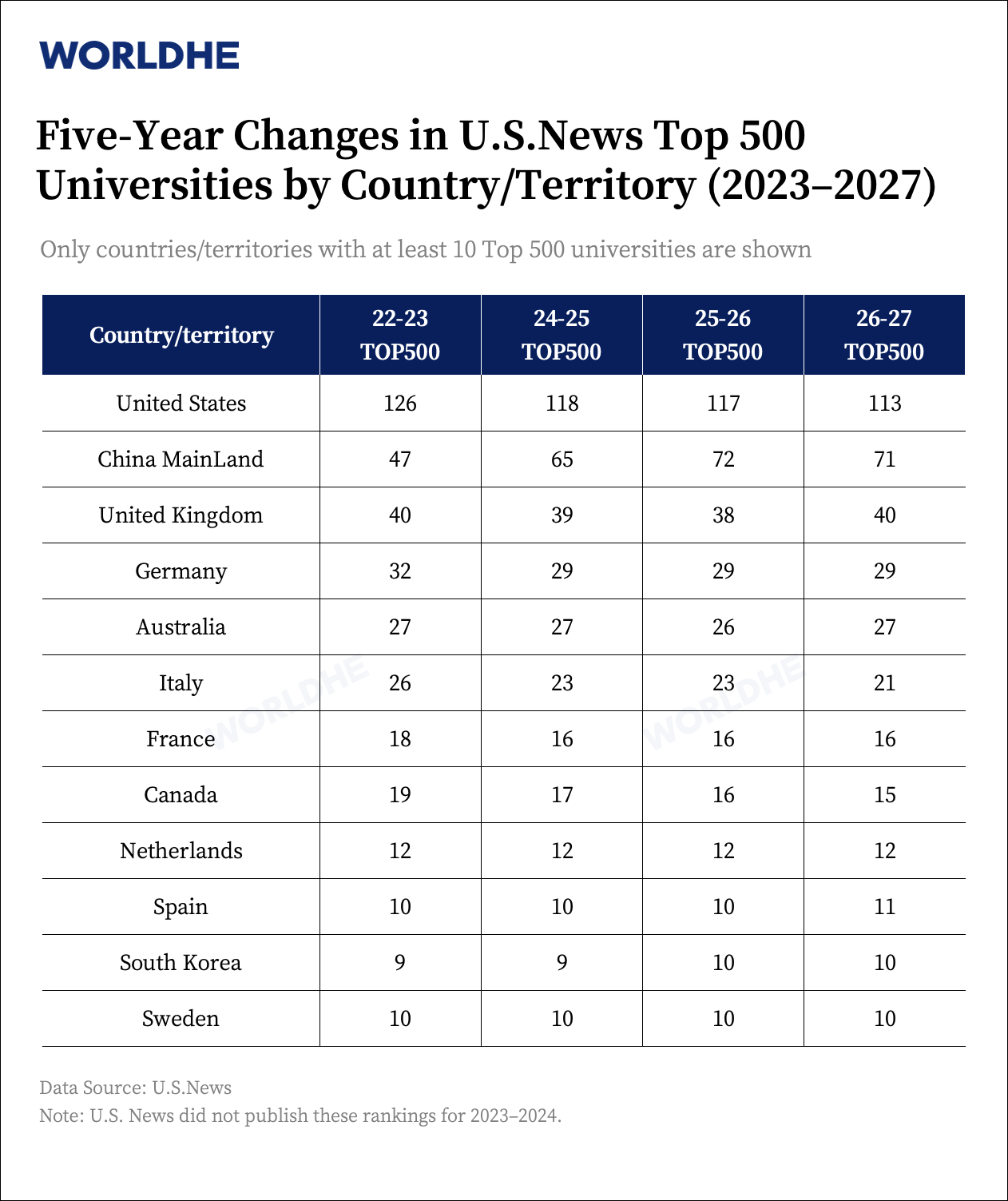
The U.S. News rankings over the past five years tell the story of an ongoing transformation in the global higher education landscape through the language of data. This is not simply a narrative of success or failure for individual universities; rather, it reflects differences in national higher education philosophies, resource allocation models, and internationalization strategies.
Yet rankings are never the ultimate destination for universities. Instead, they serve as navigational markers in an increasingly dynamic and competitive environment, helping institutions recalibrate their direction as the global higher education ecosystem continues to evolve.
Note: Data are based on the 2026–2027 U.S. News Best Global Universities Rankings. Since U.S. News did not publish rankings for 2023–2024, the analysis effectively covers four ranking cycles. This study is based on quantifiable ranking data and does not represent a comprehensive evaluation of overall institutional quality.


TRENDING
MIT Tops QS World Rankings for 15th Straight Year
Data & Rankings
Harvard Tops U.S. News Global University Rankings
Data & Rankings
Top-Ranked Journals in Each JCR Category: 2026 Rankings Released
Research & Innovation
The World's Fastest-Rising Universities Revealed
Data & Rankings
Harvard Dethroned as Zhejiang Takes Top Spot
Data & Rankings