
The Biggest Five-Year Shifts in QS World University Rankings


Recently, QS released the 2027 World University Rankings, evaluating more than 1,500 universities across 106 countries and territories. Based on five-year ranking data (2023–2027) of the top 500 universities in the QS World University Rankings, WorldHE systematically analyzes global shifts in higher education, highlighting a structural transformation in the global academic landscape.
Structural Changes in the Top 500 Universities
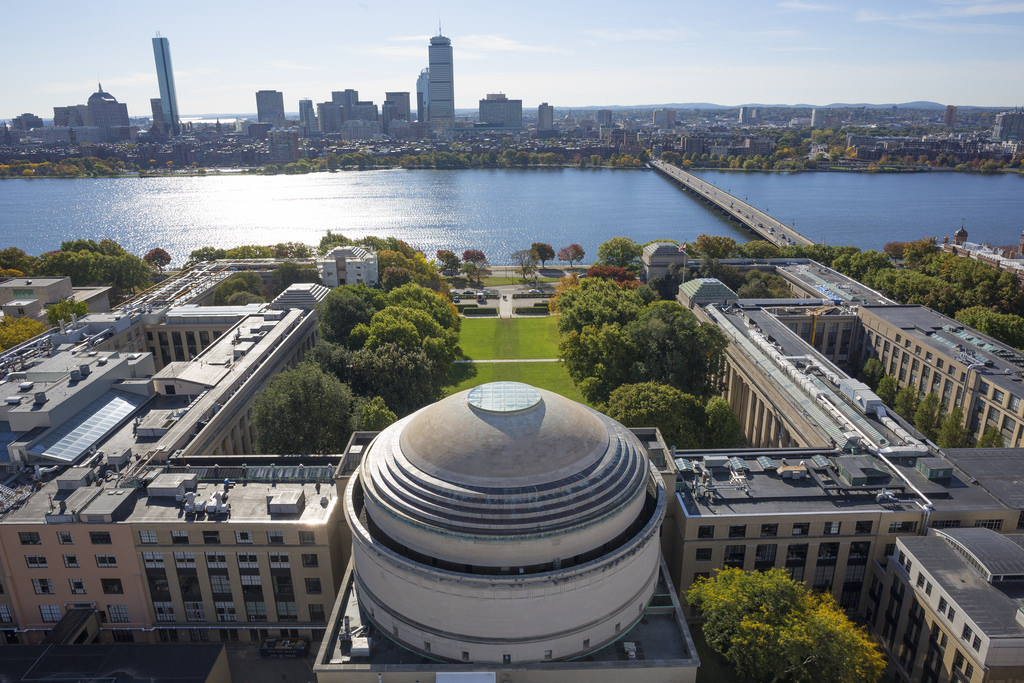
Over the past five years, the overall structure of the QS Top 10 has remained relatively stable. The Massachusetts Institute of Technology (MIT) has retained the global No. 1 position for 15 consecutive years, underscoring the enduring dominance of leading research universities. The University of Oxford and Harvard University have remained stable within the 3rd–4th positions.
The most notable rise within the Top 10 comes from Imperial College London, which climbed from 6th to 2nd globally—one of the most remarkable gains among Western universities. In contrast, the University of Cambridge fell from 2nd to 6th, marking the largest decline within the Top 10. The exchange of positions between the two institutions reflects the diverging trajectories of internationally oriented STEM-focused universities and traditional comprehensive research universities under the current QS evaluation system.
Within the Top 100, the largest improvement came from King Fahd University of Petroleum & Minerals (KFUPM) in Saudi Arabia, which rose from 160th to 63rd (+97 places), driven by sustained national investment in higher education. University College Dublin also made significant progress, climbing from 181st to 100th, maintaining a nearly continuous upward trajectory over five years—an outcome of Ireland’s long-term internationalization strategy within the EU framework.
Among the Top 500 universities, Stellenbosch University in South Africa recorded the fastest rise, jumping from 454th in 2023–2024 to 283rd, before stabilizing around the 300 range, reflecting the growing potential of leading African institutions. Italy’s University of Rome “Tor Vergata” rose 157 places, while Turkey’s Koç University improved by 148 places, both showing strong upward momentum. In contrast, Russia’s Novosibirsk State University dropped 228 places, and Switzerland’s USI – Università della Svizzera italiana fell 216 places, reflecting increasing global competitive pressure.

Regional Competitive Landscape
Within the QS Top 500, the United States holds the largest share with 68 universities, including 26 in the Top 100—leading all other regions. However, between 2023 and 2027, the number of U.S. universities in the Top 500 declined from 83 to 68. While elite institutions remained stable, many mid-tier universities—such as the University of Michigan–Ann Arbor (–26), Columbia University (–21), and Duke University (–20)—experienced collective decline. This suggests a growing misalignment between QS indicators and the U.S. higher education system.
Australia stands out as one of the biggest winners over the five-year period. Universities such as the University of Technology Sydney (UTS) (+50), RMIT University (+71), and Macquarie University (+69) have consistently performed well, many ranking within the global Top 200. Australia increased its presence in the Top 500 from 24 to 27 institutions and now has nine universities in the Top 100, all of which showed upward movement. The University of New South Wales (UNSW Sydney) rose from 45th to 19th, marking a breakthrough into the global Top 20.
Japan has experienced one of the most systematic regional declines in this ranking cycle. Among its 12 Top 500 universities, all except Waseda University showed downward trends. The University of Tokyo fell from 23rd to 39th, while Kyoto University (–28), Osaka University (–27), Institute of Science Tokyo (–42), and Hiroshima University (–143) also recorded significant declines.
Meanwhile, China Mainland now has 38 universities in the global Top 500, an increase of 10 compared with 2023, reflecting substantial expansion. Peking University (13th) and Tsinghua University (14th) remain firmly in the global Top 20. Fudan University has entered the global Top 30, while Shanghai Jiao Tong University has reached the Top 40, forming the first-tier group of China Mainland’s universities. In the second tier, Nanjing University (+43), Tongji University (+66), and Wuhan University (+29) recorded notable upward movements.
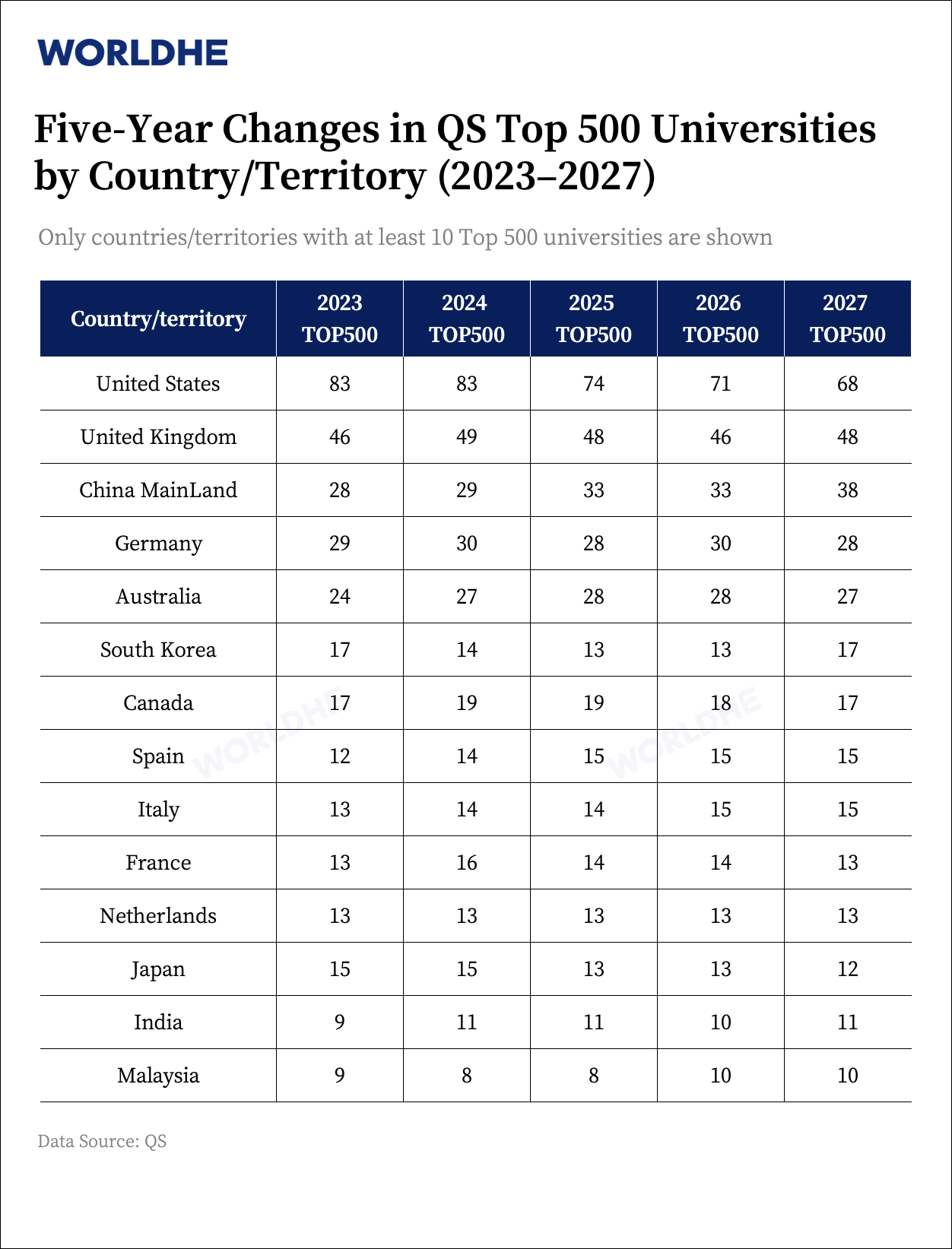
Over the 2023–2027 period, the QS rankings reveal a structural reshaping of the global higher education landscape. The US–UK “dual-core” dominance remains, but internal divergence is widening. Australia and China Mainland continue to rise steadily, with top institutions strengthening their global positions, while countries such as Russia and Japan face increasing competitive pressure.
Rankings are ultimately a tool rather than an end goal. However, as a quantifiable reflection of global academic reputation, they reveal the level of national investment in higher education, the emphasis placed on internationalization strategies, and the underlying vitality of each country’s research and innovation ecosystem. In this sense, every ranking change represents a broader policy narrative about national priorities.
Note: Data is sourced from the QS World University Rankings 2027. Five-year changes are calculated based on ranking differences between 2023 and 2027. This analysis is based on quantitative ranking data and does not represent a comprehensive evaluation of institutional overall strength.


TRENDING
MIT Overtakes Harvard as U.S. and China Dominate September Nature and Science Output
Data & Rankings
Harvard Leads the Citation Laureates Rankings as Nobel Prize Season Approaches
Data & Rankings
Good University Guide 2027: St Andrews Takes No. 1 as Imperial Climbs Three Places
Data & Rankings
From Lasker to Nobel: The Universities Behind Biomedical Breakthroughs
Data & Rankings
Before the Nobel: Which Universities Are Leading in Biomedical Breakthroughs?
Data & Rankings